i
Solution Manual For Preparing Effective Business Plans An Entrepreneurial Approach, 2nd edition Bruce R. Barringer Chapter 1-11
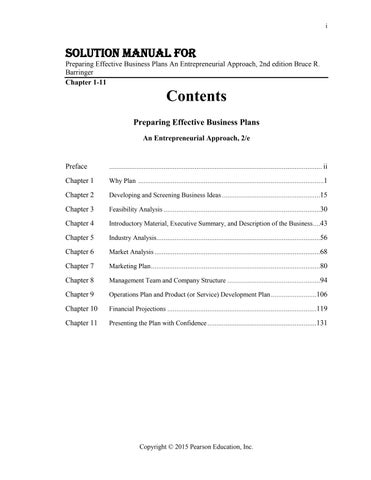
Contents Preparing Effective Business Plans An Entrepreneurial Approach, 2/e
Preface
..................................................................................................................... ii
Chapter 1
Why Plan ......................................................................................................1
Chapter 2
Developing and Screening Business Ideas ......................................................15
Chapter 3
Feasibility Analysis ......................................................................................30
Chapter 4
Introductory Material, Executive Summary, and Description of the Business ....43
Chapter 5
Industry Analysis..........................................................................................56
Chapter 6
Market Analysis ...........................................................................................68
Chapter 7
Marketing Plan .............................................................................................80
Chapter 8
Management Team and Company Structure ...................................................94
Chapter 9
Operations Plan and Product (or Service) Development Plan .........................106
Chapter 10
Financial Projections ..................................................................................119
Chapter 11
Presenting the Plan with Confidence ............................................................131
Copyright © 2015 Pearson Education, Inc.
ii
Part I: Starting the Process Chapter 1 Why Plan? Key Words Business plan—a written document that carefully explains every aspect of a new business venture Due Diligence—the process investors go through after they tentatively commit to an investment Lean Startup Movement—associated with the school of thought that advocates experimentation and trial-and-error learning gleaned through customer feedback over formal planning Elevator speech—a brief, carefully constructed statement, usually 1—2 minutes long that outlines the merits of a business venture Stealth mode—companies that formulate their business plans in secret, to avoid tipping off potential competitors as to what they’re planning Feasibility Analysis—the process of determining if a business idea is viable; normally conducted prior to writing the business plan Corridor principle—an academic principle which states that once an entrepreneur starts a business, he or she begins a journey down a path where ―corridors‖ leading to new venture opportunities become apparent
Chapter Overview This chapter introduces the idea of the business plan, including the rationale for writing one, the multiple purposes that a business plan can serve both inside and outside the firm, and the key audiences for a business plan. Students will also learn about major imperatives in creating a business plan, as well as some potential pitfalls in writing the business plan. The organization of the text is also laid out by topic and associated chapter(s). The outline of the text walks the reader through the process from understanding and conceptualizing the plan, to preparing to write the plan, to creating the plan, and finally, to presenting the plan to potential investors and others.
Chapter Summary 1. 2.
3.
A business plan is a written document that carefully explains every aspect of a new business venture. The most effective business plans are part of a comprehensive process that includes (1) identifying a business idea, (2) screening the idea (or ideas) to determine their preliminary feasibility, (3) conducting a full feasibility analysis, and (4) writing the plan. There are two primary reasons for writing a business plan: (1) it forces the founding team to work together to hammer out the details of the business venture, (2) it Copyright © 2015 Pearson Education, Inc.
iii
4. 5. 6.
7.
8. 9 10. 11.
communicates the merits of a new venture to outsiders, such as investors or bankers. The process of writing a business plan forces a team to not only work together, but to turn abstract ideas into concrete realities. The two primary audiences for a firm’s business plan are the firm’s employees and investors and other external stakeholders. It is important to remember that a firm’s business plan, executive summary or a set of PowerPoint slides is typically the first aspect of a proposed venture that will be seen by an investor (or anyone else who reads the plan), and if the plan is incomplete or looks sloppy, it is easy for an investor to infer that the venture itself is incomplete or sloppy. To make the best impression, a business plan should follow a conventional structure. Typically, the individuals who read business plans are busy people who want a plan that allows them to easily find critical information. It is a good idea to develop a 1—2 minute elevator speech which briefly outlines the merits of the venture. As a business plan is written, the people involved should continually measure the type of company that they are hoping to start against their personal goals and aspirations. There are four types of businesses: survival, lifestyle, managed growth, and aggressive growth. This book focuses on lifestyle, managed growth, and aggressive growth firms. While the preparation of a business plan is essential, it is often an insufficient exercise through which to complete a full and candid analysis of the merits of a new business venture. Steps that logically precede the completion of a business plan, which include the preliminary screening of business ideas and feasibility analysis, are also important.
Chapter Outline I. II.
III.
IV.
V.
Introduction Reasons for Writing a Business Plan a. Internal Reason b. External Reason Who Reads the Business Plan—And What Are They Looking For? a. A Firm’s Employees b. Investors and Other External Stakeholders Guidelines for Writing a Business Plan a. Structure and Style of the Business Plan i. Outside resources ii. Appearance iii. Develop an Elevator Speech 1. Four Steps in an Elevator Speech iv. Red Flags in a Business Plan b. Content of the Business Plan c. Measuring the Business Plan Against Your Personal Goals and Aspirations i. Investor expectations ii. Attractiveness of revised business plan d. Recognizing That Elements of the Plan May Change
Types of Business Copyright © 2015 Pearson Education, Inc.
iv
VI.
The Plan for the Book a. Section 1: Starting the Process b. Section 2: What to Do Before the Business Plan Is Written c. Section 3: Preparing a Business Plan d. Section 4: Presenting the Business Plan to Investors and Others
Chapter Notes I.
II.
III.
Introduction Research reveals an increased interest in the study of entrepreneurship o More than 2,000 colleges and universities, about two-thirds of the total, offer entrepreneurship coursework o 54 percent of millennials (ages 18-34) either want to start a business or have already started one o 63 percent of African Americans and 64 percent of Latinos expressed a desire to start their own company The business plan is a written document that carefully explains every aspect of a new business venture o Inside the firm, the business plan is used to develop a ―road map‖ o Outside the firm, it introduces potential investors and other stakeholders to the business opportunities Although a relatively small percentage of entrepreneurs write business plans, there is ample evidence that writing a business plan is an extremely good investment of time and money. Reasons for Writing a Business Plan There are two primary reasons for writing a business plan o Internal reason—forces the founders of a firm to systematically think through each aspect of their new venture o External reason—communicates the merits of a new venture to outsiders, such as investors and bankers Investors rely heavily on the business plan to make their decisions regarding initial investment The business plan helps a new company build credibility by providing detailed information and demonstrating that the entrepreneur has thought through each element of the business Placing highly or winning a university-, community-, or statesponsored business plan competition also helps to establish credibility for a firm
There is an emerging school of thought, associated with the Lean Startup movement, that opposes the idea of writing a business plan and advocates experimentation and trial-and-error learning through customer feedback over formal planning Who Reads the Business Plan—And What Are They Looking For? There are two primary audiences for a firm’s business plan Copyright © 2015 Pearson Education, Inc.
v a.
b.
IV.
a.
A firm’s employees—because the business plan articulates the vision and future of the firm, both the management team and the rank-and-file employees can benefit from reading the business plan in order to operate in sync and with purpose Investors and other external stakeholders—investors, potential business partners, potential customers, private and government-funded grantawarding agencies, and key employees who are being recruited are all part of the second audience for a business plan To appeal to this group, the business plan must be clear, concise, and not overly optimistic or naive
Guidelines for Writing a Business Plan It is important to remember that a firm’s business plan, executive summary, or a set of PowerPoint slides is typically the first aspect of a proposed venture that will be seen by an investor or whomever the plan is presented to A good business plan will be sensitive to the structure, style, and content of a plan before exposing it to a firm’s employees or sending it to an outsider Individuals writing the plan should also measure the type of company that they are envisioning against their personal goals, aspirations, and preferred lifestyle Structure and Style of the Business Plan The business plan should follow a conventional structure Most experts recommend a length of between 25 and 35 pages Effective business plans should be sharp, but not look expensive to produce or overly flashy Business plan software can help provide structure, but all of the content should come from the entrepreneur Outside assistance in putting the plan together is fine, but the enthusiasm of the founder should remain i.
Develop an Elevator Speech An elevator speech is a brief, carefully constructed statement, usually 45 seconds to two minutes long that outlines the merits of a business venture (business plan insight feature) 1.
ii.
Steps in an Elevator Speech (from business plan insight feature) Describe the opportunity—45 seconds Describe how your product or service meets the opportunity—45 seconds Describe your qualifications—15 seconds Describe your market—15 seconds
Red Flags in a Business Plan (Table 1-2) Founders with none of their own money at risk A poorly cited plan Defining the market size too broadly Overly aggressive financials Copyright © 2015 Pearson Education, Inc.