Programming Logic and Design, 8e
Solutions 1-1
Programming Logic and Design, 8th Edition Chapter 1 Review Questions 1.
2.
3.
4.
5.
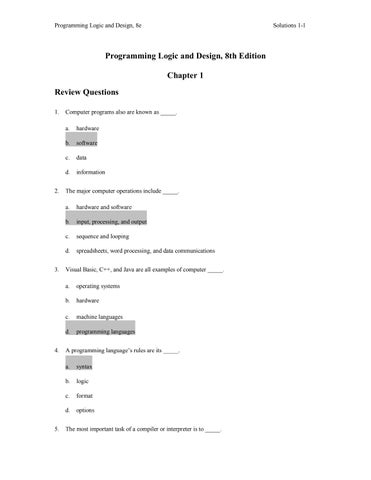
Computer programs also are known as _____. a.
hardware
b.
software
c.
data
d.
information
The major computer operations include _____. a.
hardware and software
b.
input, processing, and output
c.
sequence and looping
d.
spreadsheets, word processing, and data communications
Visual Basic, C++, and Java are all examples of computer _____. a.
operating systems
b.
hardware
c.
machine languages
d.
programming languages
A programming language’s rules are its _____. a.
syntax
b.
logic
c.
format
d.
options
The most important task of a compiler or interpreter is to _____.
Programming Logic and Design, 8e
6.
7.
8.
9.
a.
create the rules for a programming language
b.
translate English statements into a language such as Java
c.
translate programming language statements into machine language
d.
execute machine language programs to perform useful tasks
Solutions 1-2
Which of the following is temporary, internal storage? a.
CPU
b.
hard disk
c.
keyboard
d.
memory
Which of the following pairs of steps in the programming process is in the correct order? a.
code the program, plan the logic
b.
test the program, translate it into machine language
c.
put the program into production, understand the problem
d.
code the program, translate it into machine language
A programmer’s most important task before planning the logic of a program is to _____. a.
decide which programming language to use
b.
code the problem
c.
train the users of the program
d.
understand the problem
The two most commonly used tools for planning a program’s logic are _____. a.
flowcharts and pseudocode
b.
ASCII and EBCDIC
c.
Java and Visual Basic
d.
word processors and spreadsheets
10. Writing a program in a language such as C++ or Java is known as _____ the program.
Programming Logic and Design, 8e
a.
translating
b.
coding
c.
interpreting
d.
compiling
Solutions 1-3
11. An English-like programming language such as Java or Visual Basic is a _____ programming language. a.
machine-level
b.
low-level
c.
high-level
d.
binary-level
12. Which of the following is an example of a syntax error? a.
producing output before accepting input
b.
subtracting when you meant to add
c.
misspelling a programming language word
d.
all of the above
13. Which of the following is an example of a logical error? a.
performing arithmetic with a value before inputting it
b.
accepting two input values when a program requires only one
c.
dividing by 3 when you meant to divide by 30
d.
all of the above
14. The parallelogram is the flowchart symbol representing _____. a.
input
b.
output
c.
either a or b
d.
none of the above
Programming Logic and Design, 8e
Solutions 1-4
15. In a flowchart, a rectangle represents _____. a.
input
b.
a sentinel
c.
a question
d.
processing
16. In flowcharts, the decision symbol is a _____. a.
parallelogram
b.
rectangle
c.
lozenge
d.
diamond
17. The term ―eof‖ represents _____. a.
a standard input device
b.
a generic sentinel value
c.
a condition in which no more memory is available for storage
d.
the logical flow in a program
18. When you use an IDE, as opposed to a simple text editor, to develop a program, _____. a.
the logic is more complicated
b.
the logic is simpler
c.
the syntax is different
d.
some help is provided
19. When you write a program that will run in a GUI environment as opposed to a command-line environment, _____. a.
the logic is very different
b.
some syntax is different
c.
you do not need to plan the logic
Programming Logic and Design, 8e
d.
Solutions 1-5
users are more confused
20. As compared to procedural programming, with object-oriented programming, _____. a.
the programmer’s focus differs
b.
you cannot use some languages, such as Java
c.
you do not accept input
d.
you do not code calculations; they are created automatically
Programming Exercises 1. Match the definition with the appropriate term. 1. Computer system devices a. 2. Another word for programs b. 3. Language rules c. 4. Order of instructions d. 5. Language translator e.
compiler syntax logic hardware software
Answer: 1. 2. 3. 4. 5.
d. e. b. c. a.
Computer system equipment Another word for programs Language rules Order of instructions Language translator
→ → → → →
hardware software syntax logic compiler
2. In your own words, describe the steps to writing a computer program. Answer: The programmer must understand the problem that the user is trying to solve. Next, the programmer plans the logic, often using a flowchart or pseudocode. Then, the program is coded in a language, such as Visual Basic or Java, and translated to machine language using a compiler or interpreter. Finally, the program is tested and then put into production and maintained over the ensuing months or years. 3. Match the term with the appropriate shape. Answer: 1. 2. 3.
Input Processing Output
→ → →
B. A. B.