Programming Logic and Design, 9e
Solutions 1-1
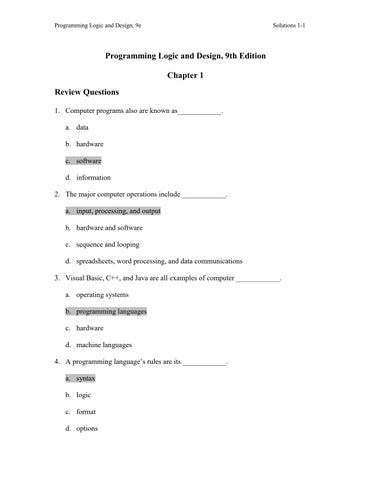
Programming Logic and Design, 9th Edition Chapter 1 Review Questions 1. Computer programs also are known as____________. a. data b. hardware c. software d. information 2. The major computer operations include ____________. a. input, processing, and output b. hardware and software c. sequence and looping d. spreadsheets, word processing, and data communications 3. Visual Basic, C++, and Java are all examples of computer ____________. a. operating systems b. programming languages c. hardware d. machine languages 4. A programming language’s rules are its ____________. a. syntax b. logic c. format d. options
Programming Logic and Design, 9e
Solutions 1-2
5. The most important task of a compiler or interpreter is to ____________. a. create the rules for a programming language b. translate English statements into a language such as Java c. translate programming language statements into machine language d. execute machine language programs to perform useful tasks 6. Which of the following is temporary, internal storage? a. CPU b. hard disk c. keyboard d. memory 7. Which of the following pairs of steps in the programming process is in the correct order? a. code the program, plan the logic b. test the program, translate it into machine language c. put the program into production, understand the problem d. code the program, translate it into machine language 8. A programmer’s most important task before planning the logic of a program is to ____________. a. decide which programming language to use b. code the problem c. train the users of the program d. understand the problem 9. The two most commonly used tools for planning a program’s logic are _____.
Programming Logic and Design, 9e
Solutions 1-3
a. ASCII and EBCDIC b. Java and Visual Basic c. flowcharts and pseudocode d. word processors and spreadsheets 10. Writing a program in a language such as C++ or Java is known as _______ the program. a. translating b. coding c. interpreting d. compiling 11. An English-like programming language such as Java or Visual Basic is a ________ programming language. a. machine-level b. low-level c. high-level d. binary-level 12. Which of the following is an example of a syntax error? a. producing output before accepting input b. subtracting when you meant to add c. misspelling a programming language word d. all of the above 13. Which of the following is an example of a logical error? a. performing arithmetic with a value before inputting it
Programming Logic and Design, 9e
Solutions 1-4
b. accepting two input values when a program requires only one c. dividing by 3 when you meant to divide by 30 d. all of the above 14. The parallelogram is the flowchart symbol representing ____________. a. input b. output c. either a or b d. none of the above 15. In a flowchart, a rectangle represents ____________. a. input b. a sentinel c. a question d. processing 16. In flowcharts, the decision symbol is a ____________. a. parallelogram b. rectangle c. lozenge d. diamond 17. The term eof represents ____________. a. a standard input device b. a generic sentinel value c. a condition in which no more memory is available for storage d. the logical flow in a program
Programming Logic and Design, 9e
Solutions 1-5
18. When you use an IDE instead of a simple text editor to develop a program, ____________. a. the logic is more complicated b. the logic is simpler c. the syntax is different d. some help is provided 19. When you write a program that will run in a GUI environment as opposed to a command-line environment, ____________. a. the logic is very different b. some syntax is different c. you do not need to plan the logic d. users are more confused 20. As compared to procedural programming, with object-oriented programming, ____________. a. the programmer’s focus differs b. you cannot use some languages, such as Java c. you do not accept input d. you do not code calculations; they are created automatically