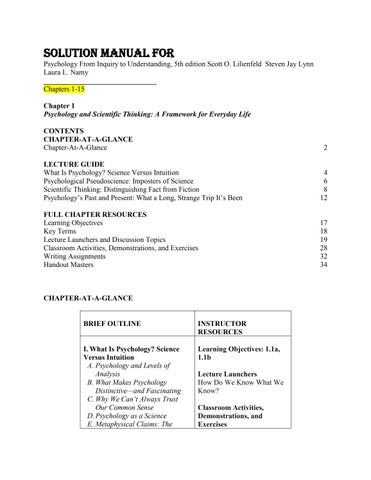
Solution Manual For Psychology From Inquiry to Understanding, 5th edition Scott O. Lilienfeld Steven Jay Lynn Laura L. Namy _______________________________ Chapters 1-15 Chapter 1 Psychology and Scientific Thinking: A Framework for Everyday Life CONTENTS CHAPTER-AT-A-GLANCE Chapter-At-A-Glance
2
LECTURE GUIDE What Is Psychology? Science Versus Intuition Psychological Pseudoscience: Imposters of Science Scientific Thinking: Distinguishing Fact from Fiction Psychology‘s Past and Present: What a Long, Strange Trip It‘s Been
4 6 8 12
FULL CHAPTER RESOURCES Learning Objectives Key Terms Lecture Launchers and Discussion Topics Classroom Activities, Demonstrations, and Exercises Writing Assignments Handout Masters
17 18 19 28 32 34
CHAPTER-AT-A-GLANCE
BRIEF OUTLINE
INSTRUCTOR RESOURCES
I. What Is Psychology? Science Versus Intuition A. Psychology and Levels of Analysis B. What Makes Psychology Distinctive—and Fascinating C. Why We Can’t Always Trust Our Common Sense D. Psychology as a Science E. Metaphysical Claims: The
Learning Objectives: 1.1a, 1.1b Lecture Launchers How Do We Know What We Know? Classroom Activities, Demonstrations, and Exercises
Boundaries of Science F. Recognizing That We Might Be Wrong
Psychology‘s Goals Applied to Matchmaking Writing Assignments Exploring Psychology and the Media
II. Psychological Pseudoscience: Imposters of Science A. The Amazing Growth of Popular Psychology B. What Is Pseudoscience? C. The Dangers of Pseudoscience: Why Should We Care?
Learning Objectives: 1.2a, 1.2b
III. Scientific Thinking: Distinguishing Fact From Fiction A. Scientific Skepticism B. A Basic Framework for Scientific Thinking
Learning Objectives: 1.3a, 1.3b
Lecture Launchers Psychology and Common Sense
Lecture Launchers Correlations and Causal Relationships Classroom Activities, Demonstrations, and Exercises Are Psychologists Scientists? Can Science Answer This Question? Handouts Can Science Answer This Question?
IV. Psychology’s Past and Present: What a Long, Strange Trip It’s Been A. Psychology’s Early History B. The Great Theoretical Frameworks of Psychology C. The Multifaceted World of Modern Psychology D. The Great Debates of Psychology E. How Psychology Affects Our Lives
Learning Objectives: 1.4a, 1.4b, 1.4c, 1.4d Lecture Launchers Black People and Psychology Women in the History of Psychology in America Biographical Profiles Scandal in Psychology—John
Watson‘s Fall from the Throne Careers in Psychology Classroom Activities, Demonstrations, and Exercises Promoting Cultural Awareness Psychologists‘ Twenty Questions Writing Psychology Exploring Psychology Through Art
LECTURE GUIDE I. WHAT IS PSYCHOLOGY? SCIENCE VERSUS INTUITION > Lecture Launchers How Do We Know What We Know? > Classroom Activities, Demonstrations, and Exercises Psychology‘s Goals Applied to Matchmaking > Writing Assignments Exploring Psychology and the Media > Handouts Knowledge of Psychology Test A. Psychology and Levels of Analysis 1. Psychology is difficult to define. In this text, we‘ll refer to psychology as what scientific psychologists do—study the mind, brain, and behavior. 2. There are many levels of analysis within the psychology discipline. These include biological and sociocultural explanations for behavior, and to fully understand psychology, we must consider multiple levels of analysis (Figure 1.1). 3. Each level of analysis tells us something different about the mind, brain, and behavior. This text avoids emphasizing the extremes. B. What Makes Psychology Distinctive—and Fascinating 1. This text covers five challenges that psychologists face:
a. Almost all actions are multiply determined, produced by many factors. i. We should be skeptical of single-variable explanations of behavior. b. Psychological influences are rarely independent of each other. i. Anorexia nervosa, a severe eating disorder, has many psychological influences that are interrelated. c. Individual differences help to explain why we respond differently to the same objective situation. This makes it difficult to develop explanations that apply to everyone. d. Reciprocal determinism: The fact that people mutually influence each other‘s behavior. e. Behavior is often shaped by culture. C. Why We Can’t Always Trust Our Common Sense 1. The way that we intuitively understand the world is frequently incorrect. Common sense is not always right! a. The adage ―There‘s safety in numbers‖ is actually disproven by psychological research that shows that the more people present in an emergency, the less likely it is that people will help (Darley & Latané, 1968a, Latané & Nida, 1981, see Chapter 12). b. Common sense can lead us to believe things that, when examined together, appear contradictory. i. Birds of a feather flock together/Opposites attract. ii. Two heads are better than one/Too many cooks spoil the broth. iii. Actions speak louder than words/The pen is mightier than the sword. 2. Naive Realism: Is Seeing Believing? a. Naive realism is the mistaken belief that we see the world as it really is (Lilienfeld et al., 2008, Ross & Ward, 1996). b. Our perceptions are not always wrong, but appearance can be deceiving. i. The Earth seems flat. ii. The sun seems to revolve around the Earth (see Figure 1.2, for another example using Shepard‘s tables). c. People who don‘t share our political views are biased, whereas we are objective. Research shows that we all tend to evaluate political issues with bias (Pronin, Gilvich, & Ross, 2004). 3. When Our Common Sense Is Right a. Our intuition can also be quite accurate (Gigerenzer, 2007; Gladwell, 2005; Meyers, 2002). i. Our snap judgments on the trustworthiness of someone we watched on a videotape are right more often than would be expected by chance (Fowler et al., 2009). b. Common sense can help us to generate hypotheses that scientists can later test rigorously (Redding, 1998). c. Learning to think scientifically teaches us when to trust our common sense and when not to. This helps us become better consumers of popular psychology and make better decisions in the real world. D. Psychology as a Science
Science isn‘t a body of knowledge. a. Science is an approach to evidence, designed to prevent us from fooling ourselves. 2. What Is a Scientific Theory? a. Scientific theory—Explanation for a large number of findings in the natural world. i. Offers an account that ties multiple findings together. ii. Good theories do more than account for existing data. They generate predictions regarding new data not yet observed. iii. A testable prediction is termed a hypothesis. iv. Testing hypotheses can lead scientists to provisionally accept the theory that generated the hypothesis, reject the theory outright, or revise it. 3. Science as a Safeguard Against Bias: Protecting Us from Ourselves a. The best scientists are aware of their biases, or at least aware they have them. b. They also know that because of personal investment, they may bias the results unintentionally to make them turn out the way they want. c. Confirmation Bias—the tendency to seek out evidence that supports our hypotheses and neglect or distort evidence that contradicts them (i.e., once you have a hammer, everything starts looking like a nail). i. Our preconceptions often lead us to focus on evidence that supports our beliefs, resulting in psychological tunnel vision. a. e.g., the Wason selection task (Wason, 1966) (Figure 1.3) d. Confirmation bias is the ―mother of all biases.‖ i. It can easily fool us into seeing what we want to see. ii. It is the most crucial bias scientists need to counteract. iii. Scientists differ from nonscientists in that the former use systematic safeguards to protect against confirmation bias, whereas the latter don‘t. e. Belief Perseverance i. Belief perseverance is the tendency to stick to our initial beliefs even when evidence contradicts them. ii. ―Don‘t confuse me with the facts‖ effect. iii. Because none of us wants to believe we‘re wrong, we‘re usually reluctant to give up our beliefs. E. Metaphysical Claims: The Boundaries of Science 1. Metaphysical claims—assertions about the world that are unfalsifiable. a. Claims include assertions about the existence of God, the soul, and the afterlife. 2. This is not to say that metaphysical claims are wrong or unimportant. a. Many scholars believe questions concerning the existence of God are more significant than scientific questions. b. It is important to treat these questions with profound respect, regardless of our beliefs about religion. 1.