SOLUTION MANUAL FOR THE EXERCISES in THE CRC BOOK: Situation Assessment in Aviation: Bayesian Networks and Fuzzy Logic Approaches. (By Jitendra, R, Raol, Sudesh K. Kashyap, and Lakshmi, S.) Chapter 2 2.1 Definition of SAW: Within the given volume of space and time, perception of environmental elements, understanding the meaning of them and projecting the status of them in the near future. The four qualitative methods of describing the SAW are: • • • •
Using a model for processing information or data to define and explain SAW; Using cycle of actions-perceptions to define and explain SAW; Comparison of SAW with the expertise; Using SAW to describe the phenomena of behaviour.
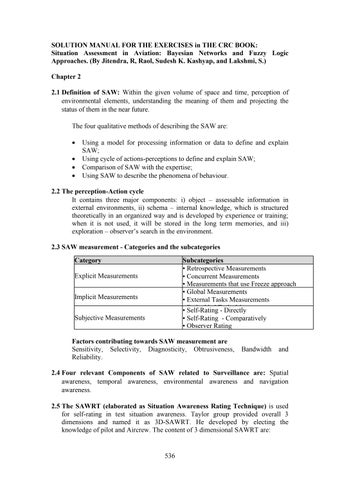
2.2 The perception-Action cycle It contains three major components: i) object – assessable information in external environments, ii) schema – internal knowledge, which is structured theoretically in an organized way and is developed by experience or training; when it is not used, it will be stored in the long term memories, and iii) exploration – observer’s search in the environment. 2.3 SAW measurement - Categories and the subcategories Category
Subcategories • Retrospective Measurements • Concurrent Measurements • Measurements that use Freeze approach • Global Measurements • External Tasks Measurements •• Embedded Measurements Self-RatingTasks - Directly
Explicit Measurements Implicit Measurements
• Self-Rating - Comparatively • Observer Rating
Subjective Measurements
Factors contributing towards SAW measurement are Sensitivity, Selectivity, Diagnosticity, Obtrusiveness, Reliability.
Bandwidth
and
2.4 Four relevant Components of SAW related to Surveillance are: Spatial awareness, temporal awareness, environmental awareness and navigation awareness. 2.5 The SAWRT (elaborated as Situation Awareness Rating Technique) is used for self-rating in test situation awareness. Taylor group provided overall 3 dimensions and named it as 3D-SAWRT. He developed by electing the knowledge of pilot and Aircrew. The content of 3 dimensional SAWRT are:
536
a. Demand on attention resources: It consists of complexity of situation, variability of situation and stability of situation. b. Supply of attentional resources: It is made up of spare mental capacity, division of attention, concentration of attention, and arousal of situation. c. Understanding of situation: This is a combination of information quality, familiarity and information quantity. Chapter 3 3.1 A situation assessment is carried out in order to understand the needs and conditions of a given scenario or mission. 3.2 Steps are: i) discuss with the expert of the field, ii) gather the details that are required, iii) make relevant observations, iv) collect the findings, v) analyse the collected information, and vi) share the results of the analysis and determine what next to do. 3.3 These are: diagnostic, formative, and summative. 3.4 Some situation analysis tools are: SWOT, PESTLE, 5C, VRIO, and Porter's Five Forces. SWOT: Strengths, Weaknesses, Opportunities, and Threats analysis. PESTLE: Political, Economic, Social, Technological, Legal and Environmental factors. 5C Analysis is a framework to analyze the environment in which a company operates, and provides insight into the key drivers of success, as well as the risk-exposure to various factors. The 5Cs are Company, Collaborators, Customers, Competitors, and Context. VRIO is an internal analysis framework that helps businesses identify the advantages and resources that give them a competitive edge. VRIO: value, rarity, imitability, and organization Porter's Five Forces are: i) Competitive Rivalry, ii) Supplier Power, iii) Buyer Power, iv) Threat of Substitution, and v) Threat of New Entry. 3.5 Threat assessment is the process of determining the credibility and seriousness of a potential threat, as well as the probability that the threat will happen. Chapter 4 4.1 The domain expert knowledge is very essential because he/she has learnt many operating aspects of the system he/she is monitoring for several years. He/she as an operator and/or the designer has a good feel of the performance of the system and if this knowledge is wired in the design and operation of FL/S then we get good design of the FL/S. Another way is to learn the required rules from the empirical data of the system. 4.2 In DM/DSS we need to take some decision based on the acquired/processed information regarding the system. If… then rule base approach of FL is naturally suitable for implementation of such systems.
537
4.3 After the FIS and aggregation process the end result is an area (or so) and hence we need to get the result as a crisp value, since this crisp value is further processed in a control system and/or FS. 4.4 The inner system is Type-I FL and the output is Type-0 FL system. In fact the Type-0 system is deterministic and not really fuzzy system. 4.5 One can define membership function for the input/output data and then use some portion of the data to see to what extent the data belong to what type/portion of the FLMF. Then one can use the predicted data to identify a parameter by using delta rule as is done in application of FFNN for system identification [28]. 4.6 The main reason is that for the intersection the severity of the intersection increases from the standard one to the drastic one, and hence the norm of the relational matrix is reduced. Whereas in the case of the union operation, the severity of union (more and more union is expected) increases and hence the norm increases. This can be ascertained from equations (4.18) to (4.21) and equations (4.35) to (4.38). 4.7 The Gaussian, trapezoidal, and triangular are very common functions. 4.8 The two methods are: 1) experts, and 2) based on the empirical data. 4.9 The experts can easily provide the rules due to their experience, and operational knowledge of the conventional (control) systems. However, they may not give out their total experience and hence the number of rules provided might be limited. The experts also have to specify the membership functions. The rules can be learned from the (training) data using ANNs. In this case the designer of the FL/S has to specify the membership functions. Chapter 5 5.1 These are propositional, predicate, temporal, modal, constraint, and probabilistic. 5.2 In Propositional logic the variables are True or False (Boolean). The operators used are AND, OR, and NOT. A rule would be: If A is True, then B is False. In Predicate logic the variables are True, False, unknown, probabilities. A typical rule might be: If z(k+1) – z(k) > ‘a’ Then the controller = Type 1 (number 1, etc.); If –‘a’ < z(k+1) – z(k) < ‘a’ Then the controller = Type 2. In temporal logic the truth variable is function of time. A rule could be: ‘A’ is True until time t, thereafter it is False. In modal logic some statements are always True, some are possibly True, etc. In constraint logic the variable would be both a logical variable and a numerical variable. The probabilistic logic incorporates uncertainty into the knowledge base. A rule could be: If the day temperature is > 40 deg., then with probability 0.9, there would be evening rains. 5.3 In a FFS some (or all) rules are fed back to each other and to themselves. 5.4 A FFS can model a dynamic system, e.g. x = f (x) .
538