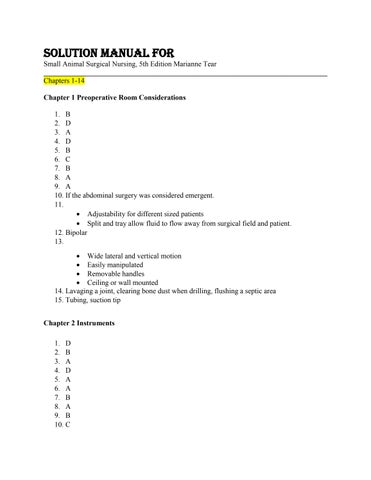
Solution Manual For Small Animal Surgical Nursing, 5th Edition Marianne Tear ______________________________________________________________________________ Chapters 1-14 Chapter 1 Preoperative Room Considerations 1. B 2. D 3. A 4. D 5. B 6. C 7. B 8. A 9. A 10. If the abdominal surgery was considered emergent. 11. Adjustability for different sized patients Split and tray allow fluid to flow away from surgical field and patient. 12. Bipolar 13. Wide lateral and vertical motion Easily manipulated Removable handles Ceiling or wall mounted 14. Lavaging a joint, clearing bone dust when drilling, flushing a septic area 15. Tubing, suction tip Chapter 2 Instruments 1. D 2. B 3. A 4. D 5. A 6. A 7. B 8. A 9. B 10. C
11. B 12. A 13. B 14. C 15. C 16. A 17. A 18. D 19. May make suture removal/identification easier 20. Bovine skin closure post-rumenotomy 21. A needle with the suture directly attached to it Chapter 3 Anesthetic Machine 1. C 2. C 3. A 4. A 5. D 6. D 7. B 8. C 9. C 10. A 11. D 12. B 13. D 14. B 15. C 16. Acts as a carrier for the vaporized anesthetic gas 17. Temperature, carrier gas flow rate, back pressure in the system Chapter 4 Preoperative Patient Considerations 1. 2. 3. 4. 5. 6. 7. 8.
A C D D C A C C
9. C 10. A 11. D 12. B 13. C 14. D 15. B 16. B 17. C 18. C 19. To avoid possible drug interactions To know whether other diagnostics tests are indicated To make any necessary adjustments to the anesthetic protocol 20. They may make the owner feel compelled to answer in a certain way. Chapter 5 Patient Preparation 1. A 2. D 3. B 4. D 5. C 6. A 7. D 8. B 9. B 10. B 11. C 12. A 13. A 14. A 15. D 16. B 17. Animal must be completely dry to avoid increased risk of hypothermia. 18. Cough, fogging of clear endotracheal tube, movement of flutter valves, movement of reservoir bag, movement of gauze or hair held at end of ET tube 19. Weight 20. Full name of drug Dose weight of drug Route
Time administered
Chapter 6 Patient Monitoring 1. B 2. A 3. A 4. D 5. C 6. D 7. C 8. B 9. D 10. A 11. B 12. A 13. A 14. B 15. When a heart contraction is detected, but there is no palpable pulse that corresponds to that contraction due to the weakness of the contraction 16. An increase in the level of CO2 in the patient’s exhaled air 17. Assesses the pressure for direct and indirect BP monitors 18. Increases respiratory dead space Probe commonly needs to be repositioned 19. Toe webbing, pinna of ear, vulva, prepuce (warm, non-pigmented, hairless, motionless site) 20. HR, pulse: femoral artery, pedal artery, MM color: prepuce or vagina, reflectance probe underside of base of tail Chapter 7 Asepsis 1. 2. 3. 4. 5. 6. 7. 8. 9.
A B C A A C B C C
10. D 11. Face to face or back to back 12. A team member that is scrubbed in 13. Opening packs and runner for surgical team 14. Only scrubbed-in personnel Chapter 8 Operating Room Personnel 1. B 2. C 3. A 4. B 5. C 6. C 7. B 8. A 9. B 10. B 11.
Do not lock knees Shift weight from one leg to another Eat prior to surgery
12. FDA compliant Non-irritating Fast-acting Broad spectrum Prolonged depressant effect on residual bacteria 13. The hair is short enough to be covered by the skull back on the sides of the head and nape of neck. 14. When personnel in surgery have beards or facial hair that are not covered by the mask 15. Decreased scrub time Avoid damage to skin Rapid reduction in bacterial counts Prevents microbial regrowth Chapter 9 Surgical Assisting—Duties During Surgery 1. A 2. A 3. A