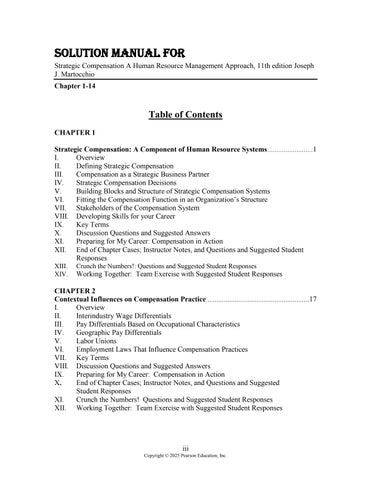
Solution Manual For Strategic Compensation A Human Resource Management Approach, 11th edition Joseph J. Martocchio Chapter 1-14
Table of Contents CHAPTER 1 Strategic Compensation: A Component of Human Resource Systems .........................1 I. Overview II. Defining Strategic Compensation III. Compensation as a Strategic Business Partner IV. Strategic Compensation Decisions V. Building Blocks and Structure of Strategic Compensation Systems VI. Fitting the Compensation Function in an Organization‘s Structure VII. Stakeholders of the Compensation System VIII. Developing Skills for your Career IX. Key Terms X. Discussion Questions and Suggested Answers XI. Preparing for My Career: Compensation in Action XII. End of Chapter Cases; Instructor Notes, and Questions and Suggested Student Responses XIII. XIV.
Crunch the Numbers!: Questions and Suggested Student Responses
Working Together: Team Exercise with Suggested Student Responses
CHAPTER 2 Contextual Influences on Compensation Practice ........................................................17 I. Overview II. Interindustry Wage Differentials III. Pay Differentials Based on Occupational Characteristics IV. Geographic Pay Differentials V. Labor Unions VI. Employment Laws That Influence Compensation Practices VII. Key Terms VIII. Discussion Questions and Suggested Answers IX. Preparing for My Career: Compensation in Action X. End of Chapter Cases; Instructor Notes, and Questions and Suggested Student Responses XI. Crunch the Numbers! Questions and Suggested Student Responses XII. Working Together: Team Exercise with Suggested Student Responses
iii Copyright © 2025 Pearson Education, Inc.
CHAPTER 3 Traditional Bases for Pay: Seniority and Merit ............................................................32 I. Seniority and Longevity Pay II. Merit Pay III. Performance Appraisal IV. Strengthening the Pay-for-Performance Link V. Possible Limitations of Merit Pay Programs VI. Key Terms VII. Discussion Questions and Suggested Answers VIII. Preparing for My Career: Compensation in Action IX. End of Chapter Cases; Instructor Notes, and Questions and Suggested Student Responses X. Crunch the Numbers!: Questions and Suggested Student Responses XI. Working Together: Team Exercise with Suggested Student Responses CHAPTER 4 Incentive Pay ....................................................................................................................48 I. Exploring Incentive Pay II. Contrasting Incentive Pay with Traditional Pay III. Individual Incentives IV. Group Incentives V. Company-Wide Incentives VI. Designing Incentive Pay Programs VII. Key Terms VIII. Discussion Questions and Suggested Answers IX. Preparing for My Career: Compensation in Action X. End of Chapter Cases; Instructor Notes, and Questions and Suggested Student Responses XI. Crunch the Numbers! Questions and Suggested Student Responses XII. Working Together: Team Exercise with Suggested Student Responses CHAPTER 5 Person-Focused Pay .........................................................................................................62 I. Defining Person-Focused Pay: Pay-for-Knowledge, Skill-Based Pay, and Competency-Based Pay II. Usage of Person-Focused Pay Programs III. Reasons to Adopt Person-Focused Pay Programs IV. Varieties of Person-Focused Pay Programs V. Contrasting Person-Focused Pay with Job-Based Pay VI. Advantages and Disadvantages of Person-Focused Pay Programs VII. Key Terms VIII. Discussion Questions and Suggested Answers IX. Preparing for My Career: Compensation in Action X. End of Chapter Cases; Instructor Notes, and Questions and Suggested Student Responses XI. Crunch the Numbers! Questions and Suggested Student Responses iv Copyright © 2025 Pearson Education, Inc.
XII.
Working Together: Team Exercise with Suggest Student Responses
CHAPTER 6 Building Internally Consistent Compensation Systems ...............................................74 I. Internal Consistency II. Job Analysis III. Job Evaluation IV. Pay Equity V. Internally Consistent Compensation Systems and Competitive Strategy VI. Key Terms VII. Discussion Questions and Suggested Answers VIII. Preparing for My Career: Compensation in Action IX. End of Chapter Cases; Instructor Notes, and Questions and Suggested Student Responses X. Crunch the Numbers! Questions and Suggested Student Responses XI. Working Together: Team Exercise with Suggested Student Responses CHAPTER 7 Building Market-Competitive Compensation Systems ................................................91 I. Market-Competitive Pay Systems: The Basic Building Blocks II. Compensation Surveys III Integrating Internal Job Structures with External Market Pay Rates IV. Compensation Policies and Strategic Mandates V. Key Terms VI. Discussion Questions and Suggested Answers VII. Preparing for My Career: Compensation in Action VIII. End of Chapter Cases; Instructor Notes, and Questions and Suggested Student Responses IX. Crunch the Numbers! Questions and Suggested Student Responses X. Working Together: Team Exercise with Suggested Student Responses CHAPTER 8 Building Pay Structures That Recognize Employee Contributions ..........................105 I. Constructing a Pay Structure II. Pay Transparency III. Designing Merit Pay Systems IV. Designing Sales Incentive Compensation Plans V. Pay Structure Variations VI. Key Terms VII. Discussion Questions and Suggested Answers VIII. Preparing for My Career: Compensation in Action IX. End of Chapter Cases; Instructor Notes, and Questions and Suggested Student Responses X. Crunch the Numbers! Questions and Suggested Student Responses XI. Working Together: Team Exercise with Suggested Student Responses
v Copyright © 2025 Pearson Education, Inc.
CHAPTER 9 Discretionary Benefits ...................................................................................................121 I. Origins of Discretionary Benefits II. Categories of Discretionary Benefits III. Legislation Pertinent to Discretionary Benefits IV. Designing and Planning the Benefits Program V. The Benefits and Costs of Discretionary Benefits VI. Key Terms VII. Discussion Questions and Suggested Answers VIII. Preparing for My Career: Compensation in Action IX. End of Chapter Cases; Instructor Notes, and Questions and Suggested Student Responses X. Crunch the Numbers! Questions and Suggested Student Responses XI. Working Together: Team Exercise with Suggested Student Responses CHAPTER 10 Legally Required Benefits .............................................................................................139 I. Origins of Legally Required Benefits II. Categories of Legally Required Benefits III. Health Insurance Program Design Alternatives IV. Additional Health Care Legislation V. The Benefits and Costs of Legally Required Benefits VI. Key Terms VII. Preparing for My Career: Compensation in Action VIII. Discussion Questions and Suggested Answers IX. End of Chapter Case; Instructor Notes, and Questions and Suggested Student Responses X. Crunch the Numbers! Questions and Suggested Student Responses XI. Working Together: Team Exercise with Suggested Student Responses CHAPTER 11 Compensating Executives ..............................................................................................159 I. Contrasting Executive Pay with Pay for Nonexecutive Employees II. Defining Executive Status III. Executive Compensation Packages IV. Principles and Processes for Setting Executive Compensation V. Executive Compensation Disclosure Rules VI. Executive Compensation: Are U.S. Executives Paid Too Much? VII. Key Terms VIII. Discussion Questions and Suggested Answers IX. Preparing for My Career: Compensation in Action X. End of Chapter Cases; Instructor Notes, and Questions and Suggested Student Responses XI. Crunch the Numbers! Questions and Suggested Student Responses XII. Working Together: Team Exercise with Suggested Student Responses
vi Copyright © 2025 Pearson Education, Inc.
CHAPTER 12 Compensating the Flexible Work Force: Contingent Employees and Flexible Work Schedules ................................................177 I. The Contingent Workforce II. Pay and Employee Benefits for Contingent Workers III. Remote Work IV. Flexible Work Schedules V. Pay and Employee Benefits for Flexible Employees VI. Strategic Issues and Choices in Using Contingent and Flexible Workers VII. Key Terms VIII. Discussion Questions and Suggested Answers IX. Preparing for My Career: Compensation in Action X. End of Chapter Cases; Instructor Notes, and Questions and Suggested Student Responses XI. Crunch the Numbers! Questions and Suggested Student Responses XII. Working Together: Team Exercise with Suggested Student Responses
CHAPTER 13 Compensating Expatriates ............................................................................................194 I. Competitive Advantage and How International Activities Fit In II. Preliminary Considerations III. Components of International Compensation Programs IV. Balance Sheet Approach for U.S. Expatriates‘ Compensation Packages V. Repatriation Pay Issues VI. Key Terms VII. Discussion Questions and Suggested Answers VIII. Preparing for My Career: Compensation in Action IX. End of Chapter Cases; Instructor Notes, and Questions and Suggested Student Responses X. Crunch the Numbers! Questions and Suggested Student Responses XI. Working Together: Team Exercise with Suggested Student Responses
CHAPTER 14 Pay and Benefits Outside the United States ................................................................210 I. Introduction II. Pertinent Concepts for Quantifying Economic Elements in the Discussion of Pay and Benefits Outside the United States III. North America IV. South America V. Europe VI. Asia VII. Key Terms VIII. Discussion Questions and Suggested Answers vii Copyright © 2025 Pearson Education, Inc.