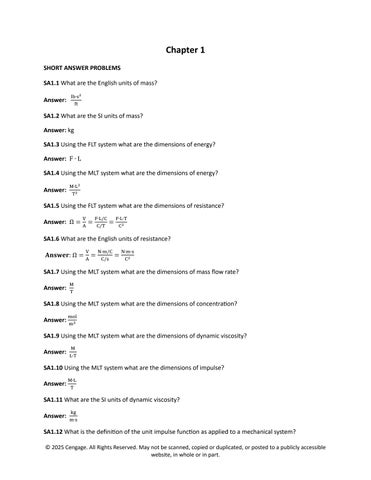
Chapter 1 SHORT ANSWER PROBLEMS SA1.1 What are the English units of mass? Answer:
lb∙s2 ft
SA1.2 What are the SI units of mass? Answer: kg SA1.3 Using the FLT system what are the dimensions of energy? Answer: F ∙ L
SA1.4 Using the MLT system what are the dimensions of energy?
Answer:
M∙L2 T2
SA1.5 Using the FLT system what are the dimensions of resistance? Answer: Ω =
V
=
F∙L/C
V
N∙m/C
A
C/T
=
F∙L∙T C2
SA1.6 What are the English units of resistance? 𝐀𝐀𝐀𝐀𝐀𝐀𝐀𝐀𝐀𝐀𝐀𝐀: Ω =
A
=
C/s
=
N∙m∙s C2
SA1.7 Using the MLT system what are the dimensions of mass flow rate? Answer:
M T
SA1.8 Using the MLT system what are the dimensions of concentration? Answer:
mol m3
SA1.9 Using the MLT system what are the dimensions of dynamic viscosity? Answer:
M
L∙T
SA1.10 Using the MLT system what are the dimensions of impulse? Answer:
M∙L T
SA1.11 What are the SI units of dynamic viscosity? Answer:
kg
m∙s
SA1.12 What is the definition of the unit impulse function as applied to a mechanical system? © 2025 Cengage. All Rights Reserved. May not be scanned, copied or duplicated, or posted to a publicly accessible website, in whole or in part.
Answer: The unit impulse function is the mathematical representation of a unit impulse. That is a very large force applied over a short period of time such that the integral of force over time is one. If the force 0 𝑡𝑡 ≠ 𝑎𝑎 is applied at time a then the unit impulse function is defined by 𝛿𝛿 (𝑡𝑡 − 𝑎𝑎) = � where ∞ 𝑡𝑡 = 𝑎𝑎 ∞ ∫0 𝛿𝛿 (𝑡𝑡 − 𝑎𝑎)𝑑𝑑𝑑𝑑 = 1
SA1.13 An electrical system has a voltage spike totaling 26 V∙s. Express this spike in mathematical form? Answer: 𝑣𝑣 (𝑡𝑡) = 26𝛿𝛿 (𝑡𝑡)
SA1.14 A mechanical system is subject to an impulse of 0.4 N∙s. Express this in mathematical form? Answer: 𝐼𝐼 (𝑡𝑡) = 0.4𝛿𝛿 (𝑡𝑡)
SA1.15 An electrical system is subject to the voltage input shown in Figure SP 1.15. Write a mathematical form for the voltage. Answer: 𝑣𝑣 (𝑡𝑡) = 100𝑡𝑡 [𝑢𝑢(𝑡𝑡) − 𝑢𝑢(−1)] + 100𝑢𝑢 (𝑡𝑡 − 1) = 100𝑡𝑡𝑡𝑡(𝑡𝑡) + 100(𝑡𝑡 − 1)𝑢𝑢(𝑡𝑡 − 1)
SA1.16 A mechanical system is subject to a force that is illustrated in Figure SP 1.16. Write a unified mathematical expression for the force. Answer: 𝐹𝐹 (𝑡𝑡) = 240𝑡𝑡 [𝑢𝑢(𝑡𝑡) − 𝑢𝑢(𝑡𝑡 − 0.05)] − 240(𝑡𝑡 − 0.1)[𝑢𝑢(𝑡𝑡 − 0.05) − 𝑢𝑢(𝑡𝑡 − 0.1)] = 240[𝑡𝑡𝑡𝑡(𝑡𝑡) − (𝑡𝑡 − 0.05)𝑢𝑢(𝑡𝑡 − 0.05) + (𝑡𝑡 − 0.1)𝑢𝑢(𝑡𝑡 − 0.1)]
SA1.17 What is the total impulse imparted to a mechanical system from the force shown in Figure SP 1.16? 0.05
Answer: ∫0
0.1
1
240𝑡𝑡𝑡𝑡𝑡𝑡 + ∫0.05 240(0.1 − 𝑡𝑡)𝑑𝑑𝑑𝑑 = (12)(0.1) = 0.6 N ∙ s 2
SA1.18 Linearize the function (1 + 0.2𝑥𝑥 )3/2 for small 𝑥𝑥. 3
1 3
1
Answer: (1 + 0.2𝑥𝑥 )3/2 = 1 + (0.2𝑥𝑥 ) + � � � � (0.2𝑥𝑥 )2 + ⋯ ≈ 1 + 0.3𝑥𝑥 2
1
2 2
2
SA1.19 Linearize the function (1 − 0.2𝑥𝑥 )4 for small 𝑥𝑥. 1
1
1 1
3
Answer: (1 − 0.2𝑥𝑥 )4 = 1 + (−0.2𝑥𝑥 ) + � � �− � (−0.2𝑥𝑥 )2 + ⋯ ≈ 1 − 0.05𝑥𝑥 4
2 4
4
SA1.20 Linearize the function (1 + 0.3𝑥𝑥 )−0.76 for small 𝑥𝑥. 1
Answer: (1 + 0.3𝑥𝑥 )−0.76 = 1 + (−0.76)(0.3𝑥𝑥 ) + (−0.76)(−1.76)(0.3𝑥𝑥 )2 + ⋯ ≈ 1 − 0.228𝑥𝑥 SA1.21 Linearize the function 𝑒𝑒 −2𝑥𝑥 for small 𝑥𝑥.
2
1
Answer: 𝑒𝑒 −2𝑥𝑥 = 1 + (−2𝑥𝑥 ) + (−2𝑥𝑥 )2 + ⋯ ≈ 1 − 2𝑥𝑥 2
SA1.22 Linearize the function sin 𝜃𝜃 cos 2𝜃𝜃 for small 𝜃𝜃. Answer: sin 𝜃𝜃 cos 2𝜃𝜃 ≈ 𝜃𝜃 (1) = 𝜃𝜃
© 2025 Cengage. All Rights Reserved. May not be scanned, copied or duplicated, or posted to a publicly accessible website, in whole or in part.
SA1.23 Linearize the function tan 0.3𝜃𝜃 for small 𝜃𝜃.
Answer: tan 0.3𝜃𝜃 ≈ 0.3𝜃𝜃
SA1.24 Linearize the function sin 𝜃𝜃 cos 2 𝜃𝜃 for small 𝜃𝜃. Answer: sin 𝜃𝜃 cos 2 𝜃𝜃 ≈ 𝜃𝜃 (1)2 = 𝜃𝜃
SA1.25 Linearize the differential equation assuming small 𝜃𝜃 Answer:
𝑑𝑑 2 𝜃𝜃 𝑑𝑑𝑡𝑡 2
+
𝑑𝑑𝜃𝜃 𝑑𝑑𝑑𝑑
+ 𝜃𝜃 = 6 sin 2𝑡𝑡
𝑑𝑑 2 𝜃𝜃 𝑑𝑑𝜃𝜃 + cos 𝜃𝜃 + tan 𝜃𝜃 = 6 sin 2𝑡𝑡 2 𝑑𝑑𝑑𝑑 𝑑𝑑𝑡𝑡
SA1.26 Linearize the differential equation assuming small 𝜃𝜃 Answer:
𝑑𝑑 2 𝜃𝜃 𝑑𝑑𝑡𝑡 2
+ 4𝑡𝑡
𝑑𝑑𝜃𝜃 𝑑𝑑𝑑𝑑
𝑑𝑑 2 𝜃𝜃 𝑑𝑑𝜃𝜃 1 � + 4𝑡𝑡 cos 𝜃𝜃 + 16 sin 𝜃𝜃� cos(3𝜃𝜃) = 6 sin 2𝑡𝑡 𝑑𝑑𝑑𝑑 𝑑𝑑𝑡𝑡 2 2
+ 8𝜃𝜃 = 6 sin 2𝑡𝑡
SA1.27 Fill in the blanks from the choices in parentheses regarding the differential equation 𝑑𝑑𝜃𝜃 𝑑𝑑 2 𝜃𝜃 + 4𝑡𝑡 + 12𝜃𝜃 = 6 sin 2𝑡𝑡 2 𝑑𝑑𝑑𝑑 𝑑𝑑𝑡𝑡
Answer: The equation is an ordinary differential equation. It has an independent variable of t and a dependent variable of 𝜃𝜃. It is a linear, nonhomogeneous differential equation with variable coefficients. SA1.28 Fill in the blanks from the choices in parentheses regarding the differential equation 𝑑𝑑 2 𝜃𝜃 𝑑𝑑𝜃𝜃 + 4 cos 𝜃𝜃 + 12 sin 𝜃𝜃 = 0 2 𝑑𝑑𝑑𝑑 𝑑𝑑𝑡𝑡
Answer: The equation is an ordinary differential equation. It has an independent variable of 𝑡𝑡 and a dependent variable of 𝜃𝜃 It is a linear, homogeneous differential equation with constant coefficients. PROBLEMS 1.1 Newton’s law of cooling is used to calculate the rate at which heat is transferred by convection to a solid body at a temperature T from a surrounding fluid at a temperature T∞. The formula is (𝑎𝑎) 𝑄𝑄̇ = ℎ𝐴𝐴(𝑇𝑇 − 𝑇𝑇∞ ) where Q˙ is the rate of heat transfer (rate of energy transfer), A is the area over which heat is transferred by convection, and h is the heat transfer coefficient (also called the film coefficient). Use Equation (a) to determine the basic dimensions of h. Suggest appropriate units for h using the English system and the SI system.
© 2025 Cengage. All Rights Reserved. May not be scanned, copied or duplicated, or posted to a publicly accessible website, in whole or in part.
Solution Equation (a) of the problem statement is used to solve for ℎ as 𝑄𝑄̇ ℎ= (𝑏𝑏) 𝐴𝐴(𝑇𝑇 − 𝑇𝑇∞ ) The Principle of Dimensional Homogeneity is used to determine the dimensions of the heat transfer coefficient. Using the F-L-T system, the dimensions of the quantities in Equation (b) are F∙L � (𝑐𝑐) �𝑄𝑄̇� = � T 2 [𝐴𝐴] = [L ] (𝑑𝑑) [𝑇𝑇 − 𝑇𝑇∞ ] = [Θ] (𝑒𝑒) From Equations (b)-(e)the dimensions of the heat transfer coefficient are F F∙L [ℎ] = � �=� � (𝑓𝑓) 2 T∙Θ∙L T∙Θ∙L N while possible units using the Possible units for the heat transfer coefficient using the SI system are
English system are
lb
ft∙s∙R
.
m∙s∙K
1.2 The Reynolds number is used as a measure of the ratio of inertia forces to the friction forces in the flow of a fluid in a circular pipe. The Reynolds number (Re) is defined as 𝜌𝜌𝜌𝜌𝜌𝜌 𝑅𝑅𝑅𝑅 = (𝑎𝑎) 𝜇𝜇 where 𝜌𝜌 is the mass density of the fluid, V is the average velocity of the flow, D is the diameter of the pipe, and μ is the dynamic viscosity of the fluid. Show that the Reynolds number is dimensionless. Solution The dimensions on the quantities on the right-hand side of Equation (a) are obtained using Table 1.2 as M [𝜌𝜌] = � 3 � (𝑏𝑏) L L [𝑉𝑉 ] = � � (𝑐𝑐) T [𝐷𝐷] = [L] (𝑑𝑑) M [𝜇𝜇] = � � (𝑒𝑒) L∙T Substituting Equations (b)-(e) into Equation (a) leads to M L 3∙T∙L L [Re] = � � = [1] M L∙T Equation (f) shows that the Reynolds number is dimensionless.
(𝑓𝑓) 𝑑𝑑𝑑𝑑
1.3 The relationship between voltage and current in a capacitor is 𝑖𝑖 = 𝐶𝐶 . Use this relation to determine 𝑑𝑑𝑑𝑑 the basic dimensions of the capacitance C. Solution The capacitance of a capacitor is defined by 𝑖𝑖 (𝑎𝑎) 𝐶𝐶 = 𝑑𝑑𝑑𝑑 𝑑𝑑𝑑𝑑 The dimension of 𝑖𝑖 is that of electric current, which is a basic dimension. The dimensions of electric potential are obtained from Table 1.2 as © 2025 Cengage. All Rights Reserved. May not be scanned, copied or duplicated, or posted to a publicly accessible website, in whole or in part.
F∙L � i∙T Thus the dimensions of time rate of change of electric potential are 𝑑𝑑𝑑𝑑 F∙L � �=� � 𝑑𝑑𝑑𝑑 i ∙ T2 Use of Equation (c) in Equation (a) leads to [𝑣𝑣 ] = �
[𝐶𝐶 ] = �
i i2 ∙ T 2 � �=� F∙L F∙L i ∙ T2
(𝑏𝑏) (𝑐𝑐) (𝑑𝑑) 𝑘𝑘
1.4 The natural frequency 𝜔𝜔𝑛𝑛 of a mechanical system of mass m and stiffness k is calculated by 𝜔𝜔𝑛𝑛 = � . 𝑚𝑚
(a) What are the dimensions of𝜔𝜔𝑛𝑛 ? (b) A mass-spring system of mass 100 g has a natural frequency of 20 Hz. What is the stiffness of the system? Solution M (a)The dimension of spring stiffness in the M-L-T system is � 2 �. Thence the dimensions of natural T frequency are M 1/2 1 2 [𝜔𝜔𝑛𝑛 ] = �� T � � = � � (𝑎𝑎) M 𝑇𝑇 (b) Converting Hz to r/s
cycles cycles 2π r r �� � = 125.7 = �20 s s s s The stiffness is calculated form the natural frequency as r 2 N 𝑘𝑘 = 𝑚𝑚𝜔𝜔𝑛𝑛2 = (0.1 kg) �125.7 � = 1.58 × 10³ s m 𝜔𝜔𝑛𝑛 = 20 Hz = 20
(𝑏𝑏) (𝑐𝑐)
1.5 Carbon nanotubes are new materials that consist of carbon atoms and are of significant interest because of their good conductivity properties, light weight, and high strength. (a) The density of a carbon nanotube is 1300 kg/m3 . A carbon nanotube is a tube with a diameter of 1 carbon atom, d = 0.68 nm. Determine the mass of a carbon nanotube whose length is 80 nm. (b) The elastic modulus of a carbon nanotube is 𝐸𝐸 = 1.1 TPa. What is its elastic modulus in pounds per square inch? (c) If modeled as a fixedfixed beam, the fundamental frequency of the nanotube is 𝜋𝜋
𝐸𝐸𝐸𝐸 𝜔𝜔 = 22.37� 𝜌𝜌𝜌𝜌𝐿𝐿4
where 𝐼𝐼 = 𝑟𝑟 4 is the cross-sectional moment of inertia of the beam and A is its cross-sectional area. 4 Calculate the fundamental frequency in hertz of a nanotube of length 80 nm. Solution (a) The mass of the nanotube is kg 𝑚𝑚 = 𝜌𝜌𝜌𝜌𝜌𝜌 = 𝜌𝜌(𝜋𝜋𝑟𝑟 2 )𝐿𝐿 = �1300 3 � π(0.34 × 10⁻⁹ m)2 (80 × 10−9 m) m (a) = 3.78 × 10⁻²³ kg (b) Conversion between TPa and psi leads to lb lb N 1 m 2 1 ft 2 � � � = 1.60 × 10⁸ 2 𝐸𝐸 = 1.1 𝑇𝑇𝑇𝑇𝑇𝑇 = �1.1 × 10¹² 2 � �0.225 � � (𝑏𝑏) N 3.28 ft in m 12 in © 2025 Cengage. All Rights Reserved. May not be scanned, copied or duplicated, or posted to a publicly accessible website, in whole or in part.