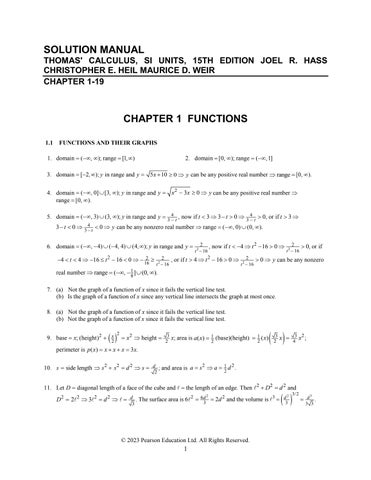
SOLUTION MANUAL THOMAS' CALCULUS, SI UNITS, 15TH EDITION JOEL R. HASS CHRISTOPHER E. HEIL MAURICE D. WEIR CHAPTER 1-19
CHAPTER 1 FUNCTIONS 1.1
FUNCTIONS AND THEIR GRAPHS
1. domain (, ); range [1, )
2. domain [0, ); range (, 1]
3. domain [2, ); y in range and y 5 x 10 0 y can be any positive real number range [0, ). 4. domain (, 0] [3, ); y in range and y x 2 3x 0 y can be any positive real number range [0, ). 5. domain (, 3) (3, ); y in range and y 3 4 t , now if t 3 3 t 0 3 4 t 0, or if t 3 3 t 0 3 4 t 0 y can be any nonzero real number range (, 0) (0, ).
, now if t 4 t 2 16 0 2 2
6. domain (, 4) ( 4, 4) (4, ); y in range and y 2 2 2 2 4 t 4 16 t 2 16 0 16 2
t 16
t 16
t 16 2
, or if t 4 t 16 0 2 2
t 16
0, or if
0 y can be any nonzero
real number range (, 18 ] (0, ). 7. (a) Not the graph of a function of x since it fails the vertical line test. (b) Is the graph of a function of x since any vertical line intersects the graph at most once. 8. (a) Not the graph of a function of x since it fails the vertical line test. (b) Not the graph of a function of x since it fails the vertical line test.
2 9. base x; (height)2 2x x 2 height 23 x; area is a( x) 12 (base)(height) 12 ( x) 23 x 43 x 2 ; perimeter is p( x) x x x 3x.
10. s side length s 2 s 2 d 2 s d ; and area is a s 2 a 12 d 2 . 2
11. Let D diagonal length of a face of the cube and the length of an edge. Then 2 D2 d 2 and 2
D2 2 2 3 2 d 2 d . The surface area is 6 2 6d3 2d 2 and the volume is 3 3
© 2023 Pearson Education Ltd. All Rights Reserved.
1
d2 3
3/2
d3 . 3 3
2
Chapter 1 Functions
12. The coordinates of P are x, x so the slope of the line joining P to the origin is m xx 1 ( x 0).
Thus, x, x
x
1 , 1 . m2 m
25 13. 2 x 4 y 5 y 12 x 54 ; L ( x 0)2 ( y 0)2 x 2 ( 12 x 54 )2 x 2 14 x 2 54 x 16
25 54 x 2 54 x 16
20 x 2 20 x 25 16
20 x 2 20 x 25 4
14. y x 3 y 2 3 x; L ( x 4) 2 ( y 0) 2 ( y 2 3 4) 2 y 2 ( y 2 1) 2 y 2
y4 2 y2 1 y2
y4 y2 1
15. The domain is ( , ).
16. The domain is ( , ).
17. The domain is ( , ).
18. The domain is ( , 0].
19. The domain is (, 0) (0, ).
20. The domain is (, 0) (0, ).
21. The domain is (, 5) (5, 3] [3, 5) (5, ).
22. The range is [5, ) .
© 2023 Pearson Education Ltd. All Rights Reserved.
Section 1.1 Functions and Their Graphs
23. Neither graph passes the vertical line test. (a)
(b)
24. Neither graph passes the vertical line test. (a)
(b)
x y 1 y 1 x x y 1 or or x y 1 y 1 x 25.
x 0 1 2 y 0 1 0
2 4 x , x 1 27. F ( x) 2 x 2 x, x 1
26.
x 0 1 2 y 1 0 0
1 , x 0 28. G ( x) x x, 0 x
29. (a) Line through (0, 0) and (1, 1): y x; Line through (1, 1) and (2, 0): y x 2 x, 0 x 1 f ( x) x 2, 1 x 2
© 2023 Pearson Education Ltd. All Rights Reserved.
3
4
Chapter 1 Functions 2, 0, (b) f ( x) 2, 0,
0 x 1 1 x 2 2 x3 3 x 4
30. (a) Line through (0, 2) and (2, 0): y x 2 0 1
Line through (2, 1) and (5, 0): m 5 2 31 13 , so y 1 ( x 2) 1 1 x 5 3
x 2, 0 x 2 f ( x) 1 5 3 x 3 , 2 x 5
3
3
3 0
(b) Line through (1, 0) and (0, 3): m 0 (1) 3, so y 3x 3 1 3
Line through (0, 3) and (2, 1) : m 2 0 24 2, so y 2 x 3 3x 3, 1 x 0 f ( x) 2 x 3, 0 x 2
31. (a) Line through (1, 1) and (0, 0): y x Line through (0, 1) and (1, 1): y 1
0 1
Line through (1, 1) and (3, 0): m 3 1 21 12 , so y 12 ( x 1) 1 12 x 23
x 1 x 0 f ( x) 1 0 x 1 1 3 1 x 3 2 x 2 (b) Line through ( 2, 1) and (0, 0): y 12 x Line through (0, 2) and (1, 0): y 2 x 2 Line through (1, 1) and (3, 1): y 1
1 0
1x 2 x 0 2 f ( x) 2 x 2 0 x 1 1 1 x 3
32. (a) Line through T2 , 0 and (T, 1): m T (T /2) T2 , so y T2 x T2 0 T2 x 1 0, 0 x T2 f ( x) 2 T T x 1, 2 x T
A, 0 x T 2 A, T x T 2 (b) f ( x) A , T x 32T A, 32T x 2T 33. (a) x 0 for x [0, 1)
(b) x 0 for x (1, 0]
34. x x only when x is an integer. 35. For any real number x, n x n 1, where n is an integer. Now: n x n 1 (n 1) x n. By definition: x n and x n x n. So x x for all real x.
© 2023 Pearson Education Ltd. All Rights Reserved.
Section 1.1 Functions and Their Graphs
36. To find f(x) you delete the decimal or fractional portion of x, leaving only the integer part.
37. Symmetric about the origin Dec: x Inc: nowhere
38. Symmetric about the y-axis Dec: x 0 Inc: 0 x
39. Symmetric about the origin Dec: nowhere Inc: x 0 0 x
40. Symmetric about the y-axis Dec: 0 x Inc: x 0
© 2023 Pearson Education Ltd. All Rights Reserved.
5