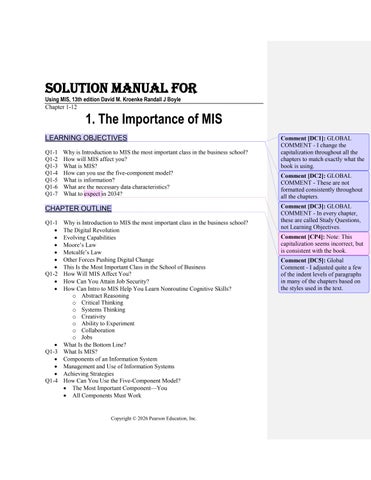
Solution Manual For Using MIS, 13th edition David M. Kroenke Randall J Boyle Chapter 1-12
1. The Importance of MIS LEARNING OBJECTIVES Q1-1 Q1-2 Q1-3 Q1-4 Q1-5 Q1-6 Q1-7
Why is Introduction to MIS the most important class in the business school? How will MIS affect you? What is MIS? How can you use the five-component model? What is information? What are the necessary data characteristics? What to expect in 2034?
CHAPTER OUTLINE Q1-1 Q1-2
Why is Introduction to MIS the most important class in the business school? The Digital Revolution Evolving Capabilities Moore’s Law Metcalfe’s Law Other Forces Pushing Digital Change This Is the Most Important Class in the School of Business How Will MIS Affect You? How Can You Attain Job Security? How Can Intro to MIS Help You Learn Nonroutine Cognitive Skills? o Abstract Reasoning o Critical Thinking o Systems Thinking o Creativity o Ability to Experiment o Collaboration o Jobs What Is the Bottom Line? Q1-3 What Is MIS? Components of an Information System Management and Use of Information Systems Achieving Strategies Q1-4 How Can You Use the Five-Component Model? The Most Important Component—You All Components Must Work
Copyright © 2026 Pearson Education, Inc.
Comment [DC1]: GLOBAL COMMENT - I change the capitalization throughout all the chapters to match exactly what the book is using. Comment [DC2]: GLOBAL COMMENT - These are not formatted consistently throughout all the chapters. Comment [DC3]: GLOBAL COMMENT - In every chapter, these are called Study Questions, not Learning Objectives. Comment [CP4]: Note: This capitalization seems incorrect, but is consistent with the book. Comment [DC5]: Global Comment - I adjusted quite a few of the indent levels of paragraphs in many of the chapters based on the styles used in the text.
Kroenke - Using MIS 13th Ed - Instructor’s Manual
1-2
High-Tech Versus Low-Tech Information Systems Understanding the Scope of New Information Systems Components Ordered by Difficulty and Disruption Q1-5 What is Information? Definitions Vary Where Is Information? Q1-6 What Are the Necessary Data Characteristics? Accurate Timely Relevant Just Barely Sufficient Worth Its Cost Q1-7 What to Expect in 2034?
Case Study 1
Comment [DC6]: GLOBAL COMMENT - I moved sections around in every chapter to match the order given in the text.
Pluralsight 1-10. Go to http://pluralsight.com and search for a course you might be interested in
taking. What is attractive to you about online versus traditional training? Student answers will vary in terms of the course that they find interesting. Attractive features of online training versus traditional classroom training include the convenience and flexibility of taking a lesson/course when time allows. (LO: 1, Learning Outcome: Describe the effects of e-commerce on the modern business world, AACSB: Analytic Skills) 1-11. What advice would you give executives at Pluralsight if they wanted to grow their
business? How could they increase revenues? Pluralsight has traditionally focused on corporate training. Students might be more familiar with an academic environment and might suggest that Pluralsight establish programs with universities so that students could take courses to supplement their traditional coursework at a reduced rate. Possibly some companies could be lined up to help pay the subscription rate, since the students should be more able to provide needed skills to those companies when they graduate. (LO: 1, Learning Outcome: Explain how IS can be used to gain and sustain competitive advantage, AACSB: Analytic Skills) 1-12. Why would corporate clients be interested in online technology training for their
internal employees? How would they benefit from paying Pluralsight for training? Technical skill requirements are constantly changing, and employee skills constantly need to be updated. Paying for skills training from Pluralsight is probably much more cost-effective for a company than trying to provide the training in-house. Pluralsight is a training outsourcer and if their training quality is good, the company is much better off obtaining the training this way. (LO: 1, Learning Outcome:
Copyright © 2026 Pearson Education, Inc.
Comment [DC7]: GLOBAL COMMENT - I have no idea how the book determines question numbers. Few sections begin with 1. They might start with 4 or 12 or whatever. I’ve matched the question numbers given in the book to all the IMs. I also don’t know why only some of the questions in the book have answers in the IMs. There doesn’t seem to be a reason why some are skipped and some are included.
Kroenke - Using MIS 13th Ed - Instructor’s Manual
1-3
Discuss the role of information systems in supporting business processes, AACSB: Analytic Skills) 1-13. Why is there a technology skills gap? Why do employers have the need for highly
skilled workers, and why do too few workers have these skills? It is difficult for a traditional college or university to include every type of technology skill in its curriculum, so graduates will not necessarily know every type of technology an employer requires. In addition, skills required evolve quickly and employees need to be updated and retrained on new technologies. (LO: 2, Learning Outcome: Discuss the role of information systems in supporting business processes, AACSB: Analytic Skills) 1-14. How might a traditional university benefit from a partnership with Pluralsight? Why
might some universities see such a partnership as a threat to their existence, while others might see it as a great opportunity? Universities could benefit from a partnership with Pluralsight in several ways. One, a university’s IT staff would undoubtedly benefit from access to these training courses. Two, faculty members in certain fields might like to enhance their own knowledge and skills. Finally, students might like to supplement their more traditional classes with training that is more skills-focused, such as those offered in Pluralsight courses. Many universities would not fear this partnership because their courses are not focused only on technical skills but more on conceptual knowledge. Colleges and universities that do offer focused skills training might find this partnership a little threatening if students preferred the Pluralsight online courses to the traditional university offerings. (LO: 1, Learning Outcome: Explain how I S can be used to gain and sustain competitive advantage, AACSB: Reflective Thinking) 1-15. Suppose you were considering buying stock in Pluralsight. What types of threats
might Pluralsight face in the future? Could a large tech company mimic its business model and threaten its profitability? How could Pluralsight defend against this type of competition? Like any company today, there are constant competitive threats. An example of a threat that could disrupt Pluralsight is the rapid growth of cloud computing. A major cloud computing provider, such as Amazon, could launch a skills training business geared toward all its cloud computing environments and tools that would be far superior to Pluralsight’s. Pluralsight could defend against this by establishing a partnership with Amazon to provide Amazon’s cloud computing skills training. (L O: 1, Learning Outcome: Explain how I S can be used to gain and sustain competitive advantage, AACSB: Reflective Thinking)
So What? IOTrends
Copyright © 2026 Pearson Education, Inc.
Kroenke - Using MIS 13th Ed - Instructor’s Manual
1-4
1. People often use the terms Web and Internet interchangeably, but they are not the same. Do your best to define each and identify exactly how they are different. Student answers will vary, but a good explanation can be found at the website https://www.geeksforgeeks.org/whats-difference-internetweb/#:~:text=The%20Internet%20is%20a%20global,on%20top%20of%20that%20in frastructure. It states: ―The Internet is a global network of networks while the Web, also referred formally as World Wide Web (www) is collection of information which is accessed via the Internet. Another way to look at this difference is: The Internet is infrastructure while the Web is service on top of that infrastructure.‖ 2. The article talks about Web 1.0 and Web 2.0. You may be wondering if Web 2.0 is the end of the line. What do you think—will there be a Web 3.0, and if so, what would it entail? Student responses will vary, but should cover some ideas and concepts that are not already part of Web 1.0 or Web 2.0 specifically. 3. While IoT is clearly having an impact on businesses (e.g., tracking manufacturing using sensors in production lines) and cities (e.g., tracking traffic flows, lighting, public transportation), how has IoT impacted your life? Do you have any IoT devices in your apartment or home? If not, which IoT devices would you be interested in owning? Student answers will vary, but some devices could include Amazon Echo, Google Nest, and similar devices. 4. Do you think IoT devices feature the newest and most advanced security measures, or could there be potential security risks from using IoT devices? Student answers will vary, but should point out that often times upon release new products do not have all their security holes covered so users should be aware and proceed with caution.
Security Guide PASSWORDS AND PASSWORD ETIQUETTE 1. Here is a line from Shakespeare’s Macbeth: ―Tomorrow, and tomorrow, and tomorrow, creeps in this petty pace.‖ Explain how to use these lines to create a password. How could you add numbers and special characters to the password in a way that you will be able to remember? There are several correct ways to create a password from this line. One way might be to take the first letters from each word. The password would then be ―tatatcitpp.‖ You could then capitalize a couple of the letters and add in special characters or numbers. The resulting password could be ―T&2morrow&tcitPP.‖ This would be a very secure password. 2. List two different phrases that you can use to create a strong password. Show the password created by each.
Copyright © 2026 Pearson Education, Inc.
Comment [CP8]: These two are indented a tab too far, but I cannot figure out how to unindent them in track changes.
Kroenke - Using MIS 13th Ed - Instructor’s Manual
1-5
There will be many correct answers to this question. Using a passphrase to create a password is done by using the first letters in the phrase, then changing some of the letters by substituting in special characters, numbers, or changes of case. For example, the phrase, ―I never count my chickens before the eggs have hatched!‖ could create the password ―iNcmCHKNSb4t3ggsHH!‖ This would be a great password. 3. One of the problems of life in the cyberworld is that we all are required to have multiple passwords—one for work or school, one for bank accounts, another for eBay or other auction sites, and so forth. Of course, it is better to use different passwords for each. But in that case, you have to remember three or four different passwords. Think of different phrases you can use to create a memorable, strong password for each of these different accounts. Relate the phrase to the purpose of the account. Show the passwords for each. There will be many correct answers to this question. For example, a passphrase for a university account may look something like, ―I will graduate from state university before 2020 or bust!‖ This could yield a password that would look like ―IwgfSUb42020ORB!‖ 4. Explain the proper behavior when you are using your computer and you need to enter, for some valid reason, another person’s password. In this case, say to the other person, ―We need your password,‖ and then get out of your chair, offer your keyboard to the other person, and look away while she enters the password. Among professionals working in organizations that take security seriously, this little ―do-si-do‖ move—one person getting out of the way so another person can enter her password—is common and accepted. 5. Explain the proper behavior when someone else is using her computer and that person needs to enter your password for a valid reason. If someone asks for your password, do not give it out. Instead, get up, go over to that person’s machine, and enter your own password yourself. Stay present while your password is in use, and ensure that your account is logged out at the end of the activity. No one should mind or be offended in any way when you do this. It is the mark of a professional.
The sections on Career Guide, Ethics Guide and Ask an AI are missing. No “Using Your Knowledge” section. Collaboration Exercise 1 This chapter discussed why collaboration is a key skill for maintaining job security. In this exercise, you will build a collaboration IS and then use that IS to answer the questions below in a collaborative fashion. You might want to read the four questions below before you build your IS.
Copyright © 2026 Pearson Education, Inc.