Solution Manual for Halter Varcarolis' Foundations of Psychiatric-Mental Health Nursing, 9th Edition chapter 1-36
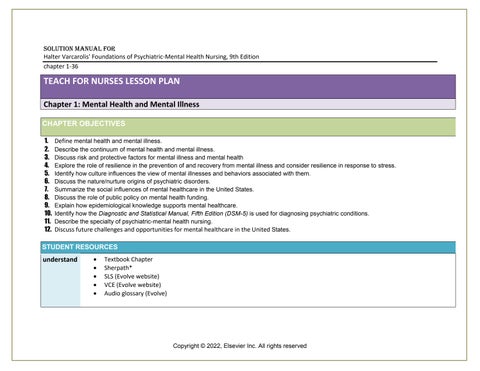
TEACH FOR NURSES LESSON PLAN Chapter 1: Mental Health and Mental Illness CHAPTER OBJECTIVES 1. Define mental health and mental illness. 2. Describe the continuum of mental health and mental illness. 3. Discuss risk and protective factors for mental illness and mental health 4. Explore the role of resilience in the prevention of and recovery from mental illness and consider resilience in response to stress. 5. Identify how culture influences the view of mental illnesses and behaviors associated with them. 6. Discuss the nature/nurture origins of psychiatric disorders. 7. Summarize the social influences of mental healthcare in the United States. 8. Discuss the role of public policy on mental health funding. 9. Explain how epidemiological knowledge supports mental healthcare. 10. Identify how the Diagnostic and Statistical Manual, Fifth Edition (DSM-5) is used for diagnosing psychiatric conditions. 11. Describe the specialty of psychiatric-mental health nursing. 12. Discuss future challenges and opportunities for mental healthcare in the United States. STUDENT RESOURCES
understand
Textbook Chapter Sherpath* SLS (Evolve website) VCE (Evolve website) Audio glossary (Evolve)
Copyright © 2022, Elsevier Inc. All rights reserved
apply
Elsevier Adaptive Quizzing* Review Questions (Evolve) Pre/Post Tests Answers to Critical Thinking questions
integrate
Simulation Learning System*
CLINICAL JUDGMENT CLASSROOM TOOLS in text
Case studies/Vignettes Review questions Critical Thinking questions
lesson focus
Recognize Cues Analyze Cues Prioritize Hypotheses Generate Solutions Take Actions Evaluate Outcomes
INSTRUCTOR RESOURCES before class
Nursing Curriculum Standards (below) Clinical Judgment Classroom Tools (above)
in class
PowerPoint Presentations (Evolve) Image Collection (Evolve) Learning Activities (below) Discussion Topics (below)
after class
Test Bank (Evolve)
* Sold separately from textbook.
Copyright © 2022, Elsevier Inc. All rights reserved
TEACHING STRATEGIES Content Focus MENTAL HEALTH AND MENTAL ILLNESS MENTAL HEALTH CONTINUUM RISK AND PROTECTIVE FACTORS Individual Attributes and Behaviors Social and Economic Circumstances Environmental Factors Perceptions of Mental Health and Mental Illness
Content Highlights
Learning Activities
Resources
Mental illness refers to all psychiatric disorders with definable diagnoses that cause significant dysfunction in developmental, biological, or psychological disturbances.
Introducing the Course: Begin by explaining that this course will use a dialectical journal activity from time to time. Learning theorists have demonstrated that adults develop critical thinking skills by using dialectics—documenting one’s preconceptions and then analyzing these after further research or investigation by— First prewriting their thoughts on a new topic, possibly raising questions Returning to these musings again after learning new material and either expanding on earlier thoughts, countering them with changed perceptions, or raising an entirely new set of more in-depth questions Explain that: Dialectical journals enable the thinker to look at what may have started as a simple topic with a wider, more multifaceted lens. They serve to help students develop a “researcher’s mind” as they make presuppositions, predict outcomes, then adjust thoughts and theories based on new information.
PowerPoint Slides 1–15 Figure 1-1: Some attributes of mental health Figure 1-2: Mental Health – Mental Illness Continuum Figure 1-3: Contributing factors to mental health and well-being Box 1.1: The Resilience Factor Test
The mental health and mental illness continuum shows how functioning may change over time. Risk factors may increase the risk of adverse mental health outcomes, while protective factors improve a person’s ability to respond to stress, trauma, and loss. Mental illness is brainbased and is therefore a physical illness. In a diathesis-stress model—diathesis represents biological predisposition and stress represents environmental stress or trauma.
Dialectical Journal #1: Before reading the chapter, have students fold a notebook page lengthwise so the centerfold line runs from top to bottom. Next, direct students to respond to the following questions on the left side of the central line; tell them that they will return to this later: What does it mean to be “mentally healthy”? What comprises the specialty of psychiatric-mental health nursing and what kinds of professional activities to you anticipate or hope to participate in should you choose this specialty? Remind students that later they will return to their responses and expand on them with what they’ve learned.
Copyright © 2022, Elsevier Inc. All rights reserved
TEACHING STRATEGIES Content Focus Social Influences on Mental Healthcare LEGISLATION AND MENTAL HEALTH FUNDING Mental Health Parity Patient Protection and Affordable Care Act of 2010
Content Highlights
Learning Activities
Resources
Government programs and initiatives such as the Decade of the Brain, the Human Genome Project, Brain Research through Advancing Innovative Neurotechnology, and Research Domain Criteria are expanding our knowledge of the brain and will provide the basis for future treatments.
Discussion & Research Opportunity: Review the case of Betsy Lehman and ask, “What could have changed the outcome for Ms. Lehman if the QSEN recommendations had been established and implemented long before she became ill?” Ask students to now identify other social or legislative or political influences discussed in this section that they think seem to have most effected improvements in mental healthcare. Are there any movements or legislative actions that they would disagree with? What scientific basis can they come up with to support their opinions?
PowerPoint Slides 16–17 Box 1.2: Goals for a Transformed Mental Health System in the United States
Until recently, funding for psychiatric care had not been equal to that of other medical care. Mental health parity refers to equality in funding.
EPIDEMIOLOGY OF MENTAL DISORDERS
The study of epidemiology can help identify high-risk groups and behaviors, as well as the causes of some disorders. Prevalence rates identify the proportion of a population experiencing a specific mental disorder at a given time.
Beginning the Inner Dialogue—Responding to the Pre-Class Dialectical Journal: After students have read this section, direct them to return to their dialectical journal entry and respond in the right-hand column. Ask them to compare their own definition of mental health with that of SAMHSA. Ask: How do you feel about SAMHSA’s definition? Do you think it is helpful to more patients or fewer, when compared with the traditional concept of “recovery” in terms of physical health?
Online Research/Blog Activity: Direct students to use online or library resources to compare the DSM-5 with the DSM-4 as both are available. Ask them to write in the online blog about differences they may have found in psychiatric disorders. Ask, “How do these changes come about?” (Use this as an opportunity to talk about evidence-based practice.)
Copyright © 2022, Elsevier Inc. All rights reserved
PowerPoint Slides 18–20
TEACHING STRATEGIES Content Focus
Content Highlights
Learning Activities
Resources
Classification of Mental Disorders
The DSM-5 provides criteria for psychiatric disorders and a basis for the development of comprehensive and appropriate interventions.
Lab/Research Activity: Discuss how the hierarchy of disorders fits together. Then, depending on available resources, challenge students to research and compare this classification structure with that of the ICD-10-M. Because your school’s library may have a limited number of volumes, allow some time for completion of this lab/research activity. It will be well worth the time taken.
PowerPoint Slides 21–23 Table 1.1: Twelve-Month Prevalence of Psychiatric Disorders in the United States Figure 1.4: Neonatal Abstinence Syndrome Incidence, 25 States 20122013
PSYCHIATRIC-MENTAL HEALTH NURSING
A standardized nursing classification system, the International Classification for Nursing Practice, is used to form and communicate patient problems.
Collaborative Research Activity: Assign teams to work together to create a chart demonstrating similarities and differences among the DSM, NANDA, and ICNP classification systems discussed in this section. Allow 10 minutes (or less) for this collaboration. Next, invite one group to begin re-creating their chart on the board. Interrupt them to have the next team take over, and so on.
PowerPoint Slides 24–26 Box 1.3: Phenomena of Concern for Psychiatric-Mental Health Nurses Table 1.2: Basic Level and Advanced Practice Psychiatric-Mental Health Nursing Interventions
What Is PsychiatricMental Health Nursing? Classification of Nursing Diagnoses Psychiatric-Mental Health Nurse Education Levels
Interprofessional Discussion: When the chart is finished, ask, “Why are there so many systems of classification? Why wouldn’t there be just one?” “What other medical, health, and social services professionals can you envision a nurse consulting in various cases within these classifications?”
Discussion Topic: Close by explaining the importance of interprofessional collaboration in all aspects of nursing, and how this particularly enhances the role of the psychiatricmental health nurse, especially an advanced practice nurse. If possible, expand on the types of professionals whose input can be valuable, depending on a patient’s needs (e.g., special educators, social workers, etc.—not just physician specialists, which is what most students think of).
Copyright © 2022, Elsevier Inc. All rights reserved