Chapter 1
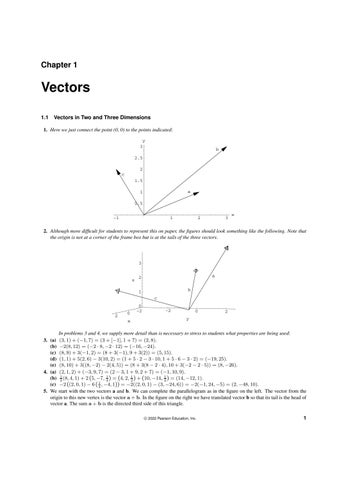
Vectors 1.1 Vectors in Two and Three Dimensions 1. Here we just connect the point (0, 0) to the points indicated: y 3
b
2.5 2 c 1.5 a
1 0.5 -1
1
2
3
x
2. Although more difficult for students to represent this on paper, the figures should look something like the following. Note that the origin is not at a corner of the frame box but is at the tails of the three vectors.
3
z
a
2 b
1 c
2
0
0 -2
-2
0
2
y
x
In problems 3 and 4, we supply more detail than is necessary to stress to students what properties are being used: 3. (a) (3, 1) + (−1, 7) = (3 + [−1], 1 + 7) = (2, 8). (b) −2(8, 12) = (−2 · 8, −2 · 12) = (−16, −24). (c) (8, 9) + 3(−1, 2) = (8 + 3(−1), 9 + 3(2)) = (5, 15). (d) (1, 1) + 5(2, 6) − 3(10, 2) = (1 + 5 · 2 − 3 · 10, 1 + 5 · 6 − 3 · 2) = (−19, 25). (e) (8, 10) + 3((8, −2) − 2(4, 5)) = (8 + 3(8 − 2 · 4), 10 + 3(−2 − 2 · 5)) = (8, −26). 4. (a) (2, 1, 2) + (−3, ) 10, 9). ( 9, 7) = )(2 −( 3, 1 +)9, 2(+ 7) = (−1, (b) 12 (8,( 4, 1) + 2 5,(−7, 14 =)) 4, 2, 12 + 10, −14, 12 = (14, −12, 1). (c) −2 (2, 0, 1) − 6 12 , −4, 1 = −2((2, 0, 1) − (3, −24, 6)) = −2(−1, 24, −5) = (2, −48, 10). 5. We start with the two vectors a and b. We can complete the parallelogram as in the figure on the left. The vector from the origin to this new vertex is the vector a + b. In the figure on the right we have translated vector b so that its tail is the head of vector a. The sum a + b is the directed third side of this triangle. c
2022 Pearson Education, Inc.
1
2
Chapter 1
Vectors y
y 7
7 6
a+b
6
a+b
5 b translated
5
4
b
4
b
3
3
2
2
a
1
1
-2
-1.5
-1
-0.5
6. a = (3, 2) b = (−1, 1) a − b = (3 − (−1), 2 − 1) = (4, 1)
a
0.5
1 a= 2
1
(3 2
x
) ,1
-2
-1.5
-1
-0.5
a + 2b = (1, 4)
y 4
a+2b
3
a
2
-2
a-b
1
b
(1/2)a
-1
1
2
5
4
3
-1
−→ −→ − → 7. (a) AB = (−3 − 1, 3 − 0, 1 − 2) = (−4, 3, −1) BA = −AB = (4, −3, 1) − → (b) AC = (2 − 1, 1 − 0, 5 − 2) = (1, 1, 3) − → BC = (2 − (−3), 1 − 3, 5 − 1) = (5, −2, 4) − → −→ AC + CB = (1, 1, 3) − (5, −2, 4) = (−4, 3, −1) (c) This result is true in general: B
A
C
Head-to-tail addition demonstrates this. c
2022 Pearson Education, Inc.
x
0.5
1
x
Section 1.1. Vectors in Two and Three Dimensions
3
8. The vectors a = (1, 2, 1), b = (0, −2, 3) and a + b = (1, 2, 1) + (0, −2, 3) = (1, 0, 4) are graphed below. Again note that the origin is at the tails of the vectors in the figure. Also, −1(1, 2, 1) = (−1, −2, −1). This would be pictured by drawing the vector (1, 2, 1) in the opposite direction. Finally, 4(1, 2, 1) = (4, 8, 4) which is four times vector a and so is vector a stretched four times as long in the same direction.
4 b a+b z 2
a
0 -2
1 0 x
0
2
y
9. Since the sum on the left must equal the vector on the right componentwise: −12 + x = 2, 9 + 7 = y , and z + −3 = 5. Therefore, x = 14, y = 16, and z = 8. 10. If from (3, 1) to the x-axis we see that by the Pythagorean Theorem the length of the vector (3, 1) = √ we drop a perpendicular √ 32 + 12 = 10. y 1
0.8
0.6
0.4
0.2 x 0.5
1
1.5
2
2.5
3
11. Notice that b (represented by the dotted line) = 5a (represented by the solid line). y 10 b
8
6
4
2 a x 1
c
2
3
4
2022 Pearson Education, Inc.
5
4
Chapter 1
Vectors
12. Here the picture has been projected into two dimensions so that you can more clearly see that a (represented by the solid line) = −2b (represented by the dotted line). 8
a
6 4 2
-4
-6
-8
-2
4
2 -2
b
-4
13. The natural extension to higher dimensions is that we still add componentwise and that multiplying a scalar by a vector means that we multiply each component of the vector by the scalar. In symbols this means that: a + b = (a1 , a2 , . . . , an ) + (b1 , b2 , . . . , bn ) = (a1 + b1 , a2 + b2 , . . . , an + bn ) and ka = (ka1 , ka2 , . . . , kan ). In our particular examples, (1, 2, 3, 4) + (5, −1, 2, 0) = (6, 1, 5, 4), and 2(7, 6, −3, 1) = (14, 12, −6, 2). 14. The diagrams for parts (a), (b) and (c) are similar to Figure 1.12 from the text. The displacement vectors are: (a) (1, 1, 5) (b) (−1, −2, 3) (c) (1, 2, −3) (d) (−1, −2) Note: The displacement vectors for (b) and (c) are the same but in opposite directions (i.e., one is the negative of the other). The displacement vector in the diagram for (d) is represented by the solid line in the figure below: y 1 0.75
P1
0.5 0.25 x 0.5
1
1.5
2
2.5
3
-0.25 -0.5 P2 -0.75 -1
15. In general, we would define the displacement vector from (a1 , a2 , . . . , an ) to (b1 , b2 , . . . , bn ) to be (b1 − a1 , b2 − a2 , . . . , bn − an ). In this specific problem the displacement vector from P1 to P2 is (1, −4, −1, 1). −→ 16. Let B have coordinates (x, y , z ). Then AB = (x − 2, y − 5, z + 6) = (12, −3, 7) so x = 14, y = 2, z = 1 so B has coordinates (14, 2, 1). 17. If a is your displacement vector from the Empire State Building and b your friend’s, then the displacement vector from you to your friend is b − a. c
2022 Pearson Education, Inc.
Section 1.1. Vectors in Two and Three Dimensions
5
you a b-a Empire State Bldg b
friend
18. Property 2 follows immediately from the associative property of the reals: (a + b) + c
=
((a1 , a2 , a3 ) + (b1 , b2 , b3 )) + (c1 , c2 , c3 )
=
((a1 + b1 , a2 + b2 , a3 + b3 ) + (c1 , c2 , c3 )
=
((a1 + b1 ) + c1 , (a2 + b2 ) + c2 , (a3 + b3 ) + c3 )
=
(a1 + (b1 + c1 ), a2 + (b2 + c2 ), a3 + (b3 + c3 ))
=
(a1 , a2 , a3 ) + ((b1 + c1 ), (b2 + c2 ), (b3 + c3 ))
=
a + (b + c).
Property 3 also follows from the corresponding componentwise observation: a + 0 = (a1 + 0, a2 + 0, a3 + 0) = (a1 , a2 , a3 ) = a. 19. We provide the proofs for R3 : (1) (k + l)a = (k + l)(a1 , a2 , a3 ) = ((k + l)a1 , (k + l)a2 , (k + l)a3 ) = (ka1 + la1 , ka2 + la2 , ka3 + la3 ) = ka + la. (2) k(a + b) = k((a1 , a2 , a3 ) + (b1 , b2 , b3 )) = k(a1 + b1 , a2 + b2 , a3 + b3 ) = (k(a1 + b1 ), k(a2 + b2 ), k(a3 + b3 )) = (ka1 + kb1 , ka2 + kb2 , ka3 + kb3 ) = (ka1 , ka2 , ka3 ) + (kb1 , kb2 , kb3 ) = ka + kb. (3) k(la) = k(l(a1 , a2 , a3 )) = k(la1 , la2 , la3 ) = (kla1 , kla2 , kla3 ) = (lka1 , lka2 , lka3 ) = l(ka1 , ka2 , ka3 ) = l(ka). 20. (a) 0a is the zero vector. For example, in R3 : 0a = 0(a1 , a2 , a3 ) = (0 · a1 , 0 · a2 , 0 · a3 ) = (0, 0, 0). (b) 1a = a. Again in R3 :
1a = 1(a1 , a2 , a3 ) = (1 · a1 , 1 · a2 , 1 · a3 ) = (a1 , a2 , a3 ) = a.
21. (a) The head of the vector sa is on the x-axis between 0 and 2. Similarly the head of the vector tb lies somewhere on the vector b. Using the head-to-tail method, sa + tb is the result of translating the vector tb, in this case, to the right by 2s (represented in the figure by tb*). The result is clearly inside the parallelogram determined by a and b (and is only on the boundary of the parallelogram if either t or s is 0 or 1. b x tb
tb* sa
a
c
2022 Pearson Education, Inc.