Solution Manual For Cost Accounting A Data Analytics Approach 2024 Release By Margaret Christ, D. Kip Holderness and Vernon Richardson Chapter 1-10
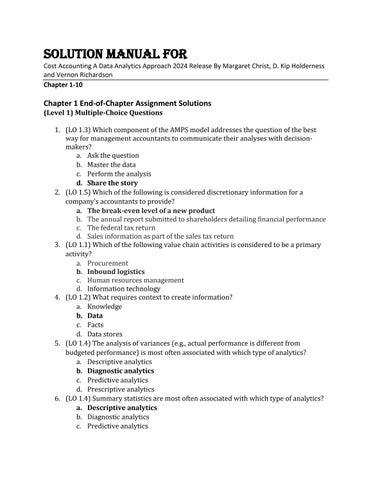
Chapter 1 End-of-Chapter Assignment Solutions (Level 1) Multiple-Choice Questions 1. (LO 1.3) Which component of the AMPS model addresses the question of the best way for management accountants to communicate their analyses with decisionmakers? a. Ask the question b. Master the data c. Perform the analysis d. Share the story 2. (LO 1.5) Which of the following is considered discretionary information for a company’s accountants to provide? a. The break-even level of a new product b. The annual report submitted to shareholders detailing financial performance c. The federal tax return d. Sales information as part of the sales tax return 3. (LO 1.1) Which of the following value chain activities is considered to be a primary activity? a. Procurement b. Inbound logistics c. Human resources management d. Information technology 4. (LO 1.2) What requires context to create information? a. Knowledge b. Data c. Facts d. Data stores 5. (LO 1.4) The analysis of variances (e.g., actual performance is different from budgeted performance) is most often associated with which type of analytics? a. Descriptive analytics b. Diagnostic analytics c. Predictive analytics d. Prescriptive analytics 6. (LO 1.4) Summary statistics are most often associated with which type of analytics? a. Descriptive analytics b. Diagnostic analytics c. Predictive analytics
d. Prescriptive analytics 7. (LO 1.4) Time series analysis is most often associated with which type of analytics? a. Descriptive analytics b. Diagnostic analytics c. Predictive analytics d. Prescriptive analytics 8. (LO 1.6) Which of the following is not one of the four overarching ethical principles mentioned in the 2017 IMA Statement of Ethical Professional Practice? a. Competence b. Honesty c. Confidentiality d. Credibility
9. (LO 1.3) Which questions aim to more clearly understand why net income is decreasing when revenues are increasing? a. What happened? What is happening? b. Why did it happen? What are the root causes of past results? c. Will it happen in the future? What is the probability something will happen? Is it forecastable? d. What should we do based on what we expect will happen? How do we optimize our performance based on potential constraints? 10. (LO 1.3) What type of visualization is used to track overtime labor on a continuous, real-time basis? a. Dashboard with static display b. Dashboard with dynamic display c. Conditional formatting d. Bar chart for the past 10 months 11. (LO 1.3) Which management accounting question will require predictive analytics? a. Why did labor expenses increase over the past year as compared to prior years? b. Should the company rent or lease its headquarters office building? c. Can we forecast future sales for this company? d. Why did our cost structure (fixed and variable costs) change over the past year? 12. (LO 1.3) Which management accounting question will require prescriptive analytics? a. Why did the company perform worse this year than last year? b. Should the company manufacture its product, or should it outsource the production of its products to an outside contractor? c. Can we forecast future sales, earnings, and cash flows for this company? d. What was the total revenue last quarter? 13. (LO 1.2) A ________ is a person who analyzes accounting-related data to help an organization make effective business decisions. a. management accountant
b. financial accountant c. data scientist d. computer programmer 14. (LO 1.2) A ________ is a person employed to acquire, maintain, curate, access, manipulate, and statistically test data to address business questions. a. management accountant b. financial accountant c. data scientist d. computer programmer 15. (LO 1.2) If a manager is a decision-maker, and a data scientist is a developer, then what best describes a management accountant? a. An interpreter b. An expert at investments c. An intermediary d. A broker 16. (LO 1.5) Which of the following is mandatory information that a company’s accountants is required to maintain? a. The cost drivers used to allocate overhead b. The calculation of the difference between actual and budgeted performance c. The product price that should be charged to maximize profits d. The amount of dividends paid to shareholders 17. (LO 1.5) Which entity sponsors the certification of management accountants as a CMA? a. Institute of Management Accountants b. Institute of Certified Public Accountants c. American Institute of Management Accountants d. Association of Certified Management Accountants 18. (LO 1.5) Which of the following applies to management accounting? a. There are required audits of management accounting information. b. Management accounting works to minimize the cost of compliance with regulatory entities. c. A source of management accounting data comes from a cost accounting system. d. Common output is the income statement. 19. (LO 1.3) Performing a regression falls into which of the following components of the AMPS model? a. Ask the question b. Master the data c. Perform the analysis d. Share the story 20. (LO 1.3) Which data visualization is used to evaluate trends of values over time? a. Bar Chart b. Pie Chart c. Scatterplot d. Line Graph
(Level 1) Discussion Questions 1. (LO 1.1) Describe the primary activities in the value chain for your college or university. In your opinion, which primary activities create the most value? Suggested Solution: Answers will vary. Universities admit students (as inputs) and use their resources (curriculum, faculty, buildings, computers, and so on) to create a job-ready, educated graduate (the output). Arguably, the school creates value (as shown in Exhibit 1.1). If it is not creating value in one form or the other, it probably will not survive. 1. INBOUND LOGISTICS are the activities associated with receiving and storing raw materials and other partially completed materials, and distributing those materials to manufacturing divisions when and where they are needed. Universities hire faculty and faculty support, construct classrooms and faculty offices, create online teaching infrastructure, construct housing (where appropriate), etc. 2. OPERATIONS are the activities that transform inputs into finished goods and services. Professors and instructors develop curricula, create degree programs, instruct and assess students for performance. 3. OUTBOUND LOGISTICS are the activities that warehouse and distribute the finished goods to customers. Placement services, job fairs, employer relations, etc., help to place graduating students. 4. MARKETING AND SALES ACTIVITIES identify the needs and wants of customers to attract them to the company’s products and then buy them. Universities market and advertise their degree programs and university services to prospective and current students. 5. SERVICE ACTIVITIES provide support to customers after the products and services are sold to them. Service activities include warranty repairs, parts, instruction manuals, and phone or internet support. Alumni programs and placement programs continue to support students after they have graduated.
2. (LO 1.1) Describe the primary activities in the value chain for an accounting firm that issues audit reports. In your opinion, which primary activities create the most value? Suggested Solution: 1. INBOUND LOGISTICS are the activities associated with receiving and storing raw materials and other partially completed materials, and distributing those materials to manufacturing divisions when and where they are needed. Accounting firms hire accounting staff. They also create software programs to access general ledger and journal transactions for assessment. 2. OPERATIONS are the activities that transform inputs into finished goods and services. Accounting firm staff evaluate the financial transactions and assess whether the financial reports fairly represent the financial position of the company. 3. OUTBOUND LOGISTICS are the activities that warehouse and distribute the finished goods to customers. Accounting firm staff ensures that financial reports and opinion rendered on those financial reports are transmitted to the focal company and submitted to the Securities and Exchange Commission (where appropriate). 4. MARKETING AND SALES ACTIVITIES identify the needs and wants of customers to attract them to the company’s products and then buy them. Accounting firm staff markets its services by bidding on audit jobs. It also does some general advertising. 5. SERVICE ACTIVITIES provide support to customers after the products and services are sold to them. Service activities include warranty repairs, parts, instruction manuals, and phone or internet support. Accounting firm staff continue to support its clients through annual audit and quarterly reviews.
3. (LO 1.1) Give five examples of business processes at Tesla. How do they create business value for Tesla and its shareholders? Suggested Solution: