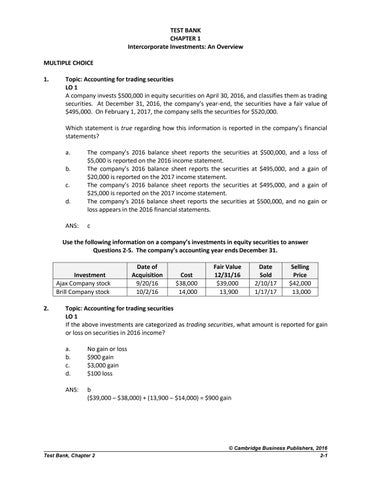
TEST BANK CHAPTER 1 Intercorporate Investments: An Overview MULTIPLE CHOICE 1.
Topic: Accounting for trading securities LO 1 A company invests $500,000 in equity securities on April 30, 2016, and classifies them as trading securities. At December 31, 2016, the company’s year-end, the securities have a fair value of $495,000. On February 1, 2017, the company sells the securities for $520,000. Which statement is true regarding how this information is reported in the company’s financial statements? a. b. c. d.
ANS:
The company’s 2016 balance sheet reports the securities at $500,000, and a loss of $5,000 is reported on the 2016 income statement. The company’s 2016 balance sheet reports the securities at $495,000, and a gain of $20,000 is reported on the 2017 income statement. The company’s 2016 balance sheet reports the securities at $495,000, and a gain of $25,000 is reported on the 2017 income statement. The company’s 2016 balance sheet reports the securities at $500,000, and no gain or loss appears in the 2016 financial statements. c
Use the following information on a company’s investments in equity securities to answer Questions 2-5. The company’s accounting year ends December 31.
Investment Ajax Company stock Brill Company stock 2.
Date of Acquisition 9/20/16 10/2/16
Cost $38,000 14,000
Fair Value 12/31/16 $39,000 13,900
Date Sold 2/10/17 1/17/17
Selling Price $42,000 13,000
Topic: Accounting for trading securities LO 1 If the above investments are categorized as trading securities, what amount is reported for gain or loss on securities in 2016 income? a. b. c. d.
No gain or loss $900 gain $3,000 gain $100 loss
ANS:
b ($39,000 – $38,000) + (13,900 – $14,000) = $900 gain
Test Bank, Chapter 2
© Cambridge Business Publishers, 2016 2-1
3.
4.
5.
Topic: Accounting for trading securities LO 1 If the above investments are categorized as trading securities, what amount is reported for gain or loss on securities in 2017 income? a. b. c. d.
$3,000 gain $2,100 loss $2,100 gain $3,100 gain
ANS:
c ($42,000 – $39,000) + ($13,000 – $13,900) = $2,100 gain
Topic: Accounting for AFS securities LO 1 If the above investments are categorized as available-for-sale securities, what amount is reported for gain or loss on securities in 2016 income? a. b. c. d.
No gain or loss $900 gain $3,000 gain $100 loss
ANS:
a
Topic: Accounting for AFS securities LO 1 If the above investments are categorized as available-for-sale securities, what amount is reported as gain or loss on securities in 2017 income? a. b. c. d.
$3,000 gain $2,100 loss $2,100 gain $3,100 gain
ANS:
a ($42,000 – $38,000) + ($13,000 – $14,000) = $3,000 gain
© Cambridge Business Publishers, 2016 2-2
Advanced Accounting, 3rd Edition
6.
Topic: Accounting for trading securities LO 1 A company buys an equity investment for $100 in 2016. At the end of 2016, the company still holds the investment and it has a market value of $115. In 2017, the company sells the investment for $108. How is this information reported in the company’s 2016 and 2017 income statements if the investment is classified as a trading investment?
7.
a. b. c. d.
$15 gain on the 2016 income statement; $7 loss on the 2017 income statement. Does not appear on the 2016 income statement; $8 gain on the 2017 income statement. Does not appear on the 2016 income statement; $7 loss on the 2017 income statement. $8 gain on the 2016 income statement; does not appear on the 2017 income statement.
ANS:
a
Topic: Accounting for trading securities LO 1 On December 20, 2016, a company pays $40,000 for a stock, classified as a trading security. On December 31, 2016, the company’s year-end, the stock has a market value of $38,000. The company sells the stock in 2017 for $43,000. On its income statement, the company reports:
8.
a. b. c. d.
A loss of $2,000 in 2016, and a gain of $5,000 in 2017 No gain or loss in 2016, and a gain of $3,000 in 2017 A gain of $3,000 in 2016, and no gain or loss in 2017 No gain or loss in 2016, and a gain of $5,000 in 2017
ANS:
a
Topic: Accounting for AFS securities LO 1 A company buys an equity investment for $100 in 2016. At the end of 2016, the company still holds the investment and it has a market value of $115. In 2017, the company sells the investment for $108. How is this information reported in the company’s 2016 and 2017 income statements if the investment is classified as an AFS investment? a. b. c. d.
ANS:
$15 gain on the 2016 income statement; $7 loss on the 2017 income statement Does not appear on the 2016 income statement; $8 gain on the 2017 income statement Does not appear on the 2016 income statement; $7 loss on the 2017 income statement $8 gain on the 2016 income statement; does not appear on the 2017 income statement b
Test Bank, Chapter 2
© Cambridge Business Publishers, 2016 2-3
9.
Topic: Accounting for AFS securities LO 1 A company invests $400,000 in equity securities on April 30, 2016, and classifies them as available-for-sale securities. At December 31, 2016, the company’s year-end, the securities have a fair value of $410,000. On February 1, 2017, the company sells the securities for $396,000. Which statement is true regarding how is this information reported in the company’s financial statements? a. b. c. d.
ANS: 10.
The company’s 2016 balance sheet reports the securities at $410,000 and a gain of $10,000 is reported in 2016 other comprehensive income. The company’s 2016 balance sheet reports the securities at $400,000 and a loss of $4,000 is reported on the 2017 income statement. The company’s 2016 balance sheet reports the securities at $410,000 and a loss of $4,000 is reported in 2017 other comprehensive income. The company’s 2016 balance sheet reports the securities at $400,000 and no gain or loss appears in the 2016 financial statements. a
Topic: Accounting for AFS securities LO 1 A company invests $700,000 in equity securities in 2016, and classifies them as available-forsale. At the end of 2016, the fair value of the securities is $650,000. In 2017, the company sells the securities for $706,000. Which statement is true concerning the entry made to record the sale of the securities? a. b. c. d.
Other comprehensive income increases by $50,000 and income increases by $6,000. There is no effect on other comprehensive income, and income increases by $6,000. Other comprehensive income declines by $50,000, and income increases by $6,000. Other comprehensive income increases by $6,000, and there is no effect on income.
ANS:
a The 2017 entry to record the sale is as follows: Cash
706,000 OCI Investment in AFS securities Gain (income)
© Cambridge Business Publishers, 2016 2-4
50,000 650,000 6,000
Advanced Accounting, 3rd Edition
11.
Topic: Accounting for AFS securities LO 1 An investment in an AFS security declines in value during the year. The company still holds it at year-end. The year-end adjustment to report the investment at market value reduces the investment account What other account is reduced on the balance sheet?
12.
13.
a. b. c. d.
Accumulated other comprehensive income Loss on AFS securities (OCI) Retained earnings Allowance for impairment losses
ANS:
a
Topic: Impairment testing of AFS securities LO 1 A U.S. company holds available-for-sale securities carried at current fair value. It determines that previously reported declines in value are “other than temporary.” The effect of this decision is to: a. b. c. d.
Reduce accumulated other comprehensive income Reduce reported net income Reduce the asset, investment in AFS securities Increase stockholders’ equity
ANS:
b
Topic: Impairment testing of AFS securities LO 1 A U.S. company holds available-for-sale securities, purchased for $1,000,000 and carried at $1,500,000. At the end of the current year, the company determines that the fair value of these securities is $700,000, and the decline in value is “other than temporary.” How will the adjusting entry to record the decline in value affect income and other comprehensive income?
a. b. c. d. ANS:
Income Decrease $300,000 Decrease $800,000 No effect Decrease $300,000
OCI Decrease $500,000 No effect Decrease $800,000 Increase $500,000
a The entry to record the impairment loss is: OCI Loss (income)
500,000 300,000 Investment in AFS securities
Test Bank, Chapter 2
800,000
© Cambridge Business Publishers, 2016 2-5