Name:
Class:
Date:
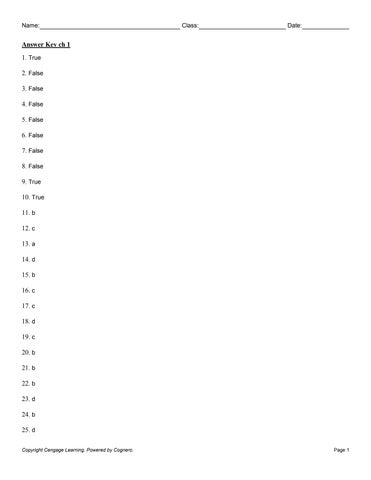
Answer Key ch 1 1. True 2. False 3. False 4. False 5. False 6. False 7. False 8. False 9. True 10. True 11. b 12. c 13. a 14. d 15. b 16. c 17. c 18. d 19. c 20. b 21. b 22. b 23. d 24. b 25. d Copyright Cengage Learning. Powered by Cognero.
Page 1
Name:
Class:
Date:
26. a 27. c 28. c 29. d 30. d 31. b 32. a 33. b 34. a 35. a 36. b 37. a 38. Procedure-oriented languages: COBOL, BASIC, and C. Object-oriented languages: C++, Visual Basic, Java, Python, and C#. 39. Absolutely. The programmer will initially meet with the user to determine the exact problem and to agree on a solution. After the programmer and user agree on the solution, the programmer begins converting the solution into a program. During the conversion stage, the programmer meets periodically with the user to determine whether the program fulfills the user‟s needs and to refine any details of the solution. The creation of a good computer solution to a problem requires a great deal of interaction between the programmer and the user. 40. The directions given to a computer are called programs. The people who write programs are called programmers. Programmers use a variety of special languages, called programming languages, to communicate with the computer. 41. With procedure-oriented programs the programmer concentrates on the major tasks that the program needs to perform. With object-oriented programs the programmer focuses on the objects that the program can use to accomplish its goal. 42. Programming teams often contain subject matter experts, who may or may not be programmers. These individuals bring expertise to the type of program being written that the programmer may not possess. For example, an accountant might be part of a programming team working on a program that requires accounting expertise. 43. A compiler translates all of a program‟s high-level instructions before executing the program, whereas an interpreter translates the instructions line by line as the program is executing. 44. Programmers and software engineers need to have strong problem-solving and analytical skills, as well as the ability to communicate effectively with team members, end users, and other non-technical personnel. 45. Sequence, selection, and repetition. Copyright Cengage Learning. Powered by Cognero.
Page 2
Name:
Class:
Date:
You use the sequence structure each time you follow a set of step-by-step instructions, in order, from beginning to end. The selection structure, also called the decision structure, indicates that a decision (based on some condition) needs to be made, followed by an appropriate action derived from that decision. The repetition structure indicates that one or more instructions need to be repeated until some condition is met.
chapter 1
Indicate whether the statement is true or false. 1. The main reason why high-level langauges were a vast improvement over machine and assembly langagues is because they allow the programmer to use instructions that more closely resemble the English language. a. True b. False 2. The selection structure is also referred to as an iteration. a. True b. False 3. A compiler translates instructions line by line as the program is running. a. True b. False 4. The repetition structure has a true path and a false path. a. True b. False 5. There is one universal machine language used by computers. a. True b. False 6. Assembly language requires a programmer to enter the program using 1s and 0s. a. True b. False 7. An interpreter translates all of a program‟s high-level instructions into machine language before executing the program. a. True b. False 8. Mnemonics are a special number system used by assembly languages. a. True b. False 9. There are two digits in the machine language system. a. True b. False Copyright Cengage Learning. Powered by Cognero.
Page 3
Name:
Class:
Date:
10. In object-oriented programming, an object can be used in more than one program; often with little to no modification. a. True b. False
Indicate the answer choice that best completes the statement or answers the question. 11. What are program instructions written in 1s and 0s called? a. assembly language b. machine code c. procedure-oriented code d. object-oriented language 12. The choice of whether to turn left or right at a fork in the road is an example of which type of structure? a. mnemonic b. sequence c. decision d. iteration 13. With whom should a programmer have extensive interaction before converting a solution to a problem into a computer program? a. user b. language developer c. compiler vendor d. system engineer 14. What type of structure is the following set of statements an example of? if time-of-day is greater than noon set afternoon access permissions else set regular access permissions end if a. iteration b. sequence c. repetition d. selection 15. What type of structure is the following set of statements an example of? while not end of file read a line end while a. selection b. repetition c. decision d. sequence 16. Which of the following translates program instructions line by line as the program is running? a. assembler b. algorithm c. interpreter d. compiler 17. C++, Visual Basic, C#, Python, and Java are all examples of what kind of language? a. assembly b. machine c. programming d. mnemonic 18. C++, Visual Basic, Java, and C# are examples of what type of language that can be used to create both procedureoriented and object-oriented programs? a. assembly b. machine c. compiler d. high-level Copyright Cengage Learning. Powered by Cognero.
Page 4
Name:
Class:
Date:
19. What do programs written in assembly language require to convert the assembly language instructions into machine language? a. interpreter b. compiler c. assembler d. converter 20. An example of an instruction written in machine language would be ____. a. sum = num1 + num2 b. 0000 0101 1100 0000 c. ADD bx, ax d. repeat 5 times 21. What is the name for the basic structure that controls the overall flow of a program's logic? a. procedure b. control c. directional d. algorithmic 22. Which statement is an example of a repetition structure? a. if (Ginger is on the bench) b. repeat (2 times) c. sit down d. walk forward 23. Which of the following translates all of a program‟s high-level instructions before running the program? a. heuristic b. GUI c. interpreter d. compiler 24. What is the output of the following algorithm if AMOUNT is equal to $200? If AMOUNT is greater than $500 print "That's too much." Else if AMOUNT is greater than $200 print "Still too much" Else if AMOUNT is greater than $100 print "That's about right" Else print "Amount is too low." End if a. That's too much b. That's about right c. Still too much d. Amount is too low 25. After coding a program, the programmer should perform which task before releasing it to the user? a. ask the user to approve the machine code b. write a user manual c. assemble the program with an interpreter d. test the program with sample data 26. Which type of structure do all programs use? a. sequence b. selection c. repetition d. variable 27. Which of the following is an example of an instruction written in assembly language? a. sum = num1 + num2 b. 0000 0101 1100 0000 c. MUL bx, ax d. repeat 5 times 28. Which of the following is a language typically used to create procedure-oriented programs? a. C# b. Python Copyright Cengage Learning. Powered by Cognero.
Page 5