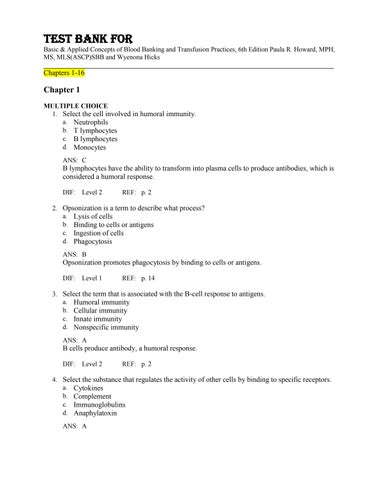
Test Bank For Basic & Applied Concepts of Blood Banking and Transfusion Practices, 6th Edition Paula R. Howard, MPH, MS, MLS(ASCP)SBB and Wyenona Hicks _______________________________________________________________________________________
Chapters 1-16
Chapter 1 MULTIPLE CHOICE 1. Select the cell involved in humoral immunity. a. Neutrophils b. T lymphocytes c. B lymphocytes d. Monocytes ANS: C
B lymphocytes have the ability to transform into plasma cells to produce antibodies, which is considered a humoral response. DIF: Level 2
REF: p. 2
2. Opsonization is a term to describe what process? a. Lysis of cells b. Binding to cells or antigens c. Ingestion of cells d. Phagocytosis ANS: B
Opsonization promotes phagocytosis by binding to cells or antigens. DIF: Level 1
REF: p. 14
3. Select the term that is associated with the B-cell response to antigens. a. Humoral immunity b. Cellular immunity c. Innate immunity d. Nonspecific immunity ANS: A
B cells produce antibody, a humoral response. DIF: Level 2
REF: p. 2
4. Select the substance that regulates the activity of other cells by binding to specific receptors. a. Cytokines b. Complement c. Immunoglobulins d. Anaphylatoxin ANS: A
Cytokines are proteins secreted by cells that regulate the activity of other cells by binding to specific receptors. DIF: Level 1
REF: p. 2
5. Which of the following is responsible for the activation of the classic pathway of
complement? a. Bacteria b. Foreign proteins c. Virus d. Antibody bound to antigen ANS: D
An antigen-antibody complex activates the classical complement cascade, whereas bacterial membranes activate the alternative pathway. DIF: Level 1
REF: p. 13
6. The major histocompatibility complex is located on chromosome 6 and is important in all the
following immune functions except: a. recognition of nonself. b. graft rejection. c. hemolysis. d. coordination of cellular and humoral immunity. ANS: C
The major histocompatibility complex codes for molecules on all nucleated tissues and cells to allow for immune recognition and response to foreign antigens. DIF: Level 2
REF: p. 19
7. A poor response to platelet transfusion that can be caused by antibodies to human leukocyte
antigens is known as: a. nonresponders. b. refractoriness. c. immune activation. d. responders. ANS: B
Blood components that contain leukocytes can increase the immune response to human leukocyte antigens, which may decrease the effectiveness of platelet transfusion, known as refractoriness. DIF: Level 2
REF: p. 19
8. In a lymphocytotoxicity test, cells that take on the dye: a. do not recognize a human leukocyte antigen. b. recognize a red cell antibody. c. are not affected by complement. d. are recognized by a specific antibody. ANS: D
A specific antigen-antibody complex in the lymphocytotoxicity test is detected by membrane damage, which allows the cells to become permeable to dye. DIF: Level 2
REF: p. 21
9. In a serologic test, the term prozone is also known as: a. equivalence. b. antigen excess. c. antibody excess. d. serum-to-cell ratio. ANS: C
Antibody excess is termed prozone, often leading to a false-negative reaction. DIF: Level 1
REF: p. 17
10. What is the potential effect in a tube agglutination test if a red cell suspension with a
concentration greater than 5% is used? a. False negatives b. False positives c. Hemolysis d. No effect ANS: A
Antigen excess is termed postzone and will lessen the reaction, causing a false negative. DIF: Level 3
REF: p. 17
11. After adding antigen and antibody to a test tube, one large agglutinate was observed. How
should this reaction be graded? a. 2+ b. 3+ c. 4+ d. 0 ANS: C
One large agglutinate is graded a 4+ reaction. DIF: Level 2
REF: p. 18
12. Select the portion of the antibody molecule that imparts the antibody’s unique class function. a. Constant region of the heavy chain b. Constant region of the light chain c. Variable region of the heavy chain d. Variable region of the light chain ANS: A
The heavy-chain constant region has the function of the class. DIF: Level 1
REF: p. 4
13. What portion of the antibody molecule binds to receptors on macrophages and assists in the
removal of antibody bound to red cells? a. Fab fragment b. Hinge region c. Fc fragment d. J chain ANS: C
The Fc portion of the antibody binds to the macrophage, which then carries the antigen-antibody complex to the spleen for removal. DIF: Level 1
REF: p. 5
14. Select the region of the antibody molecule responsible for imparting unique antibody
specificity. a. Variable region b. Constant region c. Hinge region d. Fc fragment ANS: A
The variable region is the unique antigen binding site that gives each antibody its specificity. DIF: Level 1
REF: p. 5
15. What immunoglobulin class is capable of crossing the placenta? a. IgM b. IgA c. IgE d. IgG ANS: D
Only IgG can cross the placenta as a result of IgG receptor binding sites on placental cells. DIF: Level 1
REF: p. 6
16. What immunoglobulin class reacts best at room temperature at immediate spin? a. IgM b. IgA c. IgE d. IgG ANS: A
IgM is a large immunoglobulin with multiple binding sites that is detectable at room temperature and the immediate spin phase. DIF: Level 2
REF: p. 6
17. An antigen that originates from the individual is termed: a. autologous b. allogeneic c. hapten
d. immunogen ANS: A
Autologous is a term that refers to cells or tissue from self. DIF: Level 1
REF: p. 2
18. Which of the following will cause an antigen to elicit a greater immune response? a. Small antigen size b. Composed largely of carbohydrates c. Size greater than 10,000 daltons d. Similarity to the host ANS: C
Antigens will elicit a better immune response if they are larger than 10,000 daltons, are foreign to the host, and are made of proteins. DIF: Level 1
REF: p. 3
19. Extravascular destruction of blood cells occurs in the: a. blood vessels. b. lymph nodes. c. spleen. d. thymus. ANS: C
Extravascular destruction of blood cells is initiated by macrophage interaction with IgG molecules attached to red cells that transport the red cells to the spleen for clearance. DIF: Level 2
REF: p. 5
20. It was observed that an antibody identified in the transfusion service appeared to be reacting
stronger following the second exposure to an antigen from a transfusion. The most likely explanation of this is: a. affinity maturation of the immunoglobulin molecule. b. anamnestic response. c. isotype switching. d. all of the above. ANS: D
Genetic changes in the variable region, stimulation of memory B cells, and class switching contribute to the increased strength and specificity of an antibody following the second exposure to an antigen. DIF: Level 2
REF: p. 8
21. In the complement cascade, lysis of the target cell is mediated by which of the following
components? a. C1qrs b. C4a, C3a, and C5a c. C5 to C9 d. C3a and C3b