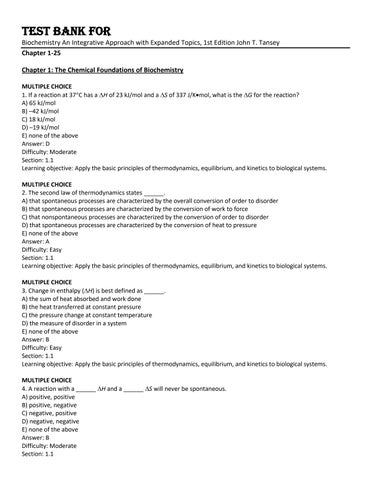
Test Bank For Biochemistry An Integrative Approach with Expanded Topics, 1st Edition John T. Tansey Chapter 1-25 Chapter 1: The Chemical Foundations of Biochemistry MULTIPLE CHOICE 1. If a reaction at 37C has a H of 23 kJ/mol and a S of 337 J/Kmol, what is the G for the reaction? A) 65 kJ/mol B) –42 kJ/mol C) 18 kJ/mol D) –19 kJ/mol E) none of the above Answer: D Difficulty: Moderate Section: 1.1 Learning objective: Apply the basic principles of thermodynamics, equilibrium, and kinetics to biological systems. MULTIPLE CHOICE 2. The second law of thermodynamics states ______. A) that spontaneous processes are characterized by the overall conversion of order to disorder B) that spontaneous processes are characterized by the conversion of work to force C) that nonspontaneous processes are characterized by the conversion of order to disorder D) that spontaneous processes are characterized by the conversion of heat to pressure E) none of the above Answer: A Difficulty: Easy Section: 1.1 Learning objective: Apply the basic principles of thermodynamics, equilibrium, and kinetics to biological systems. MULTIPLE CHOICE 3. Change in enthalpy (H) is best defined as ______. A) the sum of heat absorbed and work done B) the heat transferred at constant pressure C) the pressure change at constant temperature D) the measure of disorder in a system E) none of the above Answer: B Difficulty: Easy Section: 1.1 Learning objective: Apply the basic principles of thermodynamics, equilibrium, and kinetics to biological systems. MULTIPLE CHOICE 4. A reaction with a ______ H and a ______ S will never be spontaneous. A) positive, positive B) positive, negative C) negative, positive D) negative, negative E) none of the above Answer: B Difficulty: Moderate Section: 1.1
Learning objective: Apply the basic principles of thermodynamics, equilibrium, and kinetics to biological systems. MULTIPLE CHOICE 5. Calculate the G for a reaction with H = 20. kJ/mol and S = 20. J/K•mol that is carried out at 27°C. A) 14 J/mol B) 140 J/mol C) 1,400 J/mol D) 14,000 J/mol E) none of the above Answer: D Difficulty: Moderate Section: 1.1 Learning objective: Apply the basic principles of thermodynamics, equilibrium, and kinetics to biological systems. MULTIPLE CHOICE 6. A spontaneous process ______. A) occurs without the addition of free energy B) has a G < 0 C) is exergonic D) is all of the above E) is none of the above Answer: D Difficulty: Easy Section: 1.1 Learning objective: Apply the basic principles of thermodynamics, equilibrium, and kinetics to biological systems. MATCHING: A) phylogenetic B) negative C) H2O D) H° E) H – TS F) halobacteria G) open H) entropy I) flux J) polymers K) G°ꞌ L) thermophiles M) nitrogen N) positive 7. The term used to indicate the degree of randomness within a system is ______. Answer: H Difficulty: Easy Section: 1.1 Learning objective: Apply the basic principles of thermodynamics, equilibrium, and kinetics to biological systems. 8. Spontaneous processes are characterized by a change in Gibbs free energy that is ______. Answer: B Difficulty: Easy Section: 1.1 Learning objective: Apply the basic principles of thermodynamics, equilibrium, and kinetics to biological systems.
9. Gibbs free energy is defined as G = ______. Answer: E Difficulty: Easy Section: 1.1 Learning objective: Basic principles of thermodynamics describe all systems 10. The symbol for free energy under standard biochemical conditions is ______. Answer: K Difficulty: Easy Section: 1.1 Learning objective: Apply the basic principles of thermodynamics, equilibrium, and kinetics to biological systems. 11. Living creatures can be described thermodynamically as ______ systems. Answer: G Difficulty: Easy Section: 1.1 Learning objective: Apply the basic principles of thermodynamics, equilibrium, and kinetics to biological systems. MULTIPLE CHOICE 12. An endergonic reaction with a ______ H and a ______ S can be changed into an exergonic reaction by decreasing the temperature. A) positive, positive B) positive, negative C) negative, positive D) negative, negative Answer: D Difficulty: Moderate Section: 1.1 Learning objective: Apply the basic principles of thermodynamics, equilibrium, and kinetics to biological systems. MULTIPLE CHOICE 13. For a reaction with H = 23 kJ/mol and S = 22 J/K•mol, at 2°C, the reaction is ______. A) spontaneous B) nonspontaneous C) at equilibrium D) impossible to determine reactivity E) none of the above Answer: B Difficulty: Moderate Section: 1.1 Learning objective: Apply the basic principles of thermodynamics, equilibrium, and kinetics to biological systems. MULTIPLE CHOICE 14. An increase in disorder in the system ______. A) is required for a process to be spontaneous B) results in a decrease in entropy C) is characteristic of a system increasing in enthalpy D) results in the factor TS being positive E) is found in every exergonic process Answer: D Difficulty: Moderate Section: 1.1
Learning objective: Apply the basic principles of thermodynamics, equilibrium, and kinetics to biological systems. SHORT ANSWER 15. Consider a reaction in which H = -20. kJ/mol and S = 10. J/mol · K. a. Calculate the G for this reaction at 25°C. b. Is the reaction spontaneous (explain your answer)? Answer: a. G = H − TS G = –20,000 J/mol – (298 × 10 J/mol) = −23,000 J/mol b. The reaction is spontaneous because the G is negative. Difficulty: Moderate Section 1.1 Learning objective: Apply the basic principles of thermodynamics, equilibrium, and kinetics to biological systems. MULTIPLE CHOICE 16. Of the following amino acids, which contains an alcohol?
A
B
C
D
A) A B) B C) C D) D E) all of the above Answer: A Difficulty: Easy Section: 1.1 Learning Objective: Apply the basic principles of thermodynamics, equilibrium, and kinetics to biological systems. MULTIPLE CHOICE 17. What functional groups are present in the following molecule?
A) amine and carboxylic acid B) amine, ketone, and carboxylic acid C) amine, amide, and carboxylic acid D) alcohol, amine, amide, and carboxylic acid E) none of the above are correct Answer: C Difficulty: Medium Section: 1.1 Learning Objective: Apply the basic principles of thermodynamics, equilibrium, and kinetics to biological systems. MULTIPLE CHOICE
18. Keq can be determined from the change in standard free energy using the equation ______. A) Keq = e−G°/RT B) Keq = ln e−G°/TS C) Keq = e−H/RT D) Keq = e−G°/TS E) Keq = log e−G°/RT Answer: A Difficulty: Easy Section: 1.1 Learning objective: Apply the basic principles of thermodynamics, equilibrium, and kinetics to biological systems. MULTIPLE CHOICE 19. Consider the reaction A + B C + D. After reaching equilibrium at 25°C, the following concentrations of reactants and products were measured: [A] = 10 µM, [B] = 15 µM, [C] = 10 µM, [D] = 10 µM. Calculate ∆G°ꞌ for this reaction. A) 1,000 J/mol B) 10 kJ/mol C) 1 J/mol D) insufficient data to determine answer E) none of the above Answer: A Difficulty: Moderate Section: 1.1 Learning objective: Apply the basic principles of thermodynamics, equilibrium, and kinetics to biological systems. SHORT ANSWER 20. Consider the isomerization reaction R P, in which R is converted to P. The G°ꞌ for this reaction is −10. kJ/mol. Calculate the [P]/[R] at equilibrium at 25°C. Answer: At equilibrium [P]/[R] = Keq = e−G°/RT [P]/[R] = e− -(−-10000 J/mol)/8.3145 × 298 J/mol = e10000/8.3145 × 298 = 57 Difficulty: Moderate Section 1.1 Learning objective: Apply the basic principles of thermodynamics, equilibrium, and kinetics to biological systems. SHORT ANSWER 21. Phosphoglucomutase catalyzes the reaction in which a phosphate group is transferred from the C-1 of glucose to the C-6 of glucose (G1P G6P). A student incubates a 0.2 M solution of glucose-1-phosphate overnight with a small amount of the enzyme. At equilibrium the concentration of glucose-1-phosphate is 9.0 × 10⁻³ M and the concentration of glucose-6-phosphate is 19.1 × 10⁻² M. Calculate the equilibrium constant (Keq) and the standard state free energy (∆G°ꞌ) for this reaction at 25°C. Answer: The equilibrium constant Keq = [G6P]eq/[G1P]eq = 19.1 × 10⁻² M/ 9.0 × 10⁻³ M = 21. G°ꞌ = −RTlnKeq = −8.3145 × 298 J/mol × ln 21.2 = −7,600 J/mol. Difficulty: Difficult Section 1.1 Learning objective: Apply the basic principles of thermodynamics, equilibrium, and kinetics to biological systems. MULTIPLE CHOICE 22. Enzymes accelerate biochemical reactions by ______. A) decreasing the ∆G for the reactions B) increasing the ∆G for the reactions C) establishing a “closed system” for each reaction D) promoting reaction pathways associated with a positive ∆G