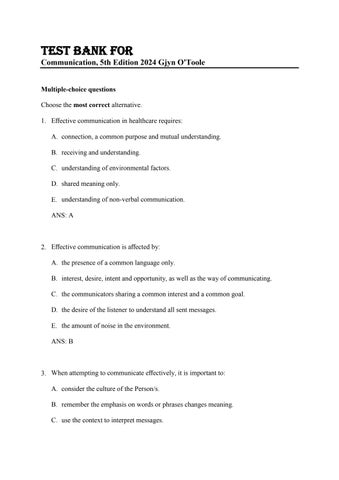
Test Bank For Communication, 5th Edition 2024 Gjyn O'Toole
Multiple-choice questions Choose the most correct alternative. 1. Effective communication in healthcare requires: A. connection, a common purpose and mutual understanding. B. receiving and understanding. C. understanding of environmental factors. D. shared meaning only. E. understanding of non-verbal communication. ANS: A
2. Effective communication is affected by: A. the presence of a common language only. B. interest, desire, intent and opportunity, as well as the way of communicating. C. the communicators sharing a common interest and a common goal. D. the desire of the listener to understand all sent messages. E. the amount of noise in the environment. ANS: B
3. When attempting to communicate effectively, it is important to: A. consider the culture of the Person/s. B. remember the emphasis on words or phrases changes meaning. C. use the context to interpret messages.
D. establish the knowledge of your audience. E. all of the above. ANS: E
4.
The overall purpose of effective communication in the health professions is to: A ensure the Person/s understands the role of the healthcare professional B establish and achieve Person-centred Care and goals. C ensure all stakeholders are satisfied with the healthcare service. D establish the power of the healthcare profession. E spend time with the Person/s. ANS: B
5. The ICF is a model that classifies functioning and: A. does not apply to communication. B. is related largely to defining health. C. indicates factors that facilitate participation and function. D. was developed in Australia for all healthcare professionals. E. considers bodily functions. ANS: C
6. Family/Person-centred Care is: A. supported by all healthcare professions. B. a new concept that developed at the beginning of this century. C. only useful when working with children and their families. D. the use of a collaborative relationship to fulfil the needs and achieve the goals of the
Person/s seeking assistance. E. the practice of only mainstream medical healthcare professions. ANS: D
7. Respect is essential when practising as a healthcare professional. A. However, you only need to respect yourself and your colleagues. B. It is the foundational factor to build a therapeutic relationship. C. It is especially important when relating to people older than you. D. However, you only need to respect those people who respect you. E. It is easier when you have been working as a healthcare professional for some time. ANS: B
8. Expressions of empathy: A. are easy for everyone and are essential from a healthcare professional. B. initially requires feelings of sympathy. C. allow the healthcare professional to fulfil their personal needs. D. require understanding and expression of the emotions or ideas of the Person/s. E. require energy and time. ANS: D
9. Healthcare professionals regularly introduce many things, but the most important is the introduction of: A. the environment and where they can find the toilets. B. the people they will meet. C. the procedures they will experience.
D. the method of cancelling an appointment if they are unable to attend. E. yourself and your role. ANS: E
10. Providing information in the healthcare professions requires: A. understanding and includes informing, instructing and explaining. B. clear understanding of the information. C. the Person/s seeking assistance to read rather than listen. D. the time of the administration personnel. E. an established therapeutic relationship. ANS: A
11. Introducing your role as a healthcare professional assists the vulnerable Person/s to: A. learn about the health service. B. learn about you and your style of communication. C. relax and feel comfortable about who you are as an individual. D. understand how you can assist them and whether you respect them. E. learn about your personal life and your hobbies. ANS: D
12. Introductions fulfil many purposes, but the most important is to: A. orient the Person/s to those around them. B. orient the Person/s to the environment. C. demonstrate interest and develop trust and rapport. D. demonstrate your level of knowledge and skill.
E. orient the Person/s to typical procedures. ANS: C
13. Consideration of emotional responses during introductions is: A. time-consuming and should be avoided until after the development of a relationship. B. an investment for future interactions; acknowledging the concerns and fears of the Person/s will save time later. C. unimportant compared with the physical needs. D. important because it will stop the Person/s seeking assistance from asking questions later that will take more time. E. appropriate and can be done by stating You don’t need to worry – we’ll look after you here. ANS: B
14. Successful provision of information may ensure that: A. the Person/s seeking assistance will feel comfortable and less vulnerable. B. the healthcare professional will have a positive relationship with the Person/s seeking assistance. C. the healthcare professional and the Person/s seeking assistance will feel relieved and have positive expectations of their therapeutic relationship. D. the Person/s seeking assistance will act and react appropriately to the events involved in seeking assistance from a healthcare professional. E. the Person/s seeking assistance is a good listener. ANS: D