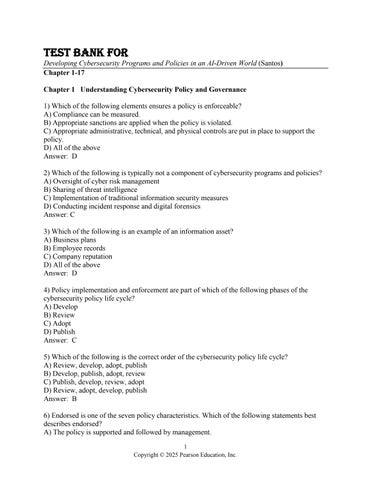
Test Bank For Developing Cybersecurity Programs and Policies in an AI-Driven World (Santos) Chapter 1-17 Chapter 1 Understanding Cybersecurity Policy and Governance 1) Which of the following elements ensures a policy is enforceable? A) Compliance can be measured. B) Appropriate sanctions are applied when the policy is violated. C) Appropriate administrative, technical, and physical controls are put in place to support the policy. D) All of the above Answer: D 2) Which of the following is typically not a component of cybersecurity programs and policies? A) Oversight of cyber risk management B) Sharing of threat intelligence C) Implementation of traditional information security measures D) Conducting incident response and digital forensics Answer: C 3) Which of the following is an example of an information asset? A) Business plans B) Employee records C) Company reputation D) All of the above Answer: D 4) Policy implementation and enforcement are part of which of the following phases of the cybersecurity policy life cycle? A) Develop B) Review C) Adopt D) Publish Answer: C 5) Which of the following is the correct order of the cybersecurity policy life cycle? A) Review, develop, adopt, publish B) Develop, publish, adopt, review C) Publish, develop, review, adopt D) Review, adopt, develop, publish Answer: B 6) Endorsed is one of the seven policy characteristics. Which of the following statements best describes endorsed? A) The policy is supported and followed by management. 1 Copyright © 2025 Pearson Education, Inc.
B) The policy is accepted by the organization’s employees. C) The policy is mandatory; compliance is measured; and appropriate sanctions are applied. D) The policy is regulated by the government. Answer: A 7) Which of the following is the outcome of policy review? A) Retirement or renewal B) Retirement or reauthorization C) Renewal or reauthorization D) None of the above Answer: B 8) Which strategy is commonly used to protect network and corporate assets in cybersecurity? A) Single-layered security approach B) Cross-boundary defense-in-depth strategy C) Random implementation of security controls D) Reliance solely on firewalls and IPS Answer: B 9) Which of the following statements is not true? A) Policies should require only what is possible. B) Policies that are no longer applicable should be retired. C) All guiding principles and corporate cultures are good. D) Guiding principles set the tone for a corporate culture. Answer: C 10) Which of the following is not one of the six key tasks of the policy development phase? A) Approve B) Write C) Communicate D) Authorize Answer: C 11) The United States Department of Homeland Security defines how many critical infrastructure sectors? A) 16 B) 14 C) 20 D) 17 Answer: A 12) Which of the following is the seminal tool used to protect both our critical infrastructure and our individual liberties? A) Information security B) Society C) Physical security D) Policy 2 Copyright © 2025 Pearson Education, Inc.
Answer: D 13) Which of the following can be defined as the shared attitudes, goals, and practices that characterize a company, corporation, or institution? A) Regulations B) Corporate culture C) Cybersecurity policy D) Guiding principles Answer: B 14) Which of the following is a collection of articles and amendments that provide a framework for the American government and define citizens’ rights? A) The Constitution B) The Torah C) Data Protection Act D) Consumer Credit Act Answer: A 15) Which layer in the defense-in-depth strategy includes firewalls, IDS/IPS devices, segmentation, and VLANs? A) Physical security B) Network security C) Perimeter security D) Application security Answer: C 16) Which of the following is another term for statutory law? A) Legislation B) Regulation C) Policy D) Governance Answer: A 17) Which of the following federal legislations, also known as the Financial Modernization Act of 1999, was created to reform and modernize the banking industry by eliminating existing barriers between banking and commerce? A) HITECH B) HIPAA C) FERPA D) GLBA Answer: D 18) Which major regulation entity within the European Union (EU) was created to maintain a single standard for data protection among all member states in the EU? A) Directive on Security of Network and Information Systems (the NIS Directive) B) EU General Data Protection Regulation (GDPR) C) European Union Agency for Network and Information Security (ENISA) 3 Copyright © 2025 Pearson Education, Inc.
D) The Consumer Credit Regulations 2010 Answer: B 19) Which key task in the policy development phase requires the authors to consult with internal and external experts, including legal counsel, human resources, compliance, cybersecurity and technology professionals, auditors, and regulators? A) Writing B) Authorizing C) Vetting D) Planning Answer: C 20) Which key task in the policy adoption phase is the busiest and most challenging task of all? A) Implementation B) Enforcement C) Monitoring D) Education Answer: A
Developing Cybersecurity Programs and Policies in an AI-Driven World (Santos) Chapter 2 Cybersecurity Policy Organization, Format, and Styles 1) Which of the following is not an example of a standard? A) Passwords must include at least one special character. B) Passwords must not include repeating characters. C) Pass phrases make good passwords. D) Passwords must not include the user’s name. Answer: C 2) Which of the following version numbers is an example of a major policy revision? A) 3.5 B) 4.0 C) 4.1 D) 5.1 Answer: B 3) Which of the following best describes the role of standards in cybersecurity policy implementation? A) Standards outline general guidelines but do not dictate mandatory requirements. B) Standards specify optional recommendations for policy implementation. C) Standards provide specifications for policy implementation and dictate mandatory requirements. D) Standards are unrelated to policy implementation and are solely focused on network infrastructure. Answer: C 4 Copyright © 2025 Pearson Education, Inc.
4) Where is the policy introduction located in a consolidated policy document? A) In a separate document B) Before the version control table C) At the beginning of the document D) After the version control table Answer: D 5) What is the purpose of the administrative notations section of a policy? A) To refer the reader to additional information B) To explain terms, abbreviations, and acronyms used in the policy C) To provide the policy version number D) To provide information about policy exceptions Answer: A 6) What is the purpose of the policy definition section? A) To provide information about policy exceptions B) To refer the reader to additional information C) To explain terms, abbreviations, and acronyms used in the policy D) To provide the policy version number Answer: C 7) Which of the following statements about standards and guidelines is true? A) Standards are mandatory, whereas guidelines are not. B) Guidelines are mandatory, whereas standards are not. C) Both standards and guidelines are mandatory. D) Neither standards nor guidelines are mandatory. Answer: A 8) Which of the following procedure formats is best suited when there is a decision-making process associated with a task? A) Simple Step B) Flowchart C) Hierarchical D) Graphic Answer: B 9) Which of the following best describes a baseline? A) Specifications for implementation of a policy B) Instructions on how a policy is carried out C) Application of a standard to a specific category or grouping D) Teaching tools that help people conform to a policy Answer: C 10) Which of the following best describes a procedure? A) Application of a standard to a specific category or grouping B) Instructions on how a policy is carried out 5 Copyright © 2025 Pearson Education, Inc.