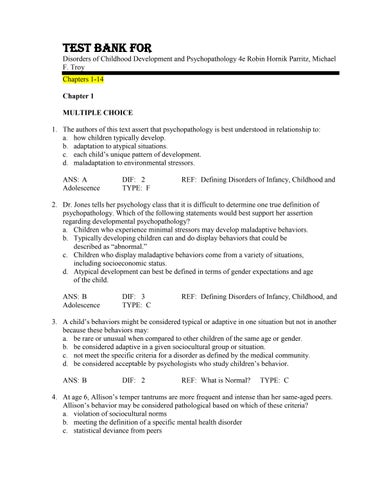
Test Bank For Disorders of Childhood Development and Psychopathology 4e Robin Hornik Parritz, Michael F. Troy Chapters 1-14 Chapter 1 MULTIPLE CHOICE 1. The authors of this text assert that psychopathology is best understood in relationship to: a. how children typically develop. b. adaptation to atypical situations. c. each child’s unique pattern of development. d. maladaptation to environmental stressors. ANS: A Adolescence
DIF: 2 TYPE: F
REF: Defining Disorders of Infancy, Childhood and
2. Dr. Jones tells her psychology class that it is difficult to determine one true definition of psychopathology. Which of the following statements would best support her assertion regarding developmental psychopathology? a. Children who experience minimal stressors may develop maladaptive behaviors. b. Typically developing children can and do display behaviors that could be described as “abnormal.” c. Children who display maladaptive behaviors come from a variety of situations, including socioeconomic status. d. Atypical development can best be defined in terms of gender expectations and age of the child. ANS: B Adolescence
DIF: 3 TYPE: C
REF: Defining Disorders of Infancy, Childhood, and
3. A child’s behaviors might be considered typical or adaptive in one situation but not in another because these behaviors may: a. be rare or unusual when compared to other children of the same age or gender. b. be considered adaptive in a given sociocultural group or situation. c. not meet the specific criteria for a disorder as defined by the medical community. d. be considered acceptable by psychologists who study children’s behavior. ANS: B
DIF: 2
REF: What is Normal?
TYPE: C
4. At age 6, Allison’s temper tantrums are more frequent and intense than her same-aged peers. Allison’s behavior may be considered pathological based on which of these criteria? a. violation of sociocultural norms b. meeting the definition of a specific mental health disorder c. statistical deviance from peers
d. major emotional maladjustment ANS: A
DIF: 2
REF: What is Normal?
TYPE: A
5. Dr. Vance works with all of his clients to identify their strengths and weaknesses and develops a plan for them to be able to function at the highest level possible. This is known as ________ adaptation. a. adequate b. foundational c. superior d. optimal ANS: D
DIF: 1
REF: The Role of Values
TYPE: A
6. Sameroff (1993) stated that “all life is characterized by disturbance that is overcome, and that only through disturbance can we advance and grow.” How does this statement further the understanding of developmental psychopathology? a. It provides a basis for defining psychopathology in youth. b. It normalizes the fact that most children can and do face challenges. c. It creates a basis for understanding why we must provide funding for children’s mental health. d. It supports the fact that in order to overcome adversity all humans need support. ANS: B
DIF: 3
REF: The Role of Values
TYPE: C
7. The major difference between psychopathology and developmental psychopathology is the: a. likelihood that children’s development will be negatively impacted. b. role of culture in understanding deviant behavior. c. understanding of how family values impact the development of maladaptive behavior. d. belief that most deviant behavior is innate. ANS: A DIF: 3 Developmental Psychopathology
REF: Definitions of Psychopathology and TYPE: C
8. Dr. Uyenco wants to know how many new cases of autism are diagnosed each year in her particular state. Which type of data should she access? a. epidemiology b. prevalence c. identification rate d. incidence ANS: D Adolescence
DIF: 2 TYPE: F
REF: Rates of Disorders in Infancy, Childhood, and
9. Tolan and Dodge (2005) have proposed a four-part model for a comprehensive mental health system that serves children and their families. Based on what is known about existing barriers to services, which of the following components would likely be a part of this model? a. access to effective emergency care to treat crisis situations
b. preventive care provided in natural settings such as schools or daycares c. emphasis on research-based treatments that address the cultural majority d. an expansion of psychiatric hospitals that are equipped to handle long-term inpatient care ANS: B DIF: 3 Accessibility of Care TYPE: C
REF: Allocation of Resources, Availability and
10. Children in Africa, Latin America, and Eastern Europe are less likely to have access to quality mental health services. These countries may be classified as: a. uneducated. b. poor. c. resource-poor. d. rural. ANS: C TYPE: F
DIF: 1
REF: The Globalization of Children’s Mental Health
TRUE/FALSE 1. In order to accurately understand psychopathology in children, it is important to distinguish between “normal” and “abnormal” development. ANS: T Adolescence
DIF: 1 TYPE: F
REF: Defining Disorders of Infancy, Childhood, and
2. In some Native American tribes, it is considered a sign of disrespect to look at an elder when talking to them. This is an example of a sociocultural norm. ANS: T TYPE: A
DIF: 2
REF: What is Normal?
3. Despite early abuse and neglect, 10-year-old Joshua has adapted well to his new foster family, has made good friends at school, and is excelling in reading and soccer. Joshua’s situation would most likely be an example of adequate adaptation. ANS: F
DIF: 2
REF: The Role of Values
TYPE: A
4. More current definitions of psychopathology include both extremes of behavior (too little or too much). ANS: T
DIF: 2
REF: The Role of Values
TYPE: F
5. Dr. Andrews wants to study how many children under the age of 5 in the United States have been diagnosed with autism over the past 10 years. In order to do this, he is most likely to use a random sampling of the general population to estimate the prevalence of autism.
ANS: T DIF: 2 REF: Rates of Disorders in Infancy, Childhood, and Adolescence TYPE: A 6. The fact that many children who need mental health care don’t receive it is primarily based on denial of mental health treatment. ANS: F DIF: 2 REF: Allocation of Resources, Availability and Accessibility of Care
TYPE: F
7. Patrick’s parents are reluctant to have him see a psychologist because they’re afraid other family members will think they are “bad” parents. Their reluctance is most closely related to lack of resources in their local community. ANS: F TYPE: A
DIF: 3
REF: The Globalization of Mental Health
FILL IN THE BLANK 1. According to the authors of this text, the understanding of developmental psychopathology must be centered in what is _______ for a particular child’s development. ANS: typical, normal DIF: 2 REF: Defining Disorders of Infancy, Childhood, and Adolescence
TYPE: F
2. Dr. Wang has diagnosed Emma with separation anxiety disorder based on her presenting symptoms, but also has considered how these symptoms impact her quality of life. Dr. Wang is using the ________ aspect of psychopathology. ANS: mental health definition REF: What is Normal?
DIF: 3 TYPE: A
3. The authors of this text believe that all children should have the support they need to reach their full potential, in spite of challenges they may face. This is known as ________. ANS: optimal adaptation REF: The Role of Values
DIF: 2 TYPE: F
4. The example of the Hmong families and their unmarried children who continue to live at home highlights the fact that ________ are critical in understanding developmental psychopathology. ANS: sociocultural norms REF: The Role of Values
DIF: 2 TYPE: A
5. Dr. Schwiesow is studying how often schizophrenia is diagnosed in the U.S. population, as well as states where there are more children who are diagnosed with attention deficit/hyperactivity disorder. His field of study is most likely ________.
ANS: developmental epidemiology DIF: 2 REF: Rates of Disorders in Infancy, Childhood, and Adolescence
TYPE: A
6. ________ are those factors that potentially prevent individuals from receiving effective treatment for mental health issues. ANS: Barriers to care DIF: 1 REF: Allocation of Resources, Availability, and Accessibility of Care
TYPE: F
7. ________ youth are more likely to have difficulty accessing appropriate and effective treatment and prevention programs related to mental health. ANS: Minority, Disadvantaged DIF: 1 REF: Allocation of Resources, Availability, and Accessibility of Care
TYPE: F
8. The Tolan and Dodge (2005) model of a comprehensive mental health system includes access to mental health services, services provided in primary care settings, preventative care for high-risk children, and ________. ANS: attention to cultural context and cultural competence DIF: 3 REF: Allocation of Resources, Availability and Accessibility of Care
TYPE: F
SHORT ANSWER ESSAY 1. Identify the pros and cons of using the statistical deviance model of abnormality. Include a brief definition. ANS: Definition – infrequency of emotions, cognitions, and/or behaviors; too much or too little of these Pros – provides a point of reference for understanding psychopathology; how different is this behavior than others their age, gender, race, etc. Cons – doesn’t acknowledge the role of culture and values in understanding statistical rarity; may focus of the cultural majority REF: What is Normal? 2. Define and provide an example of the sociocultural perspective on abnormality. How does this approach differ from the statistical deviance model? ANS: Definition – behavior is viewed by how it relates to age, gender, or culture. Example – a child who is acting a particular way based on expectations of the family (parenting styles, cultural expectations), neighborhood (aggression in a dangerous neighborhood), or school (value of education, carrying weapons to protect self), etc.