Test Bank For Essential Biochemistry 5th Edition By Charlotte W. Pratt, Kathleen Cornely Chapter 1-22 Chapter 1: The Chemical Basis of Life Question type: Multiple Choice 1) Which of the following is the most abundant element in the human body? A) B) C) D) E)
nitrogen carbon oxygen phosphorous none of the above
Answer: B Difficulty: Easy Section Reference: 1-2 Learning Objective: Identify the major classes of biological molecules
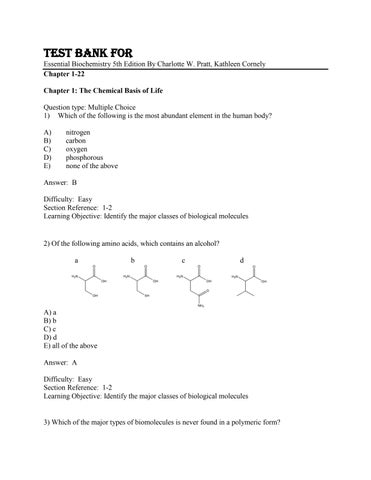
2) Of the following amino acids, which contains an alcohol? a
b
c
d
A) a B) b C) c D) d E) all of the above Answer: A Difficulty: Easy Section Reference: 1-2 Learning Objective: Identify the major classes of biological molecules
3) Which of the major types of biomolecules is never found in a polymeric form?
A) amino acids B) carbohydrates C) nucleotides D) lipids E) none of the above Answer: D Difficulty: Medium Section Reference: 1-2 Learning Objective: Identify the major classes of biological molecules
4) Which of the following biopolymers is correctly paired with the bond that forms between the monomers? A) protein: ester bond B) polysaccharide: glycosidic bond C) DNA: phosphate bond D) RNA: phosphate bond E) all of the above Answer: B Difficulty: Hard Section Reference: 1-2 Learning Objective: Identify the major classes of biological molecules
5) Which of the biopolymers is correctly paired with its major function? A) protein: information encoding B) nucleic acids: energy storage C) lipids: information encoding D) polysaccharide: energy storage E) none of the above Answer: D Difficulty: Medium Section Reference: 1-2 Learning Objective: Identify the major classes of biological molecules
6) What functional groups are present in the following molecule?
A) amine and carboxylic acid B) amine, ketone and carboxylic acid C) amine, amide and carboxylic acid D) alcohol, amine, amide and carboxylic acid E) none of the above are correct Answer: C Difficulty: Medium Section Reference: 1-2 Learning Objective: Identify the major classes of biological molecules
7) Which elements are found in simple carbohydrates? A) carbon, hydrogen and oxygen B) carbon, hydrogen, oxygen and nitrogen C) carbon, hydrogen, oxygen and phosphorous D) carbon, hydrogen, oxygen and sulfur E) none of the above Answer: A Difficulty: Medium Section Reference: 1-2 Learning Objective: Identify the major classes of biological molecules
8) Entropy is used to measure _____. A) free energy B) heat content C) temperature D) randomness E) all of the above Answer: D Difficulty: Easy
Section Reference: 1-3 Learning Objective: Explain how enthalpy, entropy, and free energy apply to biological systems
9) A spontaneous process always has _____. A) G < 0 B) G > 0 C) H < 0 D) H > 0 E) none of the above Answer: A Difficulty: Easy Section Reference: 1-3 Learning Objective: Explain how enthalpy, entropy, and free energy apply to biological systems
10) If a reaction at 37C has a H of 23 kJ/mol and a S of 337 J/Kmol, what is the G for the reaction? A) 65 kJ/mol B) -47 kJ/mol C) 18 kJ/mol D) -19 kJ/mol E) none of the above Answer: B Difficulty: Hard Section Reference: 1-3 Learning Objective: Explain how enthalpy, entropy, and free energy apply to biological systems
11) An exergonic process _____. A) occurs without the addition of free energy B) has a G < 0 C) is spontaneous D) will have more products than reactants at equilibrium E) all of the above Answer: E
Difficulty: Medium Section Reference: 1-3 Learning Objective: Explain how enthalpy, entropy, and free energy apply to biological systems
12) Which of the following molecules contains the most oxidized form of carbon? A) acetaldehyde B) ethanol C) acetic acid D) ethylene E) carbon dioxide Answer: E Difficulty: Easy Section Reference: 1-3 Learning Objective: Explain how enthalpy, entropy, and free energy apply to biological systems
13) If the following two reactions were coupled, what would be the G for the overall exergonic reaction? ATP + H2O ADP + Pi Glucose + Pi glucose-1-phosphate + H2O
G = -31 kJ/mol G = 21 kJ/mol
A) -52 kJ/mol B) -10 kJ/mol C) 10 kJ/mol D) 52 kJ/mol E) none of the above Answer: B Difficulty: Medium Section Reference: 1-3 Learning Objective: Explain how enthalpy, entropy, and free energy apply to biological systems
14) A gaseous mixture of hydrogen, water, ammonia and methane can produce which of the biomolecules when exposed to an electrical discharge (such as lightning)? A) carbohydrates B) nucleotides C) lipids