TEST BANK FOR Essential Environment The Science Behind the Stories, 7th edition Jay H Withgott Matthew Laposata Chapter 1-18 Chapter 1 Science and Sustainability: An Introduction to Environmental Science 1.1 Multiple Choice Questions
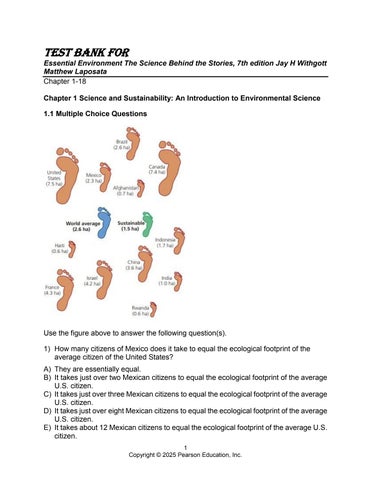
Use the figure above to answer the following question(s). 1) How many citizens of Mexico does it take to equal the ecological footprint of the average citizen of the United States? A) They are essentially equal. B) It takes just over two Mexican citizens to equal the ecological footprint of the average U.S. citizen. C) It takes just over three Mexican citizens to equal the ecological footprint of the average U.S. citizen. D) It takes just over eight Mexican citizens to equal the ecological footprint of the average U.S. citizen. E) It takes about 12 Mexican citizens to equal the ecological footprint of the average U.S. citizen. 1 Copyright © 2025 Pearson Education, Inc.
Answer: C Diff: 1 Topic/Section: 1.5 Sustainability And Our Future Learning Outcome: 1.4 2) If everyone on the planet had an ecological footprint the size of the average citizen of the United States, then . A) we would have 50% more food to go around B) we would be able to provide for everyone without much difficulty by using the 50% of the land currently not being used for agriculture C) we would need at least two more planet Earths to feed and support everyone D) we could support 50% more people on our planet E) about 50% of the people would starve Answer: C Diff: 2 Topic/Section: 1.5 Sustainability And Our Future Learning Outcome: 1.4 3) The U.S. average footprint is about footprint.
times larger than the average world
A) 2 B) 2.5 C) 3 D) 5 E) 6.7 Answer: C Diff: 3 Topic/Section: 1.5 Sustainability And Our Future Learning Outcome: 1.4 4) The average footprint per person has increased from 2.2 to 2.6 since 2008, and the footprints of many developing nations, such as India and China, have also increased. This means that . A) our collective lifestyle is even more unsustainable than before B) our collective lifestyle is slightly more sustainable than before C) the ability of the planet to sustain human beings has increased D) some nations no longer have a measurable footprint E) the populations of both India and China have decreased since 2008 Answer: A Diff: 2 Topic/Section: 1.5 Sustainability And Our Future Learning Outcome: 1.4 5) Geothermal energy, wind, and solar radiation are all examples of A) nonrenewable natural resources B) inexhaustible renewable natural resources 2 Copyright © 2025 Pearson Education, Inc.
.
C) biotic environmental factors D) exhaustible renewable natural resources E) biodegradable materials Answer: B Diff: 2 Topic/Section: 1.1 Our Island, Earth Learning Outcome: 1.2 6) Nonrenewable natural resources include all of the following EXCEPT: A) coal. B) crude oil. C) minerals. D) wind. E) natural gas. Answer: D Diff: 1 Topic/Section: 1.1 Our Island, Earth Learning Outcome: 1.2 7) Ecosystem services
.
A) contribute to keeping ecosystems productive B) are not necessary to sustainable systems C) are economically valuable services provided by natural systems D) are valuable to natural systems but not to human-created systems E) are required to rebalance natural systems that we have disturbed Answer: C Diff: 1 Topic/Section: 1.1 Our Island, Earth Learning Outcome: 1.2 8) Today (2024), there are about
.
A) 5.35 billion people on Earth, the same as for the past 6 years B) 9 billion people on Earth C) 10 billion people on Earth D) 8 billion people on Earth E) 2% fewer people on Earth than in 2010 Answer: D Diff: 1 Topic/Section: 1.1 Our Island, Earth Learning Outcome: 1.3 9) Global population is projected to be nearly
in 2050.
A) 7 billion B) 8 billion C) 9 billion D) 10 billion 3 Copyright © 2025 Pearson Education, Inc.
E) 11 billion Answer: D Diff: 2 Topic/Section: 1.1 Our Island, Earth Learning Outcome: 1.3 10) To determine your specific impacts on the environment, you can
.
A) measure local air pollution and its impacts on your health B) calculate the biodiversity of your local community C) determine your current water pollution impact D) calculate your ecological footprint E) measure the volume and type of all the wastes you contribute to the municipal waste stream Answer: D Diff: 1 Topic/Section: 1.1 Our Island, Earth Learning Outcome: 1.4 11) By studying ancient civilizations, such as the Greek and Roman empires and the Angkor civilization of Southeast Asia, historians have concluded that these civilizations declined partly because of . A) sustainable practices B) overabundance of resources C) floods D) environmental degradation due to unsustainable use of resources E) fires Answer: D Diff: 2 Topic/Section: 1.1 Our Island, Earth Learning Outcome: 1.3 12) Solutions to environmental problems
.
A) can be implemented only by scientists B) must be designed with sustainable goals C) must be on a local scale D) must be short term E) are best designed and discussed in the political arena Answer: B Diff: 1 Topic/Section: 1.1 Our Island, Earth Learning Outcome: 1.10a 13) Imagine a scenario where a small island nation, heavily reliant on tourism for its economy, faces a dilemma. The government wants to promote economic growth by attracting more tourists, but environmentalists argue that increased tourism will exacerbate resource consumption and ecological degradation. The government must balance economic development with environmental sustainability. In the given 4 Copyright © 2025 Pearson Education, Inc.
situation, which concept could the government use to evaluate the environmental impact of increasing tourism? A) ecological footprint B) greenhouse gas emissions C) biodiversity index D) energy efficiency rating E) water consumption per capita Answer: A Diff: 1 Topic/Section: 1.1 Our Island, Earth Learning Outcome: 1.9 14) What does the term "overshoot" refer to in the context of resource consumption? A) reducing waste through recycling initiatives B) achieving sustainable resource management practices C) balancing economic growth with environmental conservation D) using renewable resources faster than they are replenished E) promoting green technologies for energy production Answer: D Diff: 2 Topic/Section: 1.1 Our Island, Earth Learning Outcome: 1.9 15) How do the ecological footprints of residents from industrialized nations compare to those from industrializing nations? A) Residents of industrialized nations have smaller ecological footprints. B) Residents of industrialized nations have larger ecological footprints. C) Ecological footprints are similar across both types of nations. D) Residents of industrialized nations have no ecological footprints. E) Residents of industrialized nations have more sustainable lifestyles. Answer: B Diff: 2 Topic/Section: 1.1 Our Island, Earth Learning Outcome: 1.9 16) Which of the following best describes the practice of environmental science? A) highly specialized and focused B) integrative and interdisciplinary C) abstract and theoretical D) theoretical and controversial E) elitist and unnecessary Answer: B Diff: 1 Topic/Section: 1.2 The Nature of Environmental Science Learning Outcome: 1.1 5 Copyright © 2025 Pearson Education, Inc.