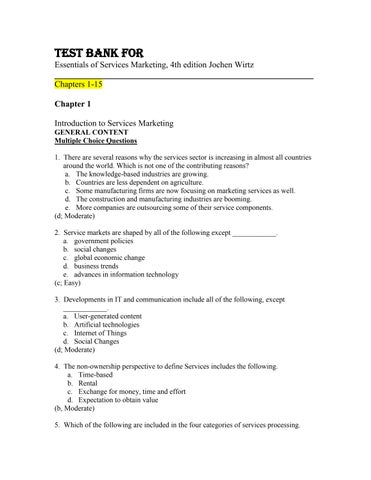
Test bank For Essentials of Services Marketing, 4th edition Jochen Wirtz _____________________________________________________________ Chapters 1-15 Chapter 1 Introduction to Services Marketing GENERAL CONTENT Multiple Choice Questions 1. There are several reasons why the services sector is increasing in almost all countries around the world. Which is not one of the contributing reasons? a. The knowledge-based industries are growing. b. Countries are less dependent on agriculture. c. Some manufacturing firms are now focusing on marketing services as well. d. The construction and manufacturing industries are booming. e. More companies are outsourcing some of their service components. (d; Moderate) 2. Service markets are shaped by all of the following except ____________. a. government policies b. social changes c. global economic change d. business trends e. advances in information technology (c; Easy) 3. Developments in IT and communication include all of the following, except ____________. a. User-generated content b. Artificial technologies c. Internet of Things d. Social Changes (d; Moderate) 4. The non-ownership perspective to define Services includes the following. a. Time-based b. Rental c. Exchange for money, time and effort d. Expectation to obtain value (b, Moderate) 5. Which of the following are included in the four categories of services processing.
a. People processing b. Possession processing c. Mental stimulus processing d. Information processing e. All of the above (e, Easy) 6. In order to design and implement effective service processes, which of the following are important considerations. a. Operational inputs and outputs can vary b. Customers are often involved in co-production c. Demand and capacity need to be balanced. d. a & b e. a, b, & c (e, Moderate) 7. Which of the following is an example of co-production? a. Withdrawing from an ATM b. Easting fast food c. Touring an aquarium d. Selling items on eBay e. Buying a stereo (a, Challenging) 8. 8. Links in the Service-Profit Chain include all of the following except a. Customer loyalty, b. Revenue growth c. Service quality d. Employee loyalty e. Top management leadership (b, Moderate) 9. The three additional Ps of services marketing that extend the original four Ps of marketing are _____________, _____________, and _____________. a. product; price; place; promotion b. prospects; process; people; promotion c. physical environment; process; people d. prosperity; process; people; promotion e. physical environment; prosperity; planning; process (c; Moderate)
10. The service framework for developing effective service strategies excludes _________________. a. understanding service products, consumers and markets b. managing the competitive landscape c. applying the 4 Ps of marketing to services d. designing and managing the customer interface e. developing customer relationships (b; Moderate)
True/False 11. Services account for 65% to 80% of the GDP in most developed nations. (True, Easy) 12. The dramatic development of Government policies is the most important force transforming service markets (False, Easy) 13. Services require a form of acquisition through which customers can obtain benefits. (False, Moderate) 14. Service production and consumption are always simultaneous (True, Difficult) 15. One way of avoiding turning customers away or having them wait is to use, dynamic pricing and reservations. (True, Difficult) 16. HR is often seen from a strategic perspective than a staff function (False, Easy) 17. The service-profit chain includes collaboration between marketing, operations, IT and HR (True, Easy) 18. Service distribution can take place through physical channels only (False, Easy) 19. Customers may go beyond the money to assess how much time and effort are involved in service consumption (True, Easy)
20. Despite advances in technology, many services will always need direct interaction between customers and service employees. (True, Easy) Short Answer 21. What are the five broad categories within the non-ownership framework? Rented goods, defined space and place rentals, labor and expertise rental, access to shared physical environments, and systems and networks: access and usage. (Moderate) 22. Define services. Services are economic activities offered by one party to another. Often time-based performances are used to bring about desired results in recipients themselves or in objects or other assets for which purchasers have responsibility. In exchange for their money, time and effort, customers expect to obtain value from access to good, labor, professional skills, facilities, networks and systems. However, they do not normally take ownership of any of the physical elements involved. (Moderate) 23. What are the eight common differences between products and services? 1) Most service products cannot be inventoried, 2) intangible elements usually dominate value creation, 3) services are often difficult to visualize and understand, 4) customers may be involved in co-production, 5) people may be part of the service experience, 6) operational inputs and outputs tend to vary more widely, 7) the time factor frequently assumes great importance, and 8) distribution may take place through non-physical channels. (Challenging) 24. Provide an example of a service that lies at each end of the tangible-dominant to intangible-dominant spectrum. Low—tailored clothing High—Internet banking (Moderate) 25. What are the three vital roles of promotion and education? Providing needed information and advice, persuading target customers of the merits of a specific brand or service products, and encouraging customers to take action at specific times. (Moderate)
Essay 26. Give an example of how the Internet is changing the face of service industries. The Internet is transferring power from suppliers to customers, particularly in consumer markets. For example, travel agencies are being replaced by Web sites like Orbitz, Travelocity, and Priceline. These sites allow customers to shop around for the best prices with greater ease. They have in effect changed the distribution system to favor the consumer. (Moderate) 27. How can firm develop effective marketing strategies? Firms need to start first understanding why service the service sector is developing so fast, and what forces are driving it. Then firms must understand consumer need and behavior. They can do this using the three-stage model of service consumption to explore how customer make decision, respond to services encounters and evaluate service performance. After that, they need to position their offerings to ensure commercial viability. The position must be so distinctive and defensible that the firm can attract a sufficient volume of business from the target customers. The next step is to apply the 4 Ps of traditional marketing into services, with the understanding that services require attention to different elements because services are different from goods. At the same time, firms have to manage the interface between the customers and the service firms. Hence, there are 3 additional Ps to be managed – process, which includes balancing demand and capacity, physical environment, and people. Finally, in order to be profitable, firms need to build relationships with customers to retain their loyalty, handle customer feedback and have service recovery systems in place, make sure that firms are productivity but maintain standards of service excellence and have a culture that focuses the firm on the service profit chain, while integrating the three key functions of marketing, operations and human resources. (Moderate)
APPLICATION CONTENT Multiple Choice Questions 28. A movie theater seat is an example of _____________. a. renting durable goods b. closely engaging customers in the service process c. renting portions of a larger physical entity d. the centrality of time to services e. differences in customer choice criteria (c; Moderate)