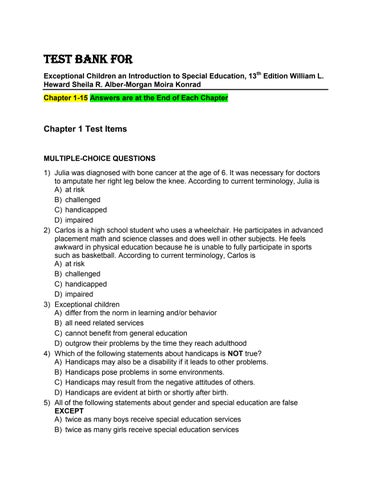
Test Bank For Exceptional Children an Introduction to Special Education, 13th Edition William L. Heward Sheila R. Alber-Morgan Moira Konrad Chapter 1-15 Answers are at the End of Each Chapter
Chapter 1 Test Items
MULTIPLE-CHOICE QUESTIONS 1) Julia was diagnosed with bone cancer at the age of 6. It was necessary for doctors to amputate her right leg below the knee. According to current terminology, Julia is A) at risk B) challenged C) handicapped D) impaired 2) Carlos is a high school student who uses a wheelchair. He participates in advanced placement math and science classes and does well in other subjects. He feels awkward in physical education because he is unable to fully participate in sports such as basketball. According to current terminology, Carlos is A) at risk B) challenged C) handicapped D) impaired 3) Exceptional children A) differ from the norm in learning and/or behavior B) all need related services C) cannot benefit from general education D) outgrow their problems by the time they reach adulthood 4) Which of the following statements about handicaps is NOT true? A) Handicaps may also be a disability if it leads to other problems. B) Handicaps pose problems in some environments. C) Handicaps may result from the negative attitudes of others. D) Handicaps are evident at birth or shortly after birth. 5) All of the following statements about gender and special education are false EXCEPT A) twice as many boys receive special education services B) twice as many girls receive special education services
C) three times as many boys receive special education services D) an equal number of boys and girls receive special education services 6) What percentage of the school-age population consists of students with disabilities in special education? A) 2.1% B) 5.5% C) 9.5% D) 30.3% 7) Which of the following is the largest disability category in special education? A) Autism B) Emotional disturbance C) Intellectual disabilities D) Specific learning disabilities 8) Which of the following reflects the percentage of students affected with a secondary disability? A) 25% B) 10% C) 50% D) 40% 9) Travis is a third-grade student with an intellectual disability. He has just been placed in Mrs. Kinard’s third-grade class. Students in his class are learning their multiplication facts. Travis is eager to participate in class but instead of allowing him to do the same activity as the other students, Mrs. Kinard gives him a coloring worksheet that she obtained from a colleague who teaches kindergarten. Which of the disadvantages of labeling is exemplified by her actions? A) The label is being used to explain his behavior. B) The label has contributed to the expenditure of greater amounts of money. C) The label has caused her to ridicule and reject Travis. D) The label has caused her to have lower expectations and apply different treatments. 10) Prior to the 1970s, . A) students with disabilities were routinely included in general education classes B) students with disabilities had individualized education plans C) students with disabilities were included in extracurricular activities D) students with disabilities could not enroll in public schools in many states 11) PARC versus Commonwealth of Pennsylvania (1972) granted a free appropriate public education to . A) all students with disabilities B) students with intellectual disabilities C) students with speech and language impairments
D) students who were previously deemed unable to benefit from instruction 12) Which principle of IDEA states that no child with a disability can be excluded from a free appropriate public education? A) Zero reject B) Due process C) Mainstreaming D) Full inclusion 13) Hector and his family came to the United States from Cuba last year. Hector speaks only Spanish and seems unable to learn English despite extended help from an E LL teacher. He is failing all subjects in second grade except for art and physical education. He was recently evaluated for the possibility of an intellectual disability. The school psychologist administered an intelligence test in Spanish. Scores indicate that Hector has significant cognitive delays. Based on the findings, the IEP team is recommending that Hector receive special education services as a student with an intellectual disability. Did Hector receive a nondiscriminatory evaluation as required by IDEA? A) No; only one test was administered. B) No; the psychologist was a stranger to Hector. C) Yes; the testing was done in Hector’s home language. D) Yes; the IEP team recommended that Hector receive services. 14) All of the following are examples of related services EXCEPT . A) therapeutic recreation services B) transportation to scheduled doctor visits C) speech and language services to prevent communicative problems D) orientation and mobility services for students who are blind or partially sighted. 15) Early intervention services . A) are also for children who are gifted and talented B) are funded by ADA C) are only mandated for infants and toddlers experiencing developmental delays D) are prescribed and implemented according to an individualized family service plan (IFSP) 16) Amelia is a student with autism who does not speak. Instead, she types what she wants to say into a device that converts the text to speech. The device helps Amelia to express her desires and needs. This is an example of . A) assistive technology B) an instructional strategy C) interdisciplinary services D) universal design for learning 17) According to current research, which of the following is NOT an outcome associated with fluency? A) Greater endurance B) Improved social relationships
C) Better retention D) Improved application and generalization 18) Which of the following court cases sought extended school year services for students with disabilities who regressed during the usual school breaks? A) Brown versus Board of Education (1954) B) Armstrong versus Kline (1979) C) Stuart versus Nappi (1978) D) Timothy W. versus Rochester School District (1989) 19) Which of the following court rulings declared that school districts could not be compelled to provide costly related services if a student with a disability made adequate progress in general education without those services? A) Honig versus Doe B) Stuart versus Nappi C) Armstrong versus Kline D) Board of Education of the Hendrick Hudson Central School District versus Rowley 20) According to the IDEA amendments of 1997, a manifestation determination hearing must be conducted . A) each time a student with a disability is suspended B) only when a student with a disability is recommended for expulsion C) when a student with a disability has been suspended in excess of 10 days D) when a student has a suspension for at least a school week (5 days) 21) Isaac is a student with a disability who belongs to a neighborhood gang. He is involved in an argument with another student in math class. Later that night, Isaac attended a school-sponsored football game. Some students reported that Isaac had a gun and was threatening to shoot the student he argued with earlier. Isaac was removed from the football game by authorities. Members of the IEP team decide to place Isaac at an alternative school for 45 days. Were Isaac’s rights violated? A) No; the IEP made the decision to remove Isaac so multiple perspectives were considered. B) No; schools have the right to remove students who bring weapons to school to an interim alternative placement C) Yes; a student with a disability cannot be removed for more than 10 days. D) Yes; a manifestation determination hearing must be conducted before Isaac can be removed. 22) Programs for students who are gifted and talented . A) are chronically underfunded B) are supported with funds from IDEA C) receive an equal share of the K–12 education budget D) are supported with funds from higher education agencies 23) In what way is IDEA and Section 504 of the Rehabilitation Act of 1973 alike? A) They are both civil rights laws.
B) They both provide funds for people with disabilities. C) They both require placement in the most integrated setting possible. D) They both require public schools and colleges to provide barrier-free environments. 24) Which of the following is NOT defined as a major life activity in the Americans with Disabilities Act? A) Caring for oneself B) Enjoying leisure time C) Communicating D) Working 25) The ultimate goal of No Child Left Behind is . A) to identify poorly performing schools B) that all teachers will be licensed by 2014 C) to reduce funding to poorly performing schools D) that all children will be proficient in reading and math by 2014 26) The Every Student Succeeds Act focuses on challenging content standards in reading, math, and . A) special education B) physical education C) social studies D) science 27) Which of the following is a characteristic of primary prevention? A) It is designed to eliminate the effects of risk factors on those so exposed. B) It is designed to reduce the number of new cases of disabilities. C) It is designed for people who are already affected by a problem. D) It is designed to prevent the effects of a disability from worsening. 28) Maurice has cerebral palsy and is physically unable to speak. His teacher helps him to learn to use a communication board. What type of intervention is this? A) Compensatory B) Preventive C) Rehabilitative D) Remedial 29) Ms. Frost gives oral reading fluency tests every week to all her first graders. The lowest-performing students receive special reading tutoring until they are reading at a minimally acceptable level. What type of intervention is this? A) Compensatory B) Intensive C) Preventive D) Remedial 30) Which is NOT a defining feature of special education? A) Intensive
B) Guided by teacher performance C) Goal directed D) Individualized ESSAY QUESTIONS 1) Compare and contrast the terms disability, handicap, and impairment. 2) List the dimensions (defining characteristics) of special education and describe/explain at least four of them. 3) Discuss the history of special education from the early 1900s to the present. Be sure to include landmark court cases in your discussion. 4) Do you think that labels help or hurt students with disabilities? Support your answer with examples. 5) Compare and contrast IDEA, Section 504 of the Rehabilitation Act of 1973, and the Americans with Disabilities Act.
Chapter 1 Test Answer Key ANSWER KEY: Chapter 1 Test (Multiple Choice) 1) D 2) C 3) A 4) D 5) A 6) C 7) D 8) D 9) D 10) D 11) D 12) A 13) A 14) B 15) D 16) A 17) B 18) B 19) D 20) C 21) B 22) A 23) C 24) B 25) D 26) D 27) B 28) A 29) D 30) B
ANSWER KEY: Chapter 1 Test (Essay) 1) Compare and contrast the terms disability, handicap, and impairment. Answers will vary but all three terms describe limitations. An impairment refers to the loss of, or reduced function of, a body part or major organ. A disability is present when an impairment restricts a person’s ability to perform certain tasks. A handicap is present when a person who is impaired or disabled experiences a problem with the environment, which may include the attitudes of others. 2) List the dimensions (defining characteristics) of special education and describe/explain at least four of them. Answers will vary but should include four of the following as listed in Table 1.5:
Individually planned -
learning goals and objectives selected for each student based on assessment results and input from parents and students
-
teaching methods and instructional materials selected and/or adapted for each student
-
setting(s) where instruction will occur determined relative to opportunities for student to learn and use targeted skills
Specialized -
sometimes involves unique or adapted teaching procedures seldom used in general education (e.g., constant time delay, token reinforcement, selfmonitoring)
-
incorporates a variety of instructional materials and supports—both natural and contrived—to help student acquire and use targeted learning objectives
-
related services (e.g., audiology, physical therapy, etc.) and technology provided as needed
Intensive -
explicit instruction presented with attention to detail, precision, structure, and clarity
-
high rates of active student engagement, repeated practice and systematic feedback
Goal-directed -
purposeful instruction intended to help student achieve the greatest possible personal self-sufficiency and success in present and future environments
-
student’s attainment of learning outcomes determine the value or effectiveness of instruction
Research-based methods
-
recognition that not all teaching approaches are equally effective
-
instructional programs and teaching procedures selected on basis of research support
Guided by student performance -
results of frequent and direct measures of student learning used to inform modifications in instruction
-
systematic, ongoing monitoring of student progress
3) Discuss the history of special education from the early 1900s to the present. Be sure to include landmark court cases in your discussion. Answers will vary but should include the following points:
In the early 1900s, students with disabilities were excluded from public schools and negative labels were used as descriptors. Prior to the 1970s, public schools in many states could legally exclude students with disabilities. Services were provided in segregated settings when schools began to accept a measure of responsibility for students with disabilities. 1954—Changes began with Brown versus Board of Education of Topeka. Supreme Court ruled that education must be available to all children on equal terms. Parents of students with disabilities wanted equal protection for their children. 1972—In PARC versus Commonwealth of Pennsylvania, the court ruled that students with intellectual disabilities were entitled to a free, appropriate public education. 1975—Congress passed P.L. 94-142 granting a free, appropriate public education to all students with disabilities. This law has been amended many times, with the most recent reauthorization in 2004. 4) Do you think that labels help or hurt students with disabilities. Support your answer with examples. Answers will vary but ―helps‖ may include:
first step in dealing with a disability
may lead to acceptance of exceptional children by peers
helps professionals communicate regarding research findings
funding often based on specific category labels
advocacy groups can spur legislative action (current examples)
helps make the exceptional children’s needs more visible (e.g., Jerry’s kids)
Answers may vary but ―hurts‖ may include:
doesn’t help teachers know how or what to teach
focus on deficits
may lead to stigmatization
may negatively affect self-esteem
may cause others to hold low expectations for the exceptional child
may acquire role of explanatory construct, dismissing need to remediate
diminishes uniqueness of each child
suggests a problem with child, reducing focus on instructional variables as a cause of problems
disproportionate number of minority children labeled
may have some permanence
costs a lot of money to label
5) Compare and contrast IDEA, Section 504 of the Rehabilitation Act of 1973, and the Americans with Disabilities Act. Answers will vary but should include details of the following:
All three laws were enacted to help people with disabilities with quality-of-life issues.
IDEA is a funding statute whereas Section 504 and ADA are civil rights laws.
The provisions of IDEA apply to education and to people with disabilities birth to age 21 whereas Section 504 applies to all people with disabilities and applies in education, employment, and other settings.
The ADA extends civil rights protection of people with disabilities to private-sector employment, public services such as accommodation, transportation, and telecommunications.
IDEA has strict eligibility guidelines and people with disabilities must qualify for services in one of 13 categories of disability.
A person is considered disabled under ADA if he or she has a physical or mental impairment that substantially limits a major life function, has a record of such an impairment, or is regarded as having an impairment.
IDEA has specific mandates such as a F APE, related services, procedural safeguards, etc.
Section 504 provides reasonable accommodations and access to facilities.
ADA accessibility provisions are limited to the areas of employment (employers with 15 or more employees), public entities, public accommodations, and commercial facilities and telecommunications.Chapter 2 Test Items
MULTIPLE-CHOICE QUESTIONS 1. Which of the following is NOT a step in prereferral intervention? A) Teacher or parent reports concern with child’s progress. B) Parents are notified. C) Parent consent for testing and evaluation is obtained. D) Intervention assistance teams help plan and implement interventions. 2. All of the following are typically members of the early intervening assistance team EXCEPT . A) general education teachers B) special education teachers C) the school nurse D) the student’s parents 3. RTI is designed for all of the following purposes EXCEPT
.
A) determining if the child has a disability B) providing IEP teams with valuable baseline data for planning C) providing immediate instructional and/or behavioral assistance D) reducing the frequency of special education placement 4. Which of the following is NOT involved in RT I? A) Universal screening B) Continuous progress monitoring C) Multifactored evaluation D) Several tiers of intensive intervention before referral 5. After parental consent has been obtained, school districts must complete the evaluation process for a student suspected of having a disability within days. A) 30 B) 45 C) 60 D) 90 6. Which of the following is NOT a reason to involve students in the development and implementation of their IEPs? A) It leads to the development of more meaningful IEPs. B) It is a requirement of ADA that students are involved in developing their IEPs.
C) It provides an opportunity for students to practice self-determination skills. D) It is a requirement of IDEA that students be present whenever appropriate. 7. In most states when a teacher encounters a child with a behavior or learning problem and the child is not currently receiving special education services, the first step is to . A) devise and implement an intervention B) design an individualized education program C) contact the state board of education to request funding D) evaluate the child for eligibility to receive special education services 8. Compared to students of other racial and ethnic groups, African American students are most likely to be identified as having . A) autism B) intellectual disabilities C) specific learning disabilities D) speech or language impairments 9. Which of the following groups are generally underrepresented in special education? A) Asian Americans B) European Americans C) Hispanic Americans D) Native Americans 10. All of the following contribute to disproportionate representation of diverse students in special education EXCEPT . A) biased referrals B) inaccurate assessment C) ineffective instructional practices D) inconsistent parental involvement 11. In program planning, the evaluation team determines all of the following EXCEPT . A) learning goals and objectives B) causation of the disability C) providers of special education and related services D) frequency of specialized instruction and related services
12. Which of the following best represents the concept of teaming? A) A group of teachers share bus duty. B) A paraeducator designs a bulletin board for a special educator. C) A special educator provides a list of possible accommodations for a student to a general educator. D) A special educator and a general educator design assignments and assessments for a student and meet to share results. 13. Mrs. Jonas, a speech therapist, Mr. Dodds, a physical therapist, and Mrs. Anthony, a special education teacher, work independently to provide services to Jasmine, a student with cerebral palsy. Mrs. Jonas addresses Jasmine’s articulation problems. Mr. Dodds focuses on helping her walk with braces, and Mrs. Anthony works on her reading and math goals. Which type of team is described in this scenario? A) Interdisciplinary B) Intradisciplinary C) Multidisciplinary D) Transdisciplinary 14. Brianna’s general education teacher and the speech therapist at her school communicate to make sure that her therapy sessions end before it is time for related arts classes. This is an example of . A) consultation B) teaming C) reciprocity D) coordination 15. Mrs. Watkins, a fifth-grade teacher, and Mrs. Dubois, a special educator, want to begin teaching a unit on fractions. They want to keep group sizes small so they each teach the same lesson to an equal number of students. Which model of co-teaching is described in this scenario? A) Alternative teaching B) Parallel teaching C) Station teaching D) Team teaching 16. Mr. Nelson helps a group of third graders who are gifted to make crystals while Mr. Waun engages the remaining students in a more traditional science lesson. Which model of co-teaching is described in this scenario? A) Alternative teaching
B) One teaching–one helping C) Parallel teaching D) Team teaching 17. Successful co-teaching requires all of the following EXCEPT
.
A) flexibility B) a sense of humor C) meticulous planning D) open communication 18. A representative of the local education agency must be included on an IEP team to . A) ensure that the meetings are orderly B) explain the results of assessments administered C) ensure inclusion in general education classes D) explain the availability of local school resources 19. All of the following are general factors that must be considered by team members developing an IEP EXCEPT . A) the results of most recent evaluation B) the communication needs of the child C) the academic, developmental, and functional needs of the child D) the concerns of parents for enhancing the education of their child 20. Which of the following statements about an IEP is inaccurate? A) An IEP is a measure of accountability. B) A school district is legally obligated to provide the services described in the IEP. C) Teachers and school districts can be prosecuted if a student does not meet the goals in the IEP. D) Schools must be able to document that they made a conscientious effort to achieve the goals in the IEP. 21. Which of the following is an example of a measurable annual goal? A) By the end of the school year, Jason will learn to enjoy reading. B) By May 2020, Elizabeth will improve her anger when teased. C) By the end of the school year, Mary Ellen will become independent in using study skills.
D) By the end of the school year, Erin will read a third-grade level reading selection with 95% accuracy. 22. Recent studies of actual IEPs indicate that they
.
A) are data based and creative B) are often useless to parents and students C) have improved greatly over the past 20 years D) represent the best of educational interventions 23. To be sure that students with disabilities receive the highest quality of instruction, teachers are required to use . A) curriculum-based assessment B) evidence-based practices C) peer-initiated strategies D) small-group instruction 24. Which of the following statements about least restrictive environment is true? A) The LRE may change over time. B) The LRE is the setting that is the most diverse. C) The LRE is the resource room for most students. D) The LRE is determined by the disability category. 25. IDEA requires that an individualized education plan be developed for all students with disabilities between . A) birth and age 21 B) age 3 and 18 C) age 3 and 21 D) age 6 and 21 26. Which school policy best illustrates the concept of least restrictive environment? A) All students with disabilities are included in general education classrooms. B) Students with severe disabilities spend part of the day in segregated settings. C) Students with disabilities are educated with peers without disabilities to the maximum extent appropriate. D) Students with disabilities cannot be removed from general education classes for more than 45 minutes each day. 27. Which of the following statements about inclusion is true?