Full Test Bank for
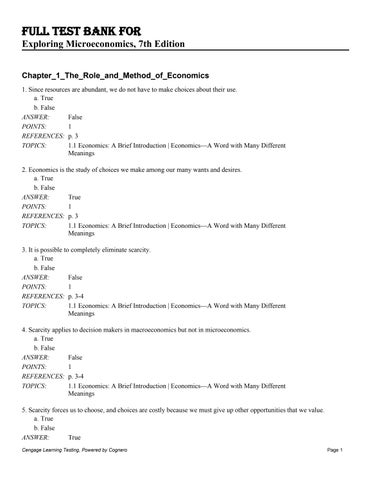
Exploring Microeconomics, 7th Edition Chapter_1_The_Role_and_Method_of_Economics 1. Since resources are abundant, we do not have to make choices about their use. a. True b. False ANSWER: False POINTS: 1 REFERENCES: p. 3 TOPICS: 1.1 Economics: A Brief Introduction | Economics—A Word with Many Different Meanings 2. Economics is the study of choices we make among our many wants and desires. a. True b. False ANSWER: True POINTS: 1 REFERENCES: p. 3 TOPICS: 1.1 Economics: A Brief Introduction | Economics—A Word with Many Different Meanings 3. It is possible to completely eliminate scarcity. a. True b. False ANSWER: False POINTS: 1 REFERENCES: p. 3-4 TOPICS: 1.1 Economics: A Brief Introduction | Economics—A Word with Many Different Meanings 4. Scarcity applies to decision makers in macroeconomics but not in microeconomics. a. True b. False ANSWER: False POINTS: 1 REFERENCES: p. 3-4 TOPICS: 1.1 Economics: A Brief Introduction | Economics—A Word with Many Different Meanings 5. Scarcity forces us to choose, and choices are costly because we must give up other opportunities that we value. a. True b. False ANSWER: True Cengage Learning Testing, Powered by Cognero
Page 1
POINTS: 1 REFERENCES: p. 3-4 TOPICS: 1.1 Economics: A Brief Introduction | Economics—A Word with Many Different Meanings 6. Wealthy consumers do not have to make decisions on what to buy or how much to save. a. True b. False ANSWER: False POINTS: 1 REFERENCES: p. 4 TOPICS: 1.1 Economics: A Brief Introduction | Economics—A Word with Many Different Meanings 7. If we choose more work we sacrifice leisure. a. True b. False ANSWER: True POINTS: 1 REFERENCES: p. 4-5 TOPICS: 1.1 Economics: A Brief Introduction | Economics Is All Around Us 8. Living in a world of scarcity involves trade-offs. a. True b. False ANSWER: True POINTS: 1 REFERENCES: p. 5 TOPICS: 1.1 Economics: A Brief Introduction | Economics Is All Around Us 9. Economists prefer to look at declared preferences (how they say they behave) rather than revealed preferences (how people actually behave). a. True b. False ANSWER: False POINTS: 1 REFERENCES: p. 13 TOPICS: 1.3 Economic Theory | Economists and Survey Data 10. One topic that microeconomics explores is how prices are determined in individual markets, while macroeconomics is concerned with issues such as the economy's overall rate of inflation, economic growth and unemployment. a. True b. False ANSWER: True POINTS: 1 Cengage Learning Testing, Powered by Cognero
Page 2
REFERENCES: p. 13 TOPICS: 1.3 Economic Theory | The Two Branches of Economics: Microeconomics and Macroeconomics 11. Microeconomics is the branch of economics in which you study inflation and unemployment in the economy. a. True b. False ANSWER: False POINTS: 1 REFERENCES: p. 13 TOPICS: 1.3 Economic Theory | The Two Branches of Economics: Microeconomics and Macroeconomics 12. Microeconomics explores the allocation of scarce resources from the perspective of small economic units such as consumers and firms. a. True b. False ANSWER: True POINTS: 1 REFERENCES: p. 13 TOPICS: 1.3 Economic Theory | The Two Branches of Economics: Microeconomics and Macroeconomics 13. Economists assume that most individuals act as if they are motivated by self-interest and respond in predictable ways to changing circumstances. a. True b. False ANSWER: True POINTS: 1 REFERENCES: p. 6-7 TOPICS: 1.2 Economic Behavior | SelfInterest 14. Economists believe that only a small part of human behavior can be explained and predicted by assuming that most people act as if they are motivated by their own self-interest in an effort to increase their expected personal satisfaction. a. True b. False ANSWER: False POINTS: 1 REFERENCES: p. 6-7 TOPICS: 1.2 Economic Behavior | SelfInterest 15. Self-interest could never include benevolence. a. True b. False ANSWER: False POINTS: 1 REFERENCES: p. 7 TOPICS: 1.2 Economic Behavior | SelfCengage Learning Testing, Powered by Cognero
Page 3
Interest 16. To an economist, individuals are acting "rationally" if they are striving to do their best to achieve their goals. a. True b. False ANSWER: True POINTS: 1 REFERENCES: p. 7 TOPICS: 1.2 Economic Behavior | What Is Rational Behavior? 17. To an economist, rational self-interest means that individuals try to weigh the expected marginal (additional) benefits and marginal (additional) costs of their decisions. a. True b. False ANSWER: True POINTS: 1 REFERENCES: p. 7 TOPICS: 1.2 Economic Behavior | What Is Rational Behavior? 18. When people make choices they typically know with certainty which choice is best. a. True b. False ANSWER: False POINTS: 1 REFERENCES: p. 7 TOPICS: 1.2 Economic Behavior | What Is Rational Behavior? 19. Economists believe that most people's actions are rational and purposeful, not random and chaotic. a. True b. False ANSWER: True POINTS: 1 REFERENCES: p. 7 TOPICS: 1.2 Economic Behavior | What Is Rational Behavior? 20. A good economic theory is always more useful when it includes detailed facts, even if the facts are not relevant to the questions being investigated. a. True b. False ANSWER: False POINTS: 1 REFERENCES: p. 9-10 TOPICS: 1.3 Economic Theory | Economic Theories 21. A good economic theory, or model, weeds out the irrelevant facts from the relevant ones. a. True b. False Cengage Learning Testing, Powered by Cognero
Page 4
ANSWER: True POINTS: 1 REFERENCES: p. 9-10 TOPICS: 1.3 Economic Theory | Economic Theories 22. Economic models are of limited use since they cannot be tested empirically. a. True b. False ANSWER: False POINTS: 1 REFERENCES: p. 10 TOPICS: 1.3 Economic Theory | Developing a Testable Proposition 23. A hypothesis is a normative statement. a. True b. False ANSWER: False POINTS: 1 REFERENCES: p. 10 TOPICS: 1.3 Economic Theory | Developing a Testable Proposition 24. A testable proposition that predicts how people will react to changed circumstances is called a hypothesis. a. True b. False ANSWER: True POINTS: 1 REFERENCES: p. 10 TOPICS: 1.3 Economic Theory | Developing a Testable Proposition 25. Theories and models are explanations of how things work that help us understand and predict how and why economic agents like consumers, producers, firms, government, etc. behave they way they do. a. True b. False ANSWER: True POINTS: 1 REFERENCES: p. 10 TOPICS: 1.3 Economic Theory | Economic Theories 26. "Ceteris paribus" is a Latin expression that means "holding everything else constant." a. True b. False ANSWER: True POINTS: 1 REFERENCES: p. 11 TOPICS: 1.3 Economic Theory | The Ceteris Paribus Assumption Cengage Learning Testing, Powered by Cognero
Page 5