Test Bank For Human Anatomy & Physiology, Global Edition, 12th edition Elaine N. Marieb Katja Hoehn Chapter 1-29 Chapter 1 The Human Body: An Orientation 1.1 Matching Questions
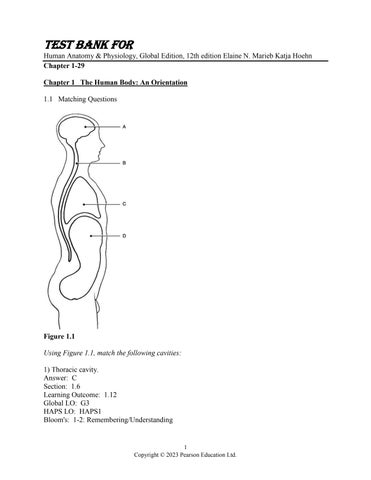
Figure 1.1 Using Figure 1.1, match the following cavities: 1) Thoracic cavity. Answer: C Section: 1.6 Learning Outcome: 1.12 Global LO: G3 HAPS LO: HAPS1 Bloom's: 1-2: Remembering/Understanding
1 Copyright © 2023 Pearson Education Ltd.
2) Cranial cavity. Answer: A Section: 1.6 Learning Outcome: 1.12 Global LO: G3 HAPS LO: HAPS1 Bloom's: 1-2: Remembering/Understanding 3) Abdominal cavity. Answer: D Section: 1.6 Learning Outcome: 1.12 Global LO: G3 HAPS LO: HAPS1 Bloom's: 1-2: Remembering/Understanding 4) Vertebral cavity. Answer: B Section: 1.6 Learning Outcome: 1.12 Global LO: G3 HAPS LO: HAPS1 Bloom's: 1-2: Remembering/Understanding
2 Copyright © 2023 Pearson Education Ltd.
Figure 1.2 Using Figure 1.2, match the following descriptions to the most appropriate letter on the diagram: 5) Information about body temperature is sent through afferent pathways to the brain. Answer: C Section: 1.4 Learning Outcome: 1.7, 1.8 Global LO: G2, G3 HAPS LO: HAPS2, HAPS3 Bloom's: 3-4: Applying/Analyzing 6) Free nerve endings in the skin detect changes in skin temperature (getting warmer). Answer: B Section: 1.4 Learning Outcome: 1.7, 1.8 Global LO: G2, G3 HAPS LO: HAPS2, HAPS3 Bloom's: 3-4: Applying/Analyzing 7) Appropriate response information is sent through efferent pathways. Answer: D Section: 1.4 Learning Outcome: 1.7, 1.8 Global LO: G2, G3 HAPS LO: HAPS2, HAPS3 Bloom's: 3-4: Applying/Analyzing
3 Copyright © 2023 Pearson Education Ltd.
8) A change in the temperature of the external environment (getting warmer). Answer: A Section: 1.4 Learning Outcome: 1.7, 1.8 Global LO: G2, G3 HAPS LO: HAPS2, HAPS3 Bloom's: 3-4: Applying/Analyzing 9) Sweat glands are stimulated as well as blood being distributed to the skin to allow cooling of the body to return the body's temperature to a physiological level. Answer: E Section: 1.4 Learning Outcome: 1.7, 1.8 Global LO: G2, G3 HAPS LO: HAPS2, HAPS3 Bloom's: 3-4: Applying/Analyzing Match the following systems to their functions: A) Muscular B) Nervous C) Skeletal D) Integumentary 10) Provides the force to move bones about their joints. Section: 1.2 Learning Outcome: 1.4 Global LO: G2, G7 HAPS LO: HAPS2, HAPS5 Bloom's: 1-2: Remembering/Understanding 11) Responds to environmental changes by transmitting appropriate electrical impulses. Section: 1.2 Learning Outcome: 1.4 Global LO: G2, G7 HAPS LO: HAPS2, HAPS5 Bloom's: 1-2: Remembering/Understanding 12) Provides a ridged framework to support the body and stores minerals. Section: 1.2 Learning Outcome: 1.4 Global LO: G2, G7 HAPS LO: HAPS2, HAPS5 Bloom's: 1-2: Remembering/Understanding 13) Prevents water loss, entry of germs into the body and synthesizes vitamin D. Section: 1.2 Learning Outcome: 1.4 Global LO: G2, G7 4 Copyright © 2023 Pearson Education Ltd.
HAPS LO: HAPS2, HAPS5 Bloom's: 1-2: Remembering/Understanding Answers: 10) A 11) B 12) C 13) D Match the following systems to their functions: A) Endocrine B) Lymphatic C) Immune D) Cardiovascular 14) Controls the body with chemical molecules called hormones. Section: 1.2 Learning Outcome: 1.4 Global LO: G2, G7 HAPS LO: HAPS2, HAPS5 Bloom's: 1-2: Remembering/Understanding 15) Delivers oxygen and nutrients to the tissues. Section: 1.2 Learning Outcome: 1.4 Global LO: G2, G7 HAPS LO: HAPS2, HAPS5 Bloom's: 1-2: Remembering/Understanding 16) A functional organ system which provides a means of protecting us from foreign invaders. Section: 1.2 Learning Outcome: 1.4 Global LO: G2, G7 HAPS LO: HAPS2, HAPS5 Bloom's: 1-2: Remembering/Understanding 17) Picks up and cleans excess fluid from tissues. Section: 1.2 Learning Outcome: 1.4 Global LO: G2, G7 HAPS LO: HAPS2, HAPS5 Bloom's: 1-2: Remembering/Understanding Answers: 14) A 15) D 16) C 17) B
5 Copyright © 2023 Pearson Education Ltd.