Test Bank For
Human Development A Cultural Approach, 4th Edition by Jeffrey Jensen Arnett , Lene Arnett Jensen Chapter 1-13 Chapter 1
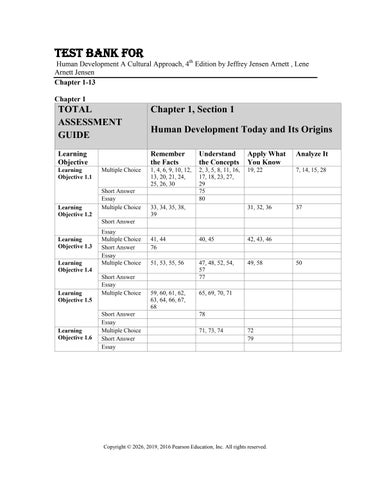
TOTAL ASSESSMENT GUIDE
Chapter 1, Section 1
Learning Objective
Remember the Facts
Understand the Concepts
Apply What You Know
Analyze It
1, 4, 6, 9, 10, 12, 13, 20, 21, 24, 25, 26, 30
2, 3, 5, 8, 11, 16, 17, 18, 23, 27, 29 75 80
19, 22
7, 14, 15, 28
31, 32, 36
37
Learning Objective 1.1
Learning Objective 1.2
Multiple Choice
Short Answer Essay Multiple Choice
Human Development Today and Its Origins
33, 34, 35, 38, 39
Short Answer Learning Objective 1.3 Learning Objective 1.4
Learning Objective 1.5
Learning Objective 1.6
Essay Multiple Choice Short Answer Essay Multiple Choice Short Answer Essay Multiple Choice
Short Answer Essay Multiple Choice Short Answer Essay
41, 44 76
40, 45
42, 43, 46
51, 53, 55, 56
47, 48, 52, 54, 57 77
49, 58
59, 60, 61, 62, 63, 64, 66, 67, 68
65, 69, 70, 71
78 71, 73, 74
72 79
Copyright © 2026, 2019, 2016 Pearson Education, Inc. All rights reserved.
50
Section 1 Human Development Today and Its Origins Multiple Choice Questions 1. The ways in which people grow and change biologically, cognitively, psychologically, and socially across the life span are collectively referred to as __________. a. human development b. evolution c. change d. maturation Answer: a Difficulty Level: Easy Skill Level: Remember the Facts Learning Objective: 1.1 Describe the nature of the ―global demographic divide,‖ and explain why the United States is following a different demographic path than other developed countries. Topic: A Demographic Profile of Humanity APA Learning Objective: 1.1 Describe key concepts, principles, and theories in psychological science. 2. The total pattern of a group‘s customs, beliefs, art, and technology is referred to as __________. a. clan b. society c. culture d. beliefs Answer: c Difficulty Level: Moderate Skill Level: Understand the Concepts Learning Objective: 1.1 Describe the nature of the ―global demographic divide,‖ and explain why the United States is following a different demographic path than other developed countries. Topic: A Demographic Profile of Humanity APA Learning Objective: 1.1 Describe key concepts, principles, and theories in psychological science. 3. For most of history, the total human population was under __________ people. a. 800,000 b. 1 million c. 5 million d. 10 million Answer: d Difficulty Level: Moderate Skill Level: Understand the Concepts Learning Objective: 1.1 Describe the nature of the ―global demographic divide,‖ and explain why the United States is following a different demographic path than other developed countries. Topic: Population Growth and Change APA Learning Objective: 1.1 Describe key concepts, principles, and theories in psychological science.
Copyright © 2026, 2019, 2016 Pearson Education, Inc. All rights reserved.
4. Throughout most of human history, how many children did women typically have? a. 1 to 2 b. 4 to 8 c. 7 to 10 d. 10 to 12 Answer: b Difficulty Level: Moderate Skill Level: Remember the Facts Learning Objective: 1.1 Describe the nature of the ―global demographic divide,‖ and explain why the United States is following a different demographic path than other developed countries. Topic: Population Growth and Change APA Learning Objective: 1.1 Describe key concepts, principles, and theories in psychological science. 5. The human population began to increase noticeably around 10,000 years ago, due primarily to ____________. a. the discovery of medicine b. the development of agriculture and the domestication of animals c. people‘s greater understanding of the mechanics of conception and childbirth d. construction techniques that allowed for stronger homes that were better heated Answer: b Difficulty Level: Moderate Skill Level: Understand the Concepts Learning Objective: 1.1 Describe the nature of the ―global demographic divide,‖ and explain why the United States is following a different demographic path than other developed countries. Topic: Population Growth and Change APA Learning Objective: 1.1 Describe key concepts, principles, and theories in psychological science. 6. When did the world population reach 500 million people? a. 400 years ago b. 1,000 years ago c. 4,000 years ago d. 10,000 years ago Answer: a Difficulty Level: Easy Skill Level: Remember the Facts Learning Objective: 1.1 Describe the nature of the ―global demographic divide,‖ and explain why the United States is following a different demographic path than other developed countries. Topic: Population Growth and Change APA Learning Objective: 1.1 Describe key concepts, principles, and theories in psychological science. 7. Compared to the others, which event most contributed to the large increase in world population that occurred around the 1800s to 1900s? a. The average number of children per household increased from one to three children. b. Fewer women were dying during childbirth because they waited longer to have children. c. The domestication of animals finally provided a larger food supply. d. Medical advances that eliminated or sharply reduced deadly diseases were introduced. Answer: d Difficulty Level: Difficult Copyright © 2026, 2019, 2016 Pearson Education, Inc. All rights reserved.
Skill Level: Analyze It Learning Objective: 1.1 Describe the nature of the ―global demographic divide,‖ and explain why the United States is following a different demographic path than other developed countries. Topic: Population Growth and Change APA Learning Objective: 1.1 Describe key concepts, principles, and theories in psychological science. 8. Between 1930 and 1999, the human population __________, from ________ to about _________. a. doubled; 4 billion; 8 billion b. doubled; 1 billion; 2 billion c. tripled; 2 billion; 6 billion d. tripled; 1 billion; 3 billion Answer: c Difficulty Level: Moderate Skill Level: Understand the Concepts Learning Objective: 1.1 Describe the nature of the ―global demographic divide,‖ and explain why the United States is following a different demographic path than other developed countries. Topic: Population Growth and Change APA Learning Objective: 1.1 Describe key concepts, principles, and theories in psychological science. 9. The total human population in 2024 was __________. a. about 5 billion b. 6.3 billion c. close to 7 billion d. over 7 billion Answer: d Difficulty Level: Easy Skill Level: Remember the Facts Learning Objective: 1.1 Describe the nature of the ―global demographic divide,‖ and explain why the United States is following a different demographic path than other developed countries. Topic: Population Growth and Change APA Learning Objective: 1.1 Describe key concepts, principles, and theories in psychological science.
Copyright © 2026, 2019, 2016 Pearson Education, Inc. All rights reserved.
10. Based on statistics presented by the United Nations, how high is the human population projected to be by the year 2100? a. 8 billion b. 9.3 billion c. 10.4 billion d. 13 billion Answer: c Difficulty Level: Easy Skill Level: Remember the Facts Learning Objective: 1.1 Describe the nature of the ―global demographic divide,‖ and explain why the United States is following a different demographic path than other developed countries. Topic: Population Growth and Change APA Learning Objective: 1.1 Describe key concepts, principles, and theories in psychological science. 11. The total fertility rate (TFR) is defined as the number of __________. a. births per woman b. conceptions per woman c. fetuses that were spontaneously aborted d. women taking fertility drugs Answer: a Difficulty Level: Moderate Skill Level: Understand the Concepts Learning Objective: 1.1 Describe the nature of the ―global demographic divide,‖ and explain why the United States is following a different demographic path than other developed countries. Topic: Population Growth and Change APA Learning Objective: 1.1 Describe key concepts, principles, and theories in psychological science. 12. What is the current total fertility rate (TFR) worldwide? a. 1.4 b. 2.3 c. 4.2 d. 5.6 Answer: b Difficulty Level: Difficult Skill Level: Remember the Facts Learning Objective: 1.1 Describe the nature of the ―global demographic divide,‖ and explain why the United States is following a different demographic path than other developed countries. Topic: Population Growth and Change APA Learning Objective: 1.1 Describe key concepts, principles, and theories in psychological science. 13. At what point does the total fertility rate (TFR) become the replacement rate of a stable population? a. 1.4 b. 2.1 c. 2.8 d. 3.2 Answer: b Difficulty Level: Difficult Copyright © 2026, 2019, 2016 Pearson Education, Inc. All rights reserved.