Name:
Class:
Date:
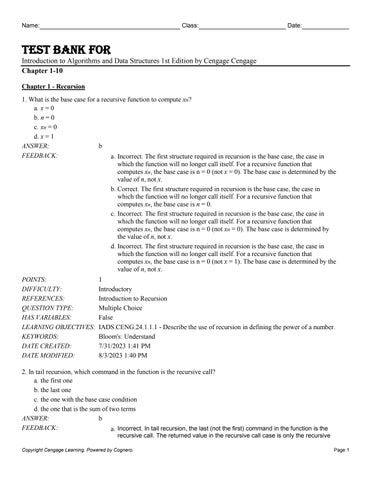
Test Bank For Introduction to Algorithms and Data Structures 1st Edition by Cengage Cengage Chapter 1-10 Chapter 1 - Recursion 1. What is the base case for a recursive function to compute xn? a. x = 0 b. n = 0 c. xn = 0 d. x = 1 ANSWER: b FEEDBACK: a. Incorrect. The first structure required in recursion is the base case, the case in which the function will no longer call itself. For a recursive function that computes xn, the base case is n = 0 (not x = 0). The base case is determined by the value of n, not x. b. Correct. The first structure required in recursion is the base case, the case in which the function will no longer call itself. For a recursive function that computes xn, the base case is n = 0. c. Incorrect. The first structure required in recursion is the base case, the case in which the function will no longer call itself. For a recursive function that computes xn, the base case is n = 0 (not xn = 0). The base case is determined by the value of n, not x. d. Incorrect. The first structure required in recursion is the base case, the case in which the function will no longer call itself. For a recursive function that computes xn, the base case is n = 0 (not x = 1). The base case is determined by the value of n, not x. POINTS: 1 DIFFICULTY: Introductory REFERENCES: Introduction to Recursion QUESTION TYPE: Multiple Choice HAS VARIABLES: False LEARNING OBJECTIVES: IADS.CENG.24.1.1.1 - Describe the use of recursion in defining the power of a number. KEYWORDS: Bloom's: Understand DATE CREATED: 7/31/2023 1:41 PM DATE MODIFIED: 8/3/2023 1:40 PM 2. In tail recursion, which command in the function is the recursive call? a. the first one b. the last one c. the one with the base case condition d. the one that is the sum of two terms ANSWER: b FEEDBACK: a. Incorrect. In tail recursion, the last (not the first) command in the function is the recursive call. The returned value in the recursive call case is only the recursive Copyright Cengage Learning. Powered by Cognero.
Page 1
Name:
Class:
Date:
function. b. Correct. In tail recursion, the last command in the function is the recursive call. The returned value in the recursive call case is only the recursive function. c. Incorrect. In tail recursion, the last command in the function is the recursive call, not the one with the base case condition. The base case condition leads to a stopping point, not a recursive call. d. Incorrect. In tail recursion, the last command in the function is the recursive call. The returned value in the recursive call case is only the recursive function. The function may or may not contain a command that is the sum of two terms.
POINTS: 1 DIFFICULTY: Introductory REFERENCES: Introduction to Recursion QUESTION TYPE: Multiple Choice HAS VARIABLES: False LEARNING OBJECTIVES: IADS.CENG.24.1.1.2 - Recall the conditions of well-defined recursive functions and procedures. KEYWORDS: Bloom's: Remember DATE CREATED: 7/31/2023 1:55 PM DATE MODIFIED: 8/3/2023 1:40 PM 3. If recursion is not well-defined, it has no stopping case and will eventually result in a stack overflow error. a. True b. False ANSWER: True FEEDBACK: Correct Well-defined recursion is a term used to describe a recursive algorithm that reaches an end state in a finite time and returns the same value every time it is used. If recursion is not well-defined, it has no stopping case and will eventually result in a stack overflow error. Incorrect Well-defined recursion is a term used to describe a recursive algorithm that reaches an end state in a finite time and returns the same value every time it is used. If recursion is not well-defined, it has no stopping case and will eventually result in a stack overflow error.
POINTS: 1 DIFFICULTY: Intermediate REFERENCES: Introduction to Recursion QUESTION TYPE: True / False HAS VARIABLES: False LEARNING OBJECTIVES: IADS.CENG.24.1.1.3 - Associate the condition of well-defined recursion with a stack overflow error. KEYWORDS: Bloom's: Understand DATE CREATED: 7/31/2023 1:58 PM DATE MODIFIED: 8/3/2023 1:40 PM 4. What is the base case for a recursive function to compute n! (factorial of n)? a. n2 = 1 b. n = 2 Copyright Cengage Learning. Powered by Cognero.
Page 2
Name:
c. n = 1 d. n = 0 ANSWER: FEEDBACK:
Class:
Date:
d a. Incorrect. The base case for a recursive function to compute n! (factorial of n) is n 2 = 0 (not n = 1). The factorial of a non-negative integer n, usually written as ―n!‖, is the product of all positive integers less than n. Calculating the factorial of an integer does not involve squaring it. b. Incorrect. The base case for a recursive function to compute n! (factorial of n) is n = 0 (not n = 2). If n = 2, calculating the factorial of n will require recursion: n * factorial(n - 1). c. Incorrect. The base case for a recursive function to compute n! (factorial of n) is n = 0 (not n = 1). If n = 1, calculating the factorial of n will require recursion: n * factorial(n - 1). d. Correct. The base case for a recursive function to compute n! (factorial of n) is n = 0. The factorial of a non-negative integer n, usually written as ―n!‖, is the product of all positive integers less than n.
POINTS: 1 DIFFICULTY: Introductory REFERENCES: Introduction to Recursion QUESTION TYPE: Multiple Choice HAS VARIABLES: False LEARNING OBJECTIVES: IADS.CENG.24.1.1.4 - Describe the relationship between recursion and the divide-andconquer strategy of problem-solving. KEYWORDS: Bloom's: Understand DATE CREATED: 7/31/2023 1:59 PM DATE MODIFIED: 8/3/2023 1:40 PM 5. How many recursive calls are made in a recursive algorithm computing the Fibonacci sequence for n = 3? a. 3 b. 4 c. 5 d. 6 ANSWER: b FEEDBACK: a. Incorrect. It requires 4 recursive calls, not 3. For a recursive function fib, fib(3) calls fib(2) and fib(1). fib(2) calls fib(1) and fib(0). The base cases are n = 0 and n = 1, and making two recursive calls to the function is necessary to compute a single number. b. Correct. It requires 4 recursive calls. For a recursive function fib, fib(3) calls fib(2) and fib(1). fib(2) calls fib(1) and fib(0). The base cases are n = 0 and n = 1, and making two recursive calls to the function is necessary to compute a single number. c. Incorrect. It requires 4 recursive calls, not 5. For a recursive function fib, fib(3) calls fib(2) and fib(1). fib(2) calls fib(1) and fib(0). The base cases are n = 0 and n = 1, and making two recursive calls to the function is necessary to compute a single number. d. Incorrect. It requires 4 recursive calls, not 6. For a recursive function fib, fib(3) Copyright Cengage Learning. Powered by Cognero.
Page 3
Name:
Class:
Date:
calls fib(2) and fib(1). fib(2) calls fib(1) and fib(0). The base cases are n = 0 and n = 1, and making two recursive calls to the function is necessary to compute a single number. POINTS: 1 DIFFICULTY: Introductory REFERENCES: Introduction to Recursion QUESTION TYPE: Multiple Choice HAS VARIABLES: False LEARNING OBJECTIVES: IADS.CENG.24.1.1.5 - Describe the use of tail recursion in recursive functions and procedures. KEYWORDS: Bloom's: Remember DATE CREATED: 7/31/2023 2:07 PM DATE MODIFIED: 8/3/2023 1:40 PM 6. Which term describes a recursive algorithm that reaches an end state in a finite time and returns the same value every time it is used? a. tail recursion b. infinite recursion c. well-defined recursion d. stack overflow recursion ANSWER: c FEEDBACK: a. Incorrect. Well-defined recursion is a term used to describe a recursive algorithm that reaches an end state in a finite time and returns the same value every time it is used. Tail recursion is a form of recursion where the last command in the function is the recursive call.
b. Incorrect. Well-defined recursion is a term used to describe a recursive algorithm that reaches an end state in a finite time and returns the same value every time it is used. Infinite recursion occurs when the function doesn’t reach a point where it stops because it is not well defined. c. Correct. Well-defined recursion is a term used to describe a recursive algorithm that reaches an end state in a finite time and returns the same value every time it is used. d. Incorrect. Well-defined recursion is a term used to describe a recursive algorithm that reaches an end state in a finite time and returns the same value every time it is used. A stack overflow error occurs when the stack doesn’t have space to store necessary data. Because each call of a function uses stack memory, recursive functions can trigger stack overflow errors when they are poorly defined.
POINTS: 1 DIFFICULTY: Introductory REFERENCES: Examples of Recursive Methods QUESTION TYPE: Multiple Choice HAS VARIABLES: False LEARNING OBJECTIVES: IADS.CENG.24.1.2.1 - Associate the recursive definition of factorials with its non-recursive definition. KEYWORDS: Bloom's: Remember DATE CREATED: 7/31/2023 2:09 PM Copyright Cengage Learning. Powered by Cognero.
Page 4
Name:
DATE MODIFIED:
Class:
Date:
8/3/2023 1:40 PM
7. The use of recursion enables you to create solutions using the divide-and-conquer strategy. a. True b. False ANSWER: True FEEDBACK: Correct Recursion is a technique to solve problems where the case at hand is divided into smaller subtasks similar to the original one, and is useful when solving a problem or executing a task that you can split into smaller tasks. Thus, the use of recursion enables you to create solutions using the divide-and-conquer strategy. Incorrect Recursion is a technique to solve problems where the case at hand is divided into smaller subtasks similar to the original one, and is useful when solving a problem or executing a task that you can split into smaller tasks. Thus, the use of recursion enables you to create solutions using the divide-and-conquer strategy.
POINTS: 1 DIFFICULTY: Advanced REFERENCES: Examples of Recursive Methods QUESTION TYPE: True / False HAS VARIABLES: False LEARNING OBJECTIVES: IADS.CENG.24.1.2.2 - Calculate the Fibonacci sequence using its recursive definition. KEYWORDS: Bloom's: Apply DATE CREATED: 7/31/2023 2:11 PM DATE MODIFIED: 8/3/2023 1:40 PM 8. If a function func1 calls a function func2, which calls a function func3, which calls the func1, what kind of recursion is this? a. infinite recursion b. tail recursion c. direct recursion d. indirect recursion ANSWER: d FEEDBACK: a. Incorrect. Indirect recursion is when a function calls to itself but in an indirect manner, such as in this example. Infinite recursion occurs when the function doesn’t reach a point when it stops. b. Incorrect. Indirect recursion is when a function calls to itself but in an indirect manner, such as in this example. Tail recursion is a form of recursion where the last command in the function is the recursive call. c. Incorrect. Indirect recursion is when a function calls to itself but in an indirect manner, such as in this example. Direct recursion is when the function calls itself directly. d. Correct. Indirect recursion is when a function calls to itself but in an indirect manner, such as in this example.
POINTS: DIFFICULTY: REFERENCES: QUESTION TYPE: HAS VARIABLES:
1 Intermediate Direct and Indirect Recursion Multiple Choice False
Copyright Cengage Learning. Powered by Cognero.
Page 5