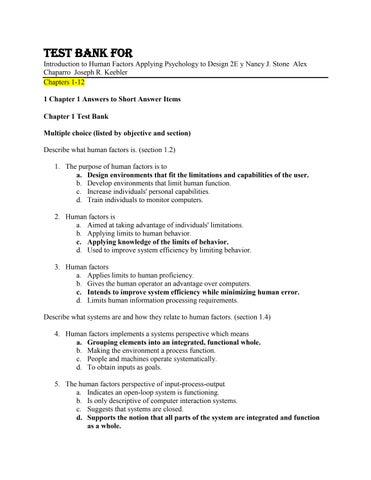
Test Bank For Introduction to Human Factors Applying Psychology to Design 2E y Nancy J. Stone Alex Chaparro Joseph R. Keebler Chapters 1-12 1 Chapter 1 Answers to Short Answer Items Chapter 1 Test Bank Multiple choice (listed by objective and section) Describe what human factors is. (section 1.2) 1. The purpose of human factors is to a. Design environments that fit the limitations and capabilities of the user. b. Develop environments that limit human function. c. Increase individuals' personal capabilities. d. Train individuals to monitor computers. 2. Human factors is a. Aimed at taking advantage of individuals' limitations. b. Applying limits to human behavior. c. Applying knowledge of the limits of behavior. d. Used to improve system efficiency by limiting behavior. 3. Human factors a. Applies limits to human proficiency. b. Gives the human operator an advantage over computers. c. Intends to improve system efficiency while minimizing human error. d. Limits human information processing requirements. Describe what systems are and how they relate to human factors. (section 1.4) 4. Human factors implements a systems perspective which means a. Grouping elements into an integrated, functional whole. b. Making the environment a process function. c. People and machines operate systematically. d. To obtain inputs as goals. 5. The human factors perspective of input-process-output a. Indicates an open-loop system is functioning. b. Is only descriptive of computer interaction systems. c. Suggests that systems are closed. d. Supports the notion that all parts of the system are integrated and function as a whole.
6. The human factors' perspective that components are integrated into a functional whole is called a. A closed system. b. Gestalt psychology. c. Processing. d. Systems theory. Explain the history of human factors. (section 1.3) 7. The impetus for the growth and emergence of human factors as a discipline occurred a. After psychometricians created tests for selection. b. As a result of Gilbreth's design of the scaffold. c. Due to practical needs, technological advancements, and linguistic developments during WWII. d. During Taylor's study of shovel size. 8. The beginning of human factors a. Can be traced to the Age of Tools when bones were used as scoops. b. Was established during WWI. c. Was established during WWII. d. Was not recognized by the engineering profession. 9. During the Age of Power (Power Revolution, 1870-1945), several breakthroughs occurred including a. The emphasis of designing the job to fit the individuals. b. Gilbreth's development of tool design procedures. c. The introduction of better masonry materials and tools. d. Taylor's idea of scientific management. 10. The importance of Taylor's scientific management is that a. Every element of a job could be scientifically specified to ensure efficiency. b. It would no longer be necessary to train workers. c. Management could be reduced because all aspects of the job are justified and documented. d. Through scientific selection, each worker could do the job well. 11. Human factors emerged as a discipline due to a. The interest in testing human performance and sensation and perception, which developed near the end of WWII. b. Paul M. Fitts' declaration that more research was needed in the areas of memory, learning, and cognition. c. Psychometricians' need to develop selection tests. d. Taylor's study of shovel size. Communicate the importance of systems theory (section 1.4)
12. Your department is redesigning a workspace, to help others understand the importance of systems theory you a. Argue that architects need to work with interior designers. b. Describe how one work group will have more space than another work group. c. Explain how certain changes in the environment might impact other people or processes. d. Recommend hiring a human factors specialist to evaluate the space. 13. In the medical field, there are often errors in administering the correct medicine or the correct amount of medicine. From a systems theory perspective, this could be reduced by a. Creating better communication so the nurses can share information not only with each other on different shifts, but with the physicians and orderlies. b. Designing better inputs such as the labels on medications so the proper medications are administered. c. Developing better outputs such as the equipment that is better understood and used appropriately. d. Ensuring the process of administering the medication is correct. 14. If poorly designed chairs lead to improper seating, which leads to sore backs, according to systems theory, the input in this situation is a. Improper seating. b. Sore backs. c. The lack of seating training. d. The poorly designed chair. Identify human factors applications. (section 1.5) 15. Given your knowledge of human factors, you are assisting your grandmother with her iPad, as she is having trouble using it. You suspect that a. She just does not understand the newer technology and you need to work the iPad for her. b. Her motor skills are not appropriate for interacting with the iPad, but some physical therapy can correct this. c. She needs new glasses. d. Some adjustments to the display and layout of the icons on her iPad would greatly help her understand and use the iPad. 16. Some friends of yours are discussing the issue of accidents between pedestrians and electric cars. Applying human factors to reduce accidents, you make the following suggestion to a. Create better warnings such as adding some noise to the electric car and developing sensors in the electric cars to sense the presence of an object. b. Design traffic flow so cars never cross into pedestrian areas. c. Have pedestrians wear sensors that will provide warnings when a car is in the vicinity.
d. Train pedestrians to be better observers of driver behavior in order to anticipate a driver’s actions. 17. When designing equipment, there can be problems that human factors can address. For example, some of the problems could be due to a. Concise instructions and minimal training requirements for the general population. b. Too strong of a focus on the inputs to the system and not enough focus on the outputs. c. The equipment being designed for men, but women or people with disabilities also need to use the equipment. d. The vast amount of data collected about inputs, processes, and data. Describe the education necessary to work in the field of human factors. (section 1.6.1 and 1.6.2) 18. A human factors specialist a. Must have a Ph.D. in psychology. b. Studies only ergonomics. c. Is an engineer. d. May come from many different disciplines including psychology, engineering, and architecture. 19. To be a human factors specialist, one a. May have almost any major/background. b. Must have a psychology major/background. c. Needs to obtain the Ph.D. and be licensed. d. Should have an engineering major/background. 20. Fundamental areas for human factors include a. Cognition, experimental, and statistics. b. Developmental, social, and physiology. c. History and systems, counseling, and memory. d. Sensation and perception, learning, and developmental. Identify the different work settings in which human factors specialists work. (section 1.6.3) 21. Human factors specialists a. Can work anywhere. b. Generally only work in military or aviation fields. c. Have the ability to contribute to a variety of industries. d. Work primarily within the fields of usability and human-computer interaction. 22. Most employers are seeking applicants with a. Basic research methods skills, statistical skills, and the ability to apply their knowledge on the job. b. Communication skills, as all other skills can be developed on the job.
c. Software development skills. d. The top five core competencies specific by the Board of Certification in Professional Ergonomics. 23. A human factors specialist working in the realm of education is most likely to be a. Creating continuing education courses. b. Designing curricula for HF programs. c. Developing computer-generated grading systems. d. Establishing the learning criteria for training programs related to aviation psychology. Short answer 1. 2. 3. 4. 5.
How would you explain to another student what human factors is? Explain the relationship between human factors and engineering. Define a system. Distinguish between open and closed-looped systems and open and closed systems. What types of system would you want, a) a closed-looped or open-looped, and b) a closed or open system? 6. List and describe the six (6) fundamental characteristics of a system? 7. Explain the concept of the input-process-output model. 8. Describe the impact Alphonse Chapanis had on the field of human factors. 9. Describe the impact Paul M. Fitts had on the field of human factors 10. Briefly explain the development of the human factors field during and after WWII. 11. When designing a new kitchen, explain why a systems perspective is important. 12. Describe how human factors can address the needs of special populations. 13. Describe the type of education one needs to be considered a human factors specialist. 14. Identify a type of work environment in which a human factors specialist might work and describe the work the HF specialist would do. 15. Briefly explain the development of the human factors field during and after WWII. Essay 1. Describe the importance of systems theory in how human factors can be applied to various situations. Be sure to include a discussion about the education of human factors specialists and the different types of work settings in which HF specialists can work. 2. Explain how human factors specialists can address the needs of special populations. Be sure to include how a systems perspective is beneficial. 3. Describe what human factors is and how the history of human factors and the education of human factors specialists affects the field of human factors.