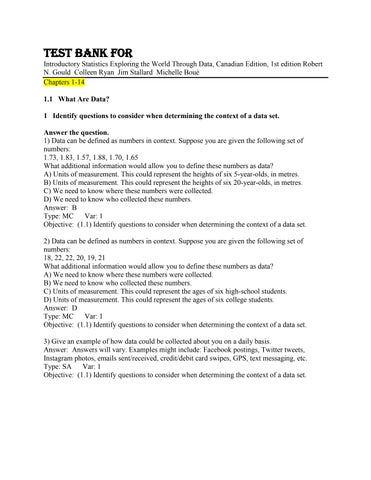
Test Bank For Introductory Statistics Exploring the World Through Data, Canadian Edition, 1st edition Robert N. Gould Colleen Ryan Jim Stallard Michelle Boué Chapters 1-14 1.1 What Are Data? 1 Identify questions to consider when determining the context of a data set. Answer the question. 1) Data can be defined as numbers in context. Suppose you are given the following set of numbers: 1.73, 1.83, 1.57, 1.88, 1.70, 1.65 What additional information would allow you to define these numbers as data? A) Units of measurement. This could represent the heights of six 5-year-olds, in metres. B) Units of measurement. This could represent the heights of six 20-year-olds, in metres. C) We need to know where these numbers were collected. D) We need to know who collected these numbers. Answer: B Type: MC Var: 1 Objective: (1.1) Identify questions to consider when determining the context of a data set. 2) Data can be defined as numbers in context. Suppose you are given the following set of numbers: 18, 22, 22, 20, 19, 21 What additional information would allow you to define these numbers as data? A) We need to know where these numbers were collected. B) We need to know who collected these numbers. C) Units of measurement. This could represent the ages of six high-school students. D) Units of measurement. This could represent the ages of six college students. Answer: D Type: MC Var: 1 Objective: (1.1) Identify questions to consider when determining the context of a data set. 3) Give an example of how data could be collected about you on a daily basis. Answer: Answers will vary. Examples might include: Facebook postings, Twitter tweets, Instagram photos, emails sent/received, credit/debit card swipes, GPS, text messaging, etc. Type: SA Var: 1 Objective: (1.1) Identify questions to consider when determining the context of a data set.
1.2 Classifying and Storing Data 1 Identify questions to consider when determining the context of a data set. Solve the problem. 1) A statistics student collected data from other students in her class who ride a bike to school. The following table shows data about their bikes:
How many variables are there? A) 5 B) 4 C) 20 D) 7 Answer: A Type: BI Var: 50+ Objective: (1.2) Identify questions to consider when determining the context of a data set. 2) A statistics student collected data from other students in her class who ride a bike to school. The following table shows data about their bikes:
Observations were made on how many bikes? A) 4 B) 5 C) 20 D) 7 Answer: A Type: BI Var: 50+ Objective: (1.2) Identify questions to consider when determining the context of a data set.
3) In a recent school poll, the administrators asked if students were satisfied with the school's course offerings. What is the population of interest here? A) All students who are satisfied with the course offerings B) All students who are not satisfied with the course offerings C) All students who attend the school D) All students who participated in the poll Answer: C Type: MC Var: 1 Objective: (1.2) Identify questions to consider when determining the context of a data set. 4) In a recent high-school poll, the principal asked if students were satisfied with the amount of after-school activities offered. What is the population of interest here? A) All students who attend the school B) All students who participated in the poll C) All students who are satisfied with the amount of after-school activities that are offered D) All students who are not satisfied with the amount of after-school activities that are offered Answer: A Type: MC Var: 1 Objective: (1.2) Identify questions to consider when determining the context of a data set. 5) In a recent survey at the University of Alberta, some incoming first-year students were asked if they planned to take more than one math class before they graduated. What is the population of interest here and what is the sample? Answer: The population is the entire first-year class at the University of Alberta. The sample includes the particular first-year who participated in the survey. Type: SA Var: 1 Objective: (1.2) Identify questions to consider when determining the context of a data set. 2 Distinguish between numerical and categorical variables and apply methods for coding categorical variables. Solve the problem. 1) The average gas mileage of the top selling mini-vans for each U.S. car manufacturer is an example of what type of variable? A) Numerical variable B) Categorical variable C) Neither Answer: A Type: MC Var: 1 Objective: (1.2) Distinguish between numerical and categorical variables and apply methods for coding categorical variables.
2) The comments of a provincial Premier about the dangers of global warming are an example of what type of variable? A) Numerical variable B) Categorical variable C) Neither Answer: C Type: MC Var: 1 Objective: (1.2) Distinguish between numerical and categorical variables and apply methods for coding categorical variables. 3) Marital status of each member of a randomly selected group of adults is an example of what type of variable? A) Numerical variable B) Categorical variable C) Neither Answer: B Type: MC Var: 1 Objective: (1.2) Distinguish between numerical and categorical variables and apply methods for coding categorical variables. 4) The ethnicity of the individual respondents in a political poll of a randomly selected group of adults is an example of what type of variable? A) Numerical variable B) Categorical variable C) Neither Answer: B Type: MC Var: 1 Objective: (1.2) Distinguish between numerical and categorical variables and apply methods for coding categorical variables. 5) The average number of hours spent completing statistics homework for a randomly selected group of statistics students is an example of what type of variable? A) Numerical variable B) Categorical variable C) Neither Answer: A Type: MC Var: 1 Objective: (1.2) Distinguish between numerical and categorical variables and apply methods for coding categorical variables.
6) The number of parents who attended parent-teacher conferences at a local elementary school is an example of what type of variable? A) Numerical variable B) Categorical variable C) Neither Answer: A Type: MC Var: 1 Objective: (1.2) Distinguish between numerical and categorical variables and apply methods for coding categorical variables. 7) A bicycle manufacturer produces four different bicycle models. Information is summarized in the table below:
Identify the variables and determine whether each variable is numerical or categorical. A) Series number: categorical; weight: numerical; style: categorical B) Series number: numerical; weight: numerical; style: categorical C) Series number: numerical; weight: categorical; style: categorical D) Series number: categorical; weight: categorical; style: categorical Answer: A Type: BI Var: 50+ Objective: (1.2) Distinguish between numerical and categorical variables and apply methods for coding categorical variables. 8) An international relations professor is supervising four master's students. Information about the students is summarized in the table.
Identify the variables and determine whether each variable is numerical or categorical. A) Student number: categorical; area of interest: categorical; GPA: numerical B) Student number: numerical; area of interest: categorical; GPA: numerical C) Student number: numerical; area of interest: categorical; GPA: categorical D) Student number: categorical; area of interest: categorical; GPA: categorical Answer: A Type: BI Var: 50+ Objective: (1.2) Distinguish between numerical and categorical variables and apply methods for coding categorical variables. 9) Determine which of the following five variables are numerical and which are categorical.