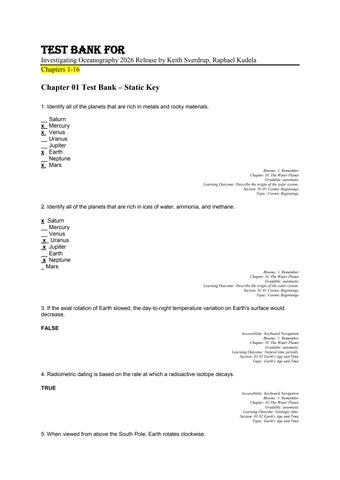
Test Bank For Investigating Oceanography 2026 Release by Keith Sverdrup, Raphael Kudela Chapters 1-16
Chapter 01 Test Bank – Static Key 1. Identify all of the planets that are rich in metals and rocky materials.
__ Saturn x Mercury x Venus __ Uranus __ Jupiter x Earth __ Neptune x Mars Blooms: 1. Remember Chapter: 01 The Water Planet Gradable: automatic Learning Outcome: Describe the origin of the solar system. Section: 01.01 Cosmic Beginnings Topic: Cosmic Beginnings
2. Identify all of the planets that are rich in ices of water, ammonia, and methane.
x Saturn __ Mercury __ Venus x_ Uranus x Jupiter __ Earth x Neptune _ Mars Blooms: 1. Remember Chapter: 01 The Water Planet Gradable: automatic Learning Outcome: Describe the origin of the solar system. Section: 01.01 Cosmic Beginnings Topic: Cosmic Beginnings
3. If the axial rotation of Earth slowed, the day-to-night temperature variation on Earth's surface would decrease. FALSE Accessibility: Keyboard Navigation Blooms: 1. Remember Chapter: 01 The Water Planet Gradable: automatic Learning Outcome: Natural time periods. Section: 01.02 Earth's Age and Time Topic: Earth's Age and Time
4. Radiometric dating is based on the rate at which a radioactive isotope decays. TRUE Accessibility: Keyboard Navigation Blooms: 1. Remember Chapter: 01 The Water Planet Gradable: automatic Learning Outcome: Geologic time. Section: 01.02 Earth's Age and Time Topic: Earth's Age and Time
5. When viewed from above the South Pole, Earth rotates clockwise.
TRUE Accessibility: Keyboard Navigation Blooms: 1. Remember Chapter: 01 The Water Planet Gradable: automatic Learning Outcome: Calculate the difference in time between two locations of known longitude. Section: 01.04 Where on Earth Are You? Topic: Where on Earth Are You?
6. When crossing the international date line from east to west, the date increases by one day. TRUE Accessibility: Keyboard Navigation Blooms: 1. Remember Chapter: 01 The Water Planet Gradable: automatic Learning Outcome: Calculate the difference in time between two locations of known longitude. Section: 01.04 Where on Earth Are You? Topic: Where on Earth Are You?
7. Determination of latitude requires that time be kept very accurately. FALSE Accessibility: Keyboard Navigation Blooms: 1. Remember Chapter: 01 The Water Planet Gradable: automatic Learning Outcome: Define and sketch lines of latitude and longitude. Section: 01.04 Where on Earth Are You? Topic: Where on Earth Are You?
8. All latitude circles are great circles. FALSE Accessibility: Keyboard Navigation Blooms: 1. Remember Chapter: 01 The Water Planet Gradable: automatic Learning Outcome: Define and sketch lines of latitude and longitude. Section: 01.04 Where on Earth Are You? Topic: Where on Earth Are You?
9. Earth turns westward as it rotates on its axis. FALSE Accessibility: Keyboard Navigation Blooms: 1. Remember Chapter: 01 The Water Planet Gradable: automatic Learning Outcome: Calculate the difference in time between two locations of known longitude. Section: 01.04 Where on Earth Are You? Topic: Where on Earth Are You?
10. The residence time of water in the atmosphere is equal to the residence time of water in the oceans. FALSE Accessibility: Keyboard Navigation Blooms: 1. Remember Chapter: 01 The Water Planet Gradable: automatic Learning Outcome: Reservoirs and residence time. Section: 01.06 Earth Is a Water Planet Topic: Earth Is a Water Planet
11. The hydrologic cycle requires an excess of evaporation over precipitation as averaged over the world's oceans. TRUE Accessibility: Keyboard Navigation Blooms: 1. Remember Chapter: 01 The Water Planet Gradable: automatic
Learning Outcome: Explain the Hydrologic Cycle. Section: 01.06 Earth Is a Water Planet Topic: Earth Is a Water Planet
12. The middle latitudes in the Northern Hemisphere have about equal areas devoted to both land and water. TRUE Accessibility: Keyboard Navigation Blooms: 1. Remember Chapter: 01 The Water Planet Gradable: automatic Learning Outcome: Water on Earth's surface. Section: 01.06 Earth Is a Water Planet Topic: Earth Is a Water Planet
13. The sidereal day is more constant and shorter than the solar day. TRUE Accessibility: Keyboard Navigation Blooms: 1. Remember Chapter: 01 The Water Planet Gradable: automatic Learning Outcome: Describe natural time periods. Section: 01.02 Earth's Age and Time Topic: Earth's Age and Time
14. Mercury, Venus, Earth, and Mars are smaller in size and closer to the sun than Jupiter, Saturn, Uranus, or Neptune. TRUE Accessibility: Keyboard Navigation Blooms: 1. Remember Chapter: 01 The Water Planet Gradable: automatic Learning Outcome: Describe the origin of the solar system. Section: 01.01 Cosmic Beginnings Topic: Cosmic Beginnings
15. There is more land located in the Northern Hemisphere than in the Southern Hemisphere. TRUE Accessibility: Keyboard Navigation Blooms: 1. Remember Chapter: 01 The Water Planet Gradable: automatic Learning Outcome: Water on Earth's surface. Section: 01.06 Earth Is a Water Planet Topic: Earth Is a Water Planet
16. Water is moved through the hydrologic cycle at different rates and in different directions in each climate zone. TRUE Accessibility: Keyboard Navigation Blooms: 1. Remember Chapter: 01 The Water Planet Gradable: automatic Learning Outcome: Reservoirs and residence time. Section: 01.06 Earth Is a Water Planet Topic: Earth Is a Water Planet
17. Our solar system is part of the Milky Way galaxy. TRUE Accessibility: Keyboard Navigation Blooms: 1. Remember Chapter: 01 The Water Planet Gradable: automatic Learning Outcome: Describe the origin of the solar system. Section: 01.01 Cosmic Beginnings Topic: Cosmic Beginnings
18. The Milky Way galaxy formed from an expanding nebula. FALSE Accessibility: Keyboard Navigation Blooms: 1. Remember Chapter: 01 The Water Planet Gradable: automatic Learning Outcome: Explain the "Big Bang" theory of the origin of the universe, and describe its structure. Section: 01.01 Cosmic Beginnings Topic: Cosmic Beginnings
19. The Milky Way galaxy contains about 200 billion stars. TRUE Accessibility: Keyboard Navigation Blooms: 1. Remember Chapter: 01 The Water Planet Gradable: automatic Learning Outcome: Explain the "Big Bang" theory of the origin of the universe, and describe its structure. Section: 01.01 Cosmic Beginnings Topic: Cosmic Beginnings
20. Earth rotates on its axis from west to east. TRUE Accessibility: Keyboard Navigation Blooms: 1. Remember Chapter: 01 The Water Planet Gradable: automatic Learning Outcome: Calculate the difference in time between two locations of known longitude. Section: 01.04 Where on Earth Are You? Topic: Where on Earth Are You?
21. On average water in a river will have a longer residence time than water in the oceans. FALSE Accessibility: Keyboard Navigation Blooms: 1. Remember Chapter: 01 The Water Planet Gradable: automatic Learning Outcome: Describe the Hydrologic Cycle. Section: 01.06 Earth Is a Water Planet Topic: Earth Is a Water Planet
22. The magnetic field surrounding Jupiter's moons may be the result of salt water bodies. TRUE Accessibility: Keyboard Navigation Blooms: 1. Remember Chapter: 01 The Water Planet Gradable: automatic Learning Outcome: Describe the origin of the solar system. Section: 01.01 Cosmic Beginnings Topic: Cosmic Beginnings
23. If a sea exists on Jupiter's moon, Europa, it is probably much smaller and shallower than the Earth's ocean. FALSE Accessibility: Keyboard Navigation Blooms: 1. Remember Chapter: 01 The Water Planet Gradable: automatic Learning Outcome: Describe the origin of the solar system. Section: 01.01 Cosmic Beginnings Topic: Cosmic Beginnings
24. There is no evidence of a past or present ocean on any planet but Earth. FALSE
Accessibility: Keyboard Navigation Blooms: 1. Remember Chapter: 01 The Water Planet Gradable: automatic Learning Outcome: Describe the origin of the solar system. Section: 01.01 Cosmic Beginnings Topic: Cosmic Beginnings
25. Free oxygen was a common constituent of the Earth's early atmosphere. FALSE Accessibility: Keyboard Navigation Blooms: 1. Remember Chapter: 01 The Water Planet Gradable: automatic Learning Outcome: Describe the origin of the solar system. Section: 01.01 Cosmic Beginnings Topic: Cosmic Beginnings
26. On the autumnal equinox every place on Earth experiences 12 hours of daylight and 12 hours of darkness. TRUE Accessibility: Keyboard Navigation Blooms: 1. Remember Chapter: 01 The Water Planet Gradable: automatic Learning Outcome: Describe Earth's natural time periods. Section: 01.02 Earth's Age and Time Topic: Earth's Age and Time
27. Lines of latitude are known as meridians. FALSE Accessibility: Keyboard Navigation Blooms: 1. Remember Chapter: 01 The Water Planet Gradable: automatic Learning Outcome: Define and sketch lines of latitude and longitude. Section: 01.04 Where on Earth Are You? Topic: Where on Earth Are You?
28. Planets exist outside of our solar system. TRUE Accessibility: Keyboard Navigation Blooms: 1. Remember Chapter: 01 The Water Planet Gradable: automatic Learning Outcome: Explain the "Big Bang" theory of the origin of the universe, and describe its structure. Section: 01.01 Cosmic Beginnings Topic: Cosmic Beginnings
29. A cluster rarely contains more than 10 galaxies. FALSE Accessibility: Keyboard Navigation Blooms: 1. Remember Chapter: 01 The Water Planet Gradable: automatic Learning Outcome: Explain the "Big Bang" theory of the origin of the universe, and describe its structure. Section: 01.01 Cosmic Beginnings Topic: Cosmic Beginnings
30. Earth's age is estimated at ____ years. 6
A. 4.6 × 10 6 B. 3.7 × 10 9 C. 4.6 × 10 9 D. 3.7 × 10 12 E. 4.6 × 10 Accessibility: Keyboard Navigation