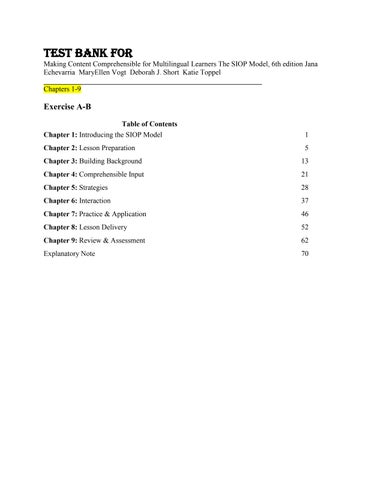
Test Bank For Making Content Comprehensible for Multilingual Learners The SIOP Model, 6th edition Jana Echevarria MaryEllen Vogt Deborah J. Short Katie Toppel ____________________________________________________________ Chapters 1-9
Exercise A-B Table of Contents Chapter 1: Introducing the SIOP Model
1
Chapter 2: Lesson Preparation
5
Chapter 3: Building Background
13
Chapter 4: Comprehensible Input
21
Chapter 5: Strategies
28
Chapter 6: Interaction
37
Chapter 7: Practice & Application
46
Chapter 8: Lesson Delivery
52
Chapter 9: Review & Assessment
62
Explanatory Note
70
Introduction In the Pearson eText Application Videos that accompany these Application Exercises, you will be stepping into a real classroom with real students and teachers. There are multilingual students in each of the classrooms with varying levels of English proficiency. The teachers you will observe are at different levels of S I O P implementation, from second-year S I O Pers to veterans. As you observe the lessons they have created, focus not only on the teacher and the content and language objectives, but also on the students. We are grateful to each of these S I O P educators for welcoming us into their classrooms, and for their dedication to S I O P, their multilingual learners, and other students. S I O P Application Exercise A: Preservice Teachers/Undergraduate Students Chapter 1: Introducing the S I O P Model Application Exercise 1.1 Chapter 1 Content Objective: List characteristics of multilingual learners that may influence their success in school. Chapter 1 Language Objective: Describe the assets your multilingual learners bring to your classroom. Directions: Individually, with a partner, or in a small group, read and answer the following questions, either orally or in writing. {Q1} Who are the multilingual learners who attend the local schools in your community? Visit a website for a school district in your community and search for demographic information about the multilingual students who attend the district schools.
What languages are spoken by the multilingual students in the district?
What is the percentage of multilingual students as compared to native English speakers?
What services are provided by the district for the multilingual students (e.g., E S L/E S O L, bilingual education, dual language programs, newcomer program, and so forth)?
What additional information can you find on the district website related to multilingual students?
Visit your state’s Department of Education website and explore the data about resources and services for multilingual students.
What languages are spoken by the multilingual students in the district? What is the percentage of multilingual students as compared to native English speakers? What services are provided by the state for the multilingual students (e.g., E S L/E S O L, bilingual education, dual language programs, newcomer programs, and so forth)?
What additional information can you find on the website about educating multilingual students in your state?
[Q1 Model Response] Answers will vary. The purpose of these questions is for undergrads and preservice students to investigate and learn about local and state multilingual learners, and the resources and programs that are available to assist both students and teachers. {Q2} Who will be the multilingual learners that you will be teaching? Visit a local elementary or secondary school as recommended by your college or university to learn about the program(s) and resources for multilingual learners, and for the teachers who teach them. If you have access to a local elementary or secondary school, interview two multilingual learners and ask each student about following:
Their native country Their home language Their number of years of schooling before coming to the United States or to the school What they like to read and write about in their home language, being mindful some multilingual students may not be literate in their home language Their favorite school subjects and why they’re favorites Something they enjoy doing that requires language outside of school, either English or the home language (e.g., visiting with family members; shopping; helping a parent or caretaker with daily tasks, and so forth)
Review the list of ―Multilingual Learners Assets‖ in Figure 1.2. Use the categories to think and write about the multilingual learners you interviewed. What assets do your students bring into the classroom? Compare the characteristics of the students you interviewed to the ―Diverse Characteristics of Multilingual Learners‖ (Figure 1.3). Where are there commonalities and where are the differences? [Q2 Model Response] Answers will vary. Obviously, without an interpreter, the multilingual learners will need to have enough English proficiency to carry on a conversation with the interviewers. Both multilingual learners and university students may benefit from conducting the interviews with a partner: two university students interviewing two multilingual learners. Application Exercise 1.2 Chapter 1 Content Objective: Distinguish between content-based language instruction and sheltered instruction.
Directions: Individually, with a partner, or in a small group, read and answer the following questions, either orally or in writing. {Q1} Review the section titled “Content-based Language Instruction and Sheltered Content Instruction‖ in Chapter 1.
How would you explain content-based language instruction to another teacher? How would you explain sheltered content instruction to another teacher? Why is it important to know the differences?
[Q1 Model Response] Content-Based Language Instruction:
Using content (e.g., history, science, health) as the vehicle for teaching academic language in the target language Course content comes from state English language development standards All students are multilingual learners Goal is to develop students’ English language proficiency Examples: Content-based E S L or E S O L; Designated E S L
Sheltered Content Instruction (S I O P):
Academic content and academic language taught simultaneously Grade-level content objectives guide development of modified lessons that are accessible to multilingual learners and others Students are a mix of multilingual speakers and native English speakers Goal is to make academic content and academic language accessible for all students Examples: S I O P, Integrated E L D, Sheltered/Structured English Immersion
Ideally, the approaches work in tandem: E S L teachers and S I O P teachers work together.
Application Exercise 1.3
Chapter 1 Language Objective : Compare your typical instruction with S I O P instruction. Directions: Individually, with a partner, or in a small group, read and answer the following questions, either orally or in writing. Note: If your undergrad students have not taught yet, have them reflect on field experiences in which they have observed lessons, or they can reflect on how they were taught in high school classes. {Q1} Implementing the S I O P Model takes time. For many teachers, it takes two years to implement it consistently in every lesson. Find the S I O P protocol in Appendix and review each of the S I O P Components (Lesson Preparation, Building Background, Comprehensible Input,
Strategies, Interaction, Practice & Application, Lesson Delivery, Review & Assessment), and the 30 instructional, S I O P features. Which S I O P component do you think will be the most comfortable to implement in your lessons? Why?
Which of the features in this component do you think will be the easiest to implement in lessons? Why?
Which S I O P component do you think will be the most challenging to implement in lessons? Why?
Which of the features in this component do you think will be the most challenging to implement in lessons? Why?
[Q1 Model Response] Answers will vary. These questions are also excellent for a self-assessment after students have completed reading Making Content Comprehensible for Multilingual Learners: The S I O P Model.
Introduction In the Pearson eText Application Videos that accompany these Application Exercises, you will be stepping into a real classroom with real students and teachers. There are multilingual students in each of the classrooms with varying levels of English proficiency. The teachers you will observe are at different levels of S I O P implementation, from second-year S I O Pers to veterans. As you observe the lessons they have created, focus not only on the teacher and the content and language objectives, but also on the students. We are grateful to each of these S I O P educators for welcoming us into their classrooms, and for their dedication to S I O P, their multilingual learners, and other students. S I O P Application Exercise A: Preservice Teachers/Undergraduate Students Chapter 2: Lesson Preparation Application Exercise 2.1: S I O P Feature 1: Content objectives clearly defined, displayed, and reviewed with students. Chapter 2 Content Objective: Identify content objectives for multilingual learners that align to state, local, or national standards. S I O P Feature 2: Language objectives clearly defined, displayed, and reviewed with students.