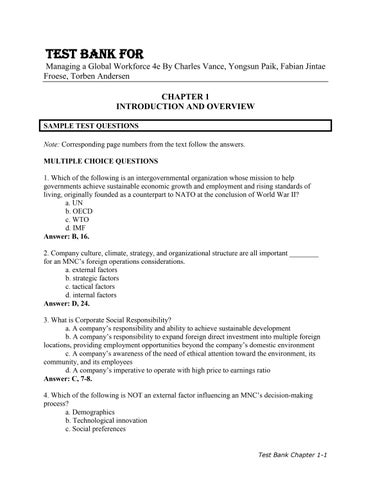
Test Bank For Managing a Global Workforce 4e By Charles Vance, Yongsun Paik, Fabian Jintae Froese, Torben Andersen CHAPTER 1 INTRODUCTION AND OVERVIEW SAMPLE TEST QUESTIONS Note: Corresponding page numbers from the text follow the answers. MULTIPLE CHOICE QUESTIONS 1. Which of the following is an intergovernmental organization whose mission to help governments achieve sustainable economic growth and employment and rising standards of living, originally founded as a counterpart to NATO at the conclusion of World War II? a. UN b. OECD c. WTO d. IMF Answer: B, 16. 2. Company culture, climate, strategy, and organizational structure are all important ________ for an MNC’s foreign operations considerations. a. external factors b. strategic factors c. tactical factors d. internal factors Answer: D, 24. 3. What is Corporate Social Responsibility? a. A company’s responsibility and ability to achieve sustainable development b. A company’s responsibility to expand foreign direct investment into multiple foreign locations, providing employment opportunities beyond the company’s domestic environment c. A company’s awareness of the need of ethical attention toward the environment, its community, and its employees d. A company’s imperative to operate with high price to earnings ratio Answer: C, 7-8. 4. Which of the following is NOT an external factor influencing an MNC’s decision-making process? a. Demographics b. Technological innovation c. Social preferences
Test Bank Chapter 1-1
d. Employee retention rate Answer: D, 25. 5. The most integrated multilateral agreement between governments is a. ASEAN b. EU c. MERCOSUR d. OECD Answer: B, 11. 6. MERCOSUR is a multilateral agreement among which countries? a. Malaysia, Indonesia, and Vietnam b. Germany, France, and Italy c. Oman, UAE, and Saudi Arabia d. Argentina, Brazil, and Uruguay Answer: D, 11. 7. The ILO’s Declaration on Fundamental Principles and Rights at Work did NOT cover which of the following areas? a. Freedom of association and the right to collective bargaining b. Fair import and export tariffs c. The elimination of forced and compulsory labor d. The abolition of child labor Answer: B, 16. 8. Labor unions, and employer and professional associations are examples of ________. a. Non-Government Organizations b. Employee-Interest Organizations c. Worker Protection Associations d. PCNs Answer: B, 19-20. 9. One of the strongest forces today to counter the great global influence of MNCs is the combined impact of ________. a. Labor unions b. World Bank c. NGOs d. Financial IGOs Answer: C, 21. 10. Which of the following statements about company culture is NOT true? a. Company culture is the overall prevailing set of assumptions, attitudes, beliefs, norms, practices, and value within the organization. b. Company culture can have powerful influence on behavior of company members. c. Company culture is relatively easy to change. d. Company culture has major impact on management thinking patterns and philosophy.
Test Bank Chapter 1-2
Answer: C, 25. 11. Which of the following is a fundamentally important priority for MNCs? a. Aligning workforce management practices and human resource functions with company strategy. b. Changing company culture periodically to provide change and variety in the work environment to maintain employee interest and satisfaction. c. Measuring company climate every quarter to ensure appropriate fit. d. Downsizing and running “lean” to optimize efficiency and productivity. Answer: A, 3-4. 12. Strategic Management should involve the identification of ________. a. employee individual weaknesses b. core company values and competencies c. MNC’s corporate responsibility liabilities d. outsourcing opportunities in politically unstable areas Answer: B, 26. 13. Institutions should acquire the following moral responsibilities when it comes to international human resource management except which of the following? a. Avoid the semblance of discriminatory treatment. b. Foster personal enlightenment and self-enrichment of all employees. c. Embrace the growth of globalization regardless of local trends. d. Help all employees develop useful, marketable skills. Answer: C, 32. 14. What is the largest, most comprehensive IGO and global forum in the external environment of global workforce management? a. WTO b. UN c. EU d. NAACP Answer: B, 14. 15. An organization’s international human resource management efforts should take into consideration a. all employees at all levels and locations, including contingent workforce members. b. only regular employees located in the country where the organization is headquartered. c. only regular (non-contingent) employees of the organization, wherever they are located. d. only employees, whether regular or contingent, located outside of the national boundaries where the organization is headquartered. Answer: A, 28-29. 16. Action-learning training methods, zero-based human resource forecasting, off-shoring back office operations, and managing foreign worksite are examples of ________.
Test Bank Chapter 1-3
a. technological innovations b. Chaos Theory c. innovations in management practice d. globalization effects on HRM practice Answer: C, 19. 17. With instant communications facilitated by the Internet and global cell phones and businesses operating in increasingly multi-national and multi-cultural common capacities, cultures are experiencing rapid ________. a. customization b. decline c. convergence d. divergence Answer: C, 34. 18. When implementation of company plans and objectives has to be adjusted for local customization, it is an example of the influence of ________. a. divergence b. globalization c. ethnocentrism d. recapitulation Answer: A, 35. 19. Which organizational function is increasingly placed in the role of “conscience” of the organization, holding the responsibility of developing and monitoring the culture and overall internal environment that support ethical behavior? a. Community Relations b. Social Responsibility Function c. Human Resources d. Public and Government Relations Answer: C, 30. 20. World Bank and IMF are examples of ________. a. NGOs b. financial IGOs c. trade unions d. common markets Answer: B, 17. 21. The ___ was established in 1999 to bring together important industrialized and developing economies to discuss key issues in the global economy. a. b. c. d.
G-20 G-7 G-77 WTO
Test Bank Chapter 1-4
Answer: A, 13-14. 22. This growing international career trend involves self-initiated expatriates from developed countries going abroad on their own to developing countries and finding new venture opportunities that can strengthen local economies. a. SIE b. Entrepreneurial Mercenery c. Migrant Entrepreneur d. Expat-Preneur Answer: A, 29. TRUE/FALSE QUESTIONS 1.
As a result of rapid globalization, companies and managers who wish to remain within their national boundaries and not venture abroad are increasingly subjected to foreign influence because the “abroad” is coming to them in such forms as foreign direct investment, foreign competition, foreign technology, and foreign labor. Answer: True, 3. 2.
Although the COVID-19 coronavirus pandemic has had a huge impact globally on employee work practices, the impact has largely been only temporary, with little longterm effect. Answer: False, 6. 3.
Global competition to increase market share and profitability by increasing the number of satisfied customers at lower cost is the primary driver of globalization. Answer: True, 8. 4.
The two primary types of innovation that affect MNCs externally are innovations in management practice and innovations in technology. Answer: True, 9-10. 5.
The WTO and the IMF are the only global intergovernmental organization dealing with the rules of trade between nations. Answer: False, 17. 6.
NGOs are increasingly partnering with MNCs to help implement corporate commitments to social responsibility. Answer: True, 22. 7.
Company climate, equivalent to company culture, is the overall level of satisfaction of the workforce, and is not prone to quick changes. Answer: False, 25. 8.
An inclusive view of workforce management includes employees who do not have citizenship in the MNC’s home country.
Test Bank Chapter 1-5