Numerical Analysis 10E Chapter 01 Sample Exam
Name (Print):
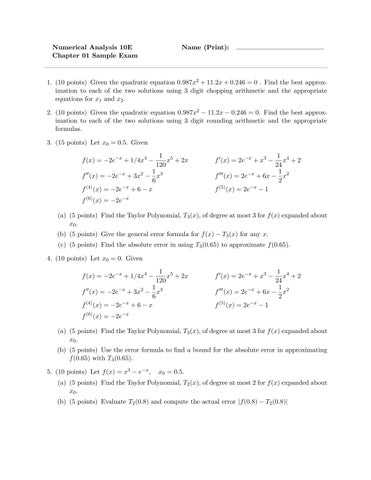
1. (10 points) Given the quadratic equation 0.987x2 + 11.2x + 0.246 = 0 . Find the best approximation to each of the two solutions using 3 digit chopping arithmetic and the appropriate equations for x1 and x2 . 2. (10 points) Given the quadratic equation 0.987x2 − 11.2x − 0.246 = 0. Find the best approximation to each of the two solutions using 3 digit rounding arithmetic and the appropriate formulas. 3. (15 points) Let x0 = 0.5. Given f (x) = −2e−x + 1/4x4 −
1 5 x + 2x 120
1 f 00 (x) = −2e−x + 3x2 − x3 6 f (4) (x) = −2e−x + 6 − x
1 4 x +2 24 1 f 000 (x) = 2e−x + 6x − x2 2 f (5) (x) = 2e−x − 1
f 0 (x) = 2e−x + x3 −
f (6) (x) = −2e−x (a) (5 points) Find the Taylor Polynomial, T3 (x), of degree at most 3 for f (x) expanded about x0 . (b) (5 points) Give the general error formula for f (x) − T3 (x) for any x. (c) (5 points) Find the absolute error in using T3 (0.65) to approximate f (0.65). 4. (10 points) Let x0 = 0. Given f (x) = −2e−x + 1/4x4 −
1 5 x + 2x 120
1 f 00 (x) = −2e−x + 3x2 − x3 6 f (4) (x) = −2e−x + 6 − x
1 4 x +2 24 1 f 000 (x) = 2e−x + 6x − x2 2 f (5) (x) = 2e−x − 1
f 0 (x) = 2e−x + x3 −
f (6) (x) = −2e−x (a) (5 points) Find the Taylor Polynomial, T3 (x), of degree at most 3 for f (x) expanded about x0 . (b) (5 points) Use the error formula to find a bound for the absolute error in approximating f (0.65) with T3 (0.65). 5. (10 points) Let f (x) = x3 − e−x ,
x0 = 0.5.
(a) (5 points) Find the Taylor Polynomial, T2 (x), of degree at most 2 for f (x) expanded about x0 . (b) (5 points) Evaluate T2 (0.8) and compute the actual error |f (0.8) − T2 (0.8)|
Numerical Analysis 10E Chapter 02 Sample Exam
Name (Print):
1. (10 points) The equation f (x) = x2 − 2ex = 0 has a solution in the interval [-1,1]. (a) (5 points) With p0 = −1 and p1 = 1 calculate p2 using the Secant method. (b) (5 points) With p2 from part (a) calculate p3 using Newton’s method. 2. (15 points) The equation f (x) = 2 − x2 sin x = 0 has a solution in the interval [-1,2]. (a) (5 points) Verify that the Bisection method can be applied to the function f (x) on [-1,2]. (b) (5 points) Using the error formula for the Bisection method find the number of iterations needed for accuracy 0.000001. Do not do the Bisection calculations. (c) (5 points) Compute p3 for the Bisection method. 3. (15 points) The following refer to the fixed-point problem (a) (5 points) State the theorem which gives conditions for a fixed-point sequence to converge to a unique fixed point. 2 − x3 + 2x (b) (5 points) Given g(x) = , use the theorem to show that the fixed-point se3 quence will converge to the unique fixed-point of g for any p0 in [-1,1.1]. (c) (5 points) With p0 = 0.5 generate p3 . 4. (10 points) Suppose the function f (x) has a unique zero p in the interval [a, b]. Further, suppose f 00 (x) exists and is continuous on the interval [a,b]. (a) (5 points) Under what conditions will Newton’s Method give a quadratically convergent sequence to p? (b) (5 points) Define quadratic convergence. 2 − x3 + 2x 5. (10 points) Let g(x) = on the interval [-1, 1.1]. Let the initial value be 0 and 3 compute the result of 2 iterations of Stefffensen’s Method to approximate the solution of x = g(x).
Numerical Analysis 10E Chapter 03 Sample Exam
Name (Print):
1. (10 points) Let f (x) = x3 − e−x ,
x0 = 0.5,
x1 = 0.7,
x2 = 1.0.
(a) (5 points) Find the Lagrange Polynomial, P2 (x), of degree at most 2 for f (x) using x0 , x1 , x2 . (b) (5 points) Evaluate P2 (0.8) and compute the actual error |f (0.8) − P2 (0.8)| 2. (15 points) Let x0 = 0,
x1 = 0.5,
f (x) = −2e−x + 1/4x4 −
x2 = 1.0. Given
1 5 x + 2x 120
1 4 x +2 24 1 f 000 (x) = 2e−x + 6x − x2 2 f (5) (x) = 2e−x − 1
f 0 (x) = 2e−x + x3 −
1 f 00 (x) = −2e−x + 3x2 − x3 6 f (4) (x) = −2e−x + 6 − x f (6) (x) = −2e−x
(a) (5 points) Find the Lagrange Interpolating Polynomial, P2 (x), of degree at most 2 for f (x) using x0 , x1 , x2 . (b) (5 points) Give the general error formula for f (x) − P2 (x). (c) (5 points) Use the formula from (b) to find a bound for the absolute error at 0.65 assuming f 000 (x) has no relevant critical points. 3. (10 points) Let f (x) = x4 − 2x3 + x2 − 3,
x0 = 0,
x1 = 0.5,
x2 = 1.0,
x3 = 1.5.
(a) (5 points) Compute the interpolating polynomial, P3 (x), of degree at most 3 for f (x) using the given nodes. (b) (5 points) Find the maximum error in using P3 (x) to approximate f (x) on the interval [0,2]. 4. (10 points) Let f (x) = x sin (2x) − x2 ,
x0 = 0,
x1 = 0.3,
x2 = 0.7.
(a) (5 points) Find Newton’s Divided-Difference form of the interpolating polynomial P2 for f (x) using the three given nodes. (b) (5 points) Add a fourth node x3 = 0.9 and compute the next interpolating polynomial P3 . x
5. (10 points) Let f (x) = xe− 2 ,
x0 = 1,
x1 = 2.
(a) (5 points) Construct the Hermite interpolating polynomial H3 (x) for f (x) using the given nodes. (b) (5 points) Approximate f (1.4) using H3 (1.4) (c) (5 points) Find the absolute error |f (1.4) − H3 (1.4)| (d) (5 points) Find a bound for the error using the error bound formula.
Numerical Analysis 10E Chapter 04 Sample Exam
1. (10 points) Let f (x) = formula with h = 0.2.
Name (Print):
cos x . Approximate f 0 (0.9) using the three point centered difference 1 + x3
2. (15 points) Let f (x) = x ln x + x4 R3 (a) (5 points) Approximate I = 1 f (x)dx using Composite Simpsons rule with n = 4. (b) (5 points) Find the smallest upper bound for the absolute error using the error formula. (c) (5 points) Find the values of n and h required for an error of at most 0.00001? Rb 3. (10 points) The Composite Trapezoidal Rule applied to the integral I = a f (x)dx gives the 2 + 2x − ex b − a 3 00 h f (µ). Suppose f 00 (x) = , a = 0.51, b = 1.0. What values of n error E = − 12 3 and h should be used to approximate I to within 0.00001? 4. (15 points) Let h = 0.2. Given f (x) = −2e−x + 1/4x4 −
1 5 x + 2x 120
1 f 00 (x) = −2e−x + 3x2 − x3 6 f (4) (x) = −2e−x + 6 − x
1 4 x +2 24 1 f 000 (x) = 2e−x + 6x − x2 2 f (5) (x) = 2e−x − 1
f 0 (x) = 2e−x + x3 −
f (6) (x) = −2e−x (a) (5 points) Approximate f 0 (0.65) using the three point centered difference formula. (b) (5 points) Give the general form of the error formula for the five point centered difference formula. (c) (5 points) Give the error formula for part (a). R1 5. (10 points) Consider the integral I = 0 f (x)dx for the function f (x) = −2e−x + 1/4x4 −
1 5 x + 2x 120
1 f 00 (x) = −2e−x + 3x2 − x3 6 (4) −x f (x) = −2e + 6 − x
1 4 x +2 24 1 f 000 (x) = 2e−x + 6x − x2 2 (5) −x f (x) = 2e − 1
f 0 (x) = 2e−x + x3 −
f (6) (x) = −2e−x (a) (5 points) Approximate I using the Composite trapezoidal rule with n = 4. (b) (5 points) Find a bound for the absolute error using the error formula. 6. (10 points) Suppose a numerical procedure is available to approximate a number N with the approximation N (h), where the parameter of the procedure is h > 0. Further, suppose there is an error expansion N = N (h) + h + 2h3 . For a given h we have calculated N (h), N ( h2 ) and N ( h4 ). Give the formulas to obtain the best possible approximation to N using what has already been calculated along with extrapolation.
Numerical Analysis 10E Chapter 05 Sample Exam
Name (Print):
1. (20 points) The Initial Value Problem y y0 = 1 + , t
1 ≤ t ≤ 2,
y(1) = 2
has the solution y(t) = t ln t + 2t (a) (5 points) Approximate y(1.2) using Euler’s Method with h = 0.1. (b) (5 points) Approximate y(1.13) using the results of part (a) and linear interpolation. (c) (5 points) Approximate y(1.2) using the Taylor’s Method or Order 2 with h = 0.1. (d) (5 points) Find a bound for the error in part (a) given by |y(1.2) − w2 |using the error formula for Euler’s Method from Chapter 5 of the textbook. 2. (20 points) Show the initial value problem y 0 = y − t cos ty,
0 ≤ t ≤ 2,
y(0) = 2
has a unique solution and is also well-posed. 3. (20 points) Given the Initial Value Problem y 0 = f (t, y), a ≤ t ≤ b, y(a) = α and an integer N , let h = b−a i = 0, 1, . . . , N − 1. The Trapezoidal method N and ti = a + ih, gives the approximations wi to y(ti ) defined by wi+1 = wi + 12 h(f (ti+1 , wi+1 ) + f (ti , wi )) for i = 0, 1, . . . , N − 1. (a) (5 points) Is the method a one-step or two-step method? (b) (5 points) Is the method explicit or implicit? Why? (c) (5 points) Given the initial value problem y 0 = t − y + 2, 0 ≤ t ≤ 1, y(0) = 3 Let N = 2 and generate w2 to approximate y(1) using Euler’s method. (d) (5 points) Using Eulers method as a predictor method and the Trapezoidal method as a corrector method, generate another approximation w2 for (1). 4. (20 points) For the initial value problem y 0 = f (t, y), a ≤ t ≤ b, y(a) = α the Adams-Bashfoth three -step explicit method is given by w0 = α, w1 = α1 , w2 = α2 , wi+1 = wi +
h (23f (ti , wi ) − 16f (ti−1 , wi−1 ) + 5f (ti−2 , wi−2 )) 12
for i = 2, 3, . . . , N − 1, the Adams-Moulton two-step implicit method is given by w0 = α, w1 = α1 , wi+1 = wi +
h (5f (ti+1 , wi+1 ) + 8f (ti , wi ) − f (ti−1 , wi−1 )), 12
for i = 1, 2, . . . , N − 1, and a Runge-Kutta method of order three is given by w0 = α, wi+1 = wi + for i = 1, 2, . . . , N − 1.
h 2h 2h h h (f (ti , wi ) + 3(f (ti + , wi + f (ti + , wi + f (ti , wi ))))) 4 3 3 3 3