Test Bank For Nursing A Concept-Based Approach to Learning, Volume 2, 4th edition Pearson Chapter 22-51
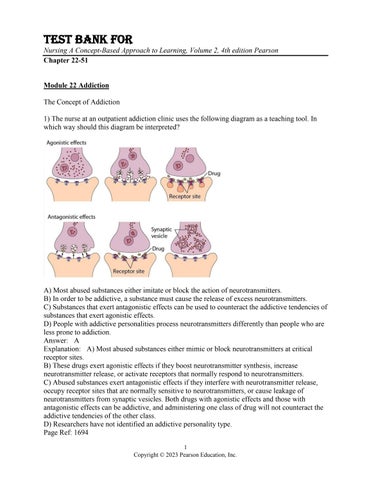
Module 22 Addiction The Concept of Addiction 1) The nurse at an outpatient addiction clinic uses the following diagram as a teaching tool. In which way should this diagram be interpreted?
A) Most abused substances either imitate or block the action of neurotransmitters. B) In order to be addictive, a substance must cause the release of excess neurotransmitters. C) Substances that exert antagonistic effects can be used to counteract the addictive tendencies of substances that exert agonistic effects. D) People with addictive personalities process neurotransmitters differently than people who are less prone to addiction. Answer: A Explanation: A) Most abused substances either mimic or block neurotransmitters at critical receptor sites. B) These drugs exert agonistic effects if they boost neurotransmitter synthesis, increase neurotransmitter release, or activate receptors that normally respond to neurotransmitters. C) Abused substances exert antagonistic effects if they interfere with neurotransmitter release, occupy receptor sites that are normally sensitive to neurotransmitters, or cause leakage of neurotransmitters from synaptic vesicles. Both drugs with agonistic effects and those with antagonistic effects can be addictive, and administering one class of drug will not counteract the addictive tendencies of the other class. D) Researchers have not identified an addictive personality type. Page Ref: 1694 1 Copyright © 2023 Pearson Education, Inc.
Cognitive Level: Applying Client Need/Sub: Physiological Integrity: Physiological Adaptation Standards: QSEN Competencies: III.A.1. Demonstrate knowledge of basic scientific methods and processes. | AACN Domains and Competencies: 2.7 Evaluate outcomes of care. | NLN Competencies: Knowledge and Science: Relationships between knowledge/science and quality and safe patient care. | Nursing Process: Evaluation Learning Outcome: 22.1. Summarize the processes involved in addiction. MNL LO: Analyze the concept of addiction and its application to nursing care. 2) A public health nurse is presenting a teaching session about alcohol use to a group of college seniors. During the session, one of the students admits to frequent alcohol use. Which action should the nurse take? A) Initiate a community assessment of the campus B) Contact the campus nurse and refer the student for services C) Notify campus security that the student may be driving while intoxicated D) Complete a crisis assessment with the student Answer: D Explanation: A) A community assessment is not necessary at this time because the issue appears to be limited to this particular student. B) Contacting the campus nurse is not advised without the student's permission. C) There is no evidence that the student is driving while intoxicated. D) The student should be assessed to determine the extent of crisis he or she is facing as the result of frequent alcohol use. This crisis assessment will allow the nurse to determine the appropriate course of action. Page Ref: 1702 Cognitive Level: Applying Client Need/Sub: Psychosocial Integrity Standards: QSEN Competencies: I.A.1. Integrate understanding of multiple dimensions of patient-centered care: Patient/family/community preferences, values; Coordination and integration of care; Information, communication, and education; Physical comfort and emotional support; Involvement of family and friends; Transition and continuity. | AACN Domains and Competencies: 2.3 Integrate assessment skills in practice. | NLN Competencies: Relationship Centered Care: Effective communication. | Nursing Process: Assessment Learning Outcome: 22.5. Differentiate common assessment procedures and tests used to examine individuals suspected of abusing a substance. MNL LO: Analyze the concept of addiction and its application to nursing care. 3) The nurse educator is teaching a group of students about theories of addiction. Which student statements indicate proper understanding of these theories? Select all that apply. A) "Addiction occurs because of a lack of emotional attachment." B) "There is a biological factor involved in the development of addiction." C) "There are social factors that contribute to the development of addiction." D) "There is a moral factor involved in the development of addiction." E) "There are psychologic elements involved in the development of addiction." Answer: B, C, E Explanation: A) Viewing addiction as only a behavioral or emotional problem oversimplifies a complex issue. B) E. Morton Jellinek first identified biological factors in his disease model of alcoholism. C) Sociocultural factors often influence individuals' decisions as to when, what, and how they use substances. 2 Copyright © 2023 Pearson Education, Inc.
D) The view of addiction as a moral disease is nontherapeutic. E) Research indicates a high correlation among substance use and childhood and adolescent trauma, such as emotional, physical, or sexual abuse. Substance abuse often co-occurs with psychiatric disorders such as anxiety and depression, as some individuals use a substance as a coping strategy and, over time, develop an addiction. Page Ref: 1694-1695 Cognitive Level: Analyzing Client Need/Sub: Psychosocial Integrity Standards: QSEN Competencies: III.A.1. Demonstrate knowledge of basic scientific methods and processes. | AACN Domains and Competencies: 2.7 Evaluate outcomes of care. | NLN Competencies: Knowledge and Science: Relationships between knowledge/science and quality and safe patient care. | Nursing Process: Evaluation Learning Outcome: 22.1. Summarize the processes involved in addiction. MNL LO: Analyze the concept of addiction and its application to nursing care. 4) The nurse observes the family dynamics of an adolescent client who has an addiction problem. Which behavior indicates to the nurse that the family is demonstrating codependency behavior? A) The family is intolerant of any frustration on the part of the client. B) The family engages in actions that enable the client's self-destructive behavior. C) The family is argumentative about seemingly insignificant issues. D) The family exhibits high levels of impatience. Answer: B Explanation: A) Although intolerance of frustration may also be present in this family, they are generally not related to the cycle of codependence and addiction. B) Codependence is a cluster of maladaptive behaviors exhibited by the significant others of a substance-abusing individual that serve to protect and perpetuate the abuse. Codependence frequently involves enabling behavior, which is any action an individual takes that either consciously or unconsciously facilitates substance dependence. C) Although argumentative behaviors may also be present in this family, they are generally not related to the cycle of codependence and addiction. D) Although impatience may also be present in this family, they are generally not related to the cycle of codependence and addiction. Page Ref: 1697 Cognitive Level: Analyzing Client Need/Sub: Psychosocial Integrity Standards: QSEN Competencies: III.A.1. Demonstrate knowledge of basic scientific methods and processes. | AACN Domains and Competencies: 2.3 Integrate assessment skills in practice. | NLN Competencies: Knowledge and Science: Relationships between knowledge/science and quality and safe patient care. | Nursing Process: Assessment Learning Outcome: 22.3. Outline the relationship between addiction and other concepts. MNL LO: Analyze the concept of addiction and its application to nursing care. 5) The nurse is conducting a crisis assessment for a client who admits to cocaine use. Which questions are appropriate for the nurse to ask the client during this process? Select all that apply. A) "Do you have access to any recreational centers?" B) "What is the most significant problem affecting your life right now?" C) "How long has this been a problem?" D) "What are the living conditions in your neighborhood?" E) "What other stresses are you dealing with?" Answer: B, C, E Explanation: A) Questions about recreational centers are more appropriate for a community 3 Copyright © 2023 Pearson Education, Inc.
crisis assessment than for an individual crisis assessment. B) When conducting a crisis assessment for a client who admits to using a substance that is associated with addiction, the nurse should ask about the most significant problem in the client's life right now. C) When conducting a crisis assessment for a client who admits to using a substance that is associated with addiction, the nurse should ask how long this problem has been occurring. D) Questions about neighborhood living conditions are more appropriate for a community crisis assessment than for an individual crisis assessment. E) When conducting a crisis assessment for a client who admits to using a substance that is associated with addiction, the nurse should ask what other stresses may be affecting the client. Page Ref: 1702 Cognitive Level: Applying Client Need/Sub: Psychosocial Integrity Standards: QSEN Competencies: I.A.1. Integrate understanding of multiple dimensions of patient-centered care: Patient/family/community preferences, values; Coordination and integration of care; Information, communication, and education; Physical comfort and emotional support; Involvement of family and friends; Transition and continuity. | AACN Domains and Competencies: 2.3 Integrate assessment skills in practice. | NLN Competencies: Relationship Centered Care: Effective communication. | Nursing Process: Evaluation Learning Outcome: 22.5. Differentiate common assessment procedures and tests used to examine individuals suspected of abusing a substance. MNL LO: Analyze the concept of addiction and its application to nursing care. 6) A client is admitted to the emergency department with signs of drug use. The client reports ingesting Percocet and is currently experiencing respiratory depression. Based on this information, which prescription should the nurse anticipate for this client? A) Diazepam B) Haldol C) Vitamin B12 D) Naloxone Answer: D Explanation: A) Diazepam would be prescribed to manage the symptoms of substance withdrawal. B) Haldol would be administered to manage an overdose of phencyclidine (PCP). C) Vitamin B12 would be used to manage the neurologic symptoms that might accompany a nitrate overdose. D) Percocet (oxycodone and acetaminophen) is an opioid narcotic. Thus, the nurse should anticipate administration of naloxone (Narcan), because this medication is used in the treatment of narcotic overdose. Page Ref: 1709 Cognitive Level: Analyzing Client Need/Sub: Physiological Integrity: Pharmacological and Parenteral Therapies Standards: QSEN Competencies: I.A.1. Integrate understanding of multiple dimensions of patient-centered care: Patient/family/community preferences, values; Coordination and integration of care; Information, communication, and education; Physical comfort and emotional support; Involvement of family and friends; Transition and continuity. | AACN Domains and Competencies: 2.5 Develop a plan of care. | NLN Competencies: Relationship Centered Care: Effective communication. | Nursing Process: Planning Learning Outcome: 22.7. Summarize collaborative therapies used by interprofessional teams for patients with substance use disorders. 4 Copyright © 2023 Pearson Education, Inc.
MNL LO: Analyze the concept of addiction and its application to nursing care. 7) The nurse who runs an addiction treatment group at an inner-city clinic has noticed that many of the group's participants struggle with the stigma attached to their condition. Which statement should the nurse make to help participants overcome this stigma? A) "Relapse is a common feature of substance abuse." B) "Heredity and complex environmental influences predispose some people to substance dependence." C) "People who have an addiction problem cannot be held accountable for their actions." D) "Alcoholics Anonymous and Narcotics Anonymous are both accepted treatment approaches." Answer: B Explanation: A) Although many clients with a history of substance abuse do relapse, this information would not help overcome the stigma of addiction. B) Many clients with addiction struggle with the stigma associated with their condition; for instance, they may feel that addiction is a form of moral failure or a result of personal weakness. Reassuring clients that addiction is rooted in a combination of heredity and environmental factors may help them overcome some of these false beliefs and move toward recovery. C) Nurses should strive to hold clients with addiction accountable for their actions; absolving them of responsibility only serves to enable their substance abuse. D) Although many clients with a history of substance abuse do relapse, information regarding Alcoholics Anonymous or Narcotics Anonymous would not be helpful. Page Ref: 1694-1695 Cognitive Level: Applying Client Need/Sub: Psychosocial Integrity Standards: QSEN Competencies: III.A.1. Demonstrate knowledge of basic scientific methods and processes. | AACN Domains and Competencies: 2.6 Demonstrate accountability for care delivery. | NLN Competencies: Knowledge and Science: Relationships between knowledge/science and quality and safe patient care. | Nursing Process: Implementation Learning Outcome: 22.1. Summarize the processes involved in addiction. MNL LO: Analyze the concept of addiction and its application to nursing care. 8) An employee health nurse is providing care to a worker who was injured on the job. The client has a history of drug addiction and is currently enrolled in a 12-step recovery program. In order to determine whether the employee was impaired at the time of the accident, which diagnostic tool should the nurse use? A) Liver enzymes B) Stool guaiac C) Toxicology testing D) Hair testing Answer: C Explanation: A) Liver enzymes detect liver damage but are not specific to damage from substance abuse. B) A stool guaiac tests for blood. C) Toxicology testing will determine whether the employee had drugs in the system during the shift in which the injury occurred. D) Hair testing can detect substance use for up to 90 days and is not an accurate tool to determine whether the employee was impaired at the time of the injury. Page Ref: 1702 Cognitive Level: Applying Client Need/Sub: Physiological Integrity: Physiological Adaptation Standards: QSEN Competencies: III.A.1. Demonstrate knowledge of basic scientific methods 5 Copyright © 2023 Pearson Education, Inc.