Published
Preview
Edit
chapter 1 This is a preview of the draft version of the quiz
Quiz Type Points Assignment Group Shuffle Answers Time Limit
Graded Quiz 37 Assignments No No Time Limit
Multiple Attempts
No
View Responses
Always
Show Correct Answers
Immediately
One Question at a Time
No
Due
For
Available from
Until
-
Everyone
-
-
Preview
Score for this quiz: 0 out of 37 *
Unanswered
Question 1
Submitted Jun 2 at 6:07pm This attempt took less than 1 minute.
0 / 1 pts
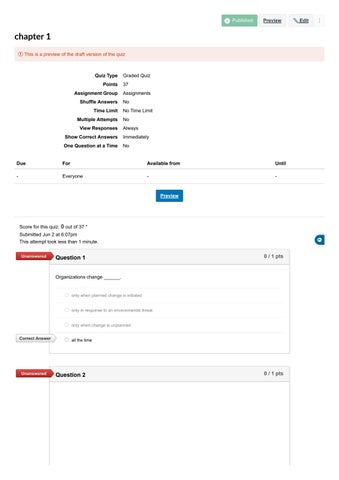
Organizations change ______.
only when planned change is initiated only in response to an environmental threat only when change is unplanned Correct Answer
Unanswered
all the time
Question 2
0 / 1 pts
Most organization change is ______.
revolutionary planned successful Correct Answer
Unanswered
evolutionary
Question 3
0 / 1 pts
Revolutionary change is ______.
planned and rare a major overhaul of the organization rare and major
Unanswered
planned, rare, and major
Question 4
0 / 1 pts
Evolutionary change is ______.
sporadic sequential planned Correct Answer
Unanswered
unplanned
Question 5 Revolutionary change involves a change in ______.
leadership and culture only Correct Answer
strategy, leadership, and culture organizational culture only strategy and leadership only
0 / 1 pts
Correct Answer
Unanswered
Question 6
0 / 1 pts
Which of the following statements is true?
The external environment now changes less rapidly than organizations do. Correct Answer
The external environment now changes more rapidly than organizations do. A few decades ago, the external environment changed more rapidly than organizations. A few decades ago, organizations changed more rapidly than the external environment.
Unanswered
Question 7
0 / 1 pts
Which of the following is true?
Today’s organizations are generally keeping up with the external environment at a two-to-one pace. Today’s organizations are generally keeping up with the external environment at a one-to-one pace. Correct Answer
Today’s organizations need to change more rapidly in order to keep up with the external environment.
Today’s organizations need to be more stable in order to keep up with the external environment.
Unanswered
Question 8
0 / 1 pts
Organizations are generally built on an assumption of ______.
discontinuity and stability continuity and instability Correct Answer
stability and continuity instability and discontinuity
Unanswered
Question 9
0 / 1 pts
Organizations’ external environments are ______.
unstable stable Correct Answer
discontinuous continuous
Unanswered
Question 10
0 / 1 pts
Organizations’ external environments are not ______.
intradependent circular Correct Answer
homeostatic
Unanswered
Question 11
0 / 1 pts
The majority of books and articles about organization change address mainly ______. Correct Answer
continuity and stabilization discontinuous change topics that are irrelevant to organizational change tried and true approaches to revolutionary change
Unanswered
Question 12 Burke relies on which of the following types of books and literature as sources for their book?
Correct Answer
organizational theory, trade and “story” books “story” books and trade books only trade books only organizational theory literature only
0 / 1 pts
unpredictable
Unanswered
Question 13
0 / 1 pts
Gladwell’s The Tipping Point (2000) ______.
neither is a “story” book nor offers insights into how change occurs is a “story” book and offers insights into how change occurs Correct Answer
offers insights into how change occurs is a “story” book
Unanswered
Question 14
0 / 1 pts
Gladwell’s (2000) research is grounded in the ______.
physical and fiscal environments Correct Answer
social and behavioral sciences psychology and management theories
chaos theory and the life sciences
Unanswered
Question 15
0 / 1 pts
According to Burke, the leader of change management par excellence is ______.
Donald Trump John Kotter Bill Gates Correct Answer
Unanswered
Alexander Hamilton
Question 16
0 / 1 pts
In the case study of the vice president’s coverage of the plans for change at Teachers College, Columbia University, the change was prompted by ______.
the fact that the buildings and facilities involved were at least a century old Correct Answer
tearing down buildings to provide space for new ones the increased enrollment