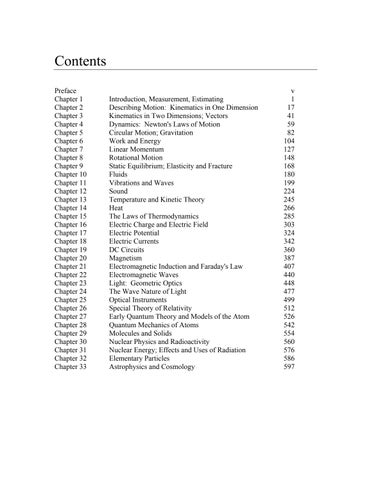
Contents Preface Chapter 1 Chapter 2 Chapter 3 Chapter 4 Chapter 5 Chapter 6 Chapter 7 Chapter 8 Chapter 9 Chapter 10 Chapter 11 Chapter 12 Chapter 13 Chapter 14 Chapter 15 Chapter 16 Chapter 17 Chapter 18 Chapter 19 Chapter 20 Chapter 21 Chapter 22 Chapter 23 Chapter 24 Chapter 25 Chapter 26 Chapter 27 Chapter 28 Chapter 29 Chapter 30 Chapter 31 Chapter 32 Chapter 33
Introduction, Measurement, Estimating Describing Motion: Kinematics in One Dimension Kinematics in Two Dimensions; Vectors Dynamics: Newton's Laws of Motion Circular Motion; Gravitation Work and Energy Linear Momentum Rotational Motion Static Equilibrium; Elasticity and Fracture Fluids Vibrations and Waves Sound Temperature and Kinetic Theory Heat The Laws of Thermodynamics Electric Charge and Electric Field Electric Potential Electric Currents DC Circuits Magnetism Electromagnetic Induction and Faraday's Law Electromagnetic Waves Light: Geometric Optics The Wave Nature of Light Optical Instruments Special Theory of Relativity Early Quantum Theory and Models of the Atom Quantum Mechanics of Atoms Molecules and Solids Nuclear Physics and Radioactivity Nuclear Energy; Effects and Uses of Radiation Elementary Particles Astrophysics and Cosmology
v 1 17 41 59 82 104 127 148 168 180 199 224 245 266 285 303 324 342 360 387 407 440 448 477 499 512 526 542 554 560 576 586 597
Test Item File to accompany
Physics: Principles with Applications Sixth Edition Douglas Giancoli Delena Bell Gatch Georgia Southern University
Preface This test bank is a revision and update of the Test Item File accompanying the fifth edition of Douglas Giancoli’s Physics: Principles with Applications. The sixth edition test bank was created with TestGenerator, a networkable program for creating quizzes and exams. TestGenerator allows users to modify existing questions/problems, including algorithmic versions, as well as create and input new questions/problems. This test bank contains approximately 2500 multiple choice, short answer, and essay questions. The majority of the multiple choice questions and problems could also be given as free response questions or problems. Like the end of chapter of Physics: Principles with Applications, each chapter of the test bank is divided into two sections: Conceptual Questions and Quantitative Problems. Thus, nearly 50% of the material in the test bank is conceptual in nature. All questions and problems are ranked by level of difficulty and are referenced to the corresponding section in the textbook. The notation in the sixth edition test bank has been updated to reflect the notation used in the sixth edition of Physics: Principles with Applications. About the Author Dr. Delena Bell Gatch has taught introductory physics at Georgia Southern University since early 2001. She completed her Ph.D. at the University of Georgia in September of 2000, and remained at the University of Georgia as a post doctorial assistant before accepting the assistant professor position Georgia Southern University. Her field of specialty is experimental condensed matter physics. Her research ventures have included the study of the properties of powder phosphors for flat panel displays, the development of new infrared detection schemes utilizing visible emission from crystals, and the investigation of the shifts in energy levels of crystals due to the application of hydrostatic pressure. During a typical semester, Dr. Gatch teaches three or four introductory physics classes, in addition to one-to-three introductory physics labs. She works with students in the University Honors Program who desire to study physics in greater depth. She also spends time outside of the classroom assisting her premedical students who are preparing to take the MCAT.
Chapter 1 Introduction, Measurement, Estimating
Conceptual Questions 1) Four students measure the mass of an object, each using a different scale. They record their results as follows: Student Mass (g )
A 49.06
B 49
C 50
D 49.2
Which student used the least precise scale? A) A B) B C) C D) D Answer: C Diff: 1
Page Ref: Sec. 1.4
2) Four students measure the mass of an object, each using a different scale. They record their results as follows: Student Mass (g )
A 49.06
B 49
C 50
D 49.2
Which student used the most precise scale? A) A B) B C) C D) D Answer: A Diff: 1
Page Ref: Sec. 1.4
3) A useful method of expressing very small or very large numbers is A) scientific notation. B) arabic numerals. C) the metric system. D) roman numerals. Answer: A Diff: 1
Page Ref: Sec. 1.4
1