Name:
Class:
Date:
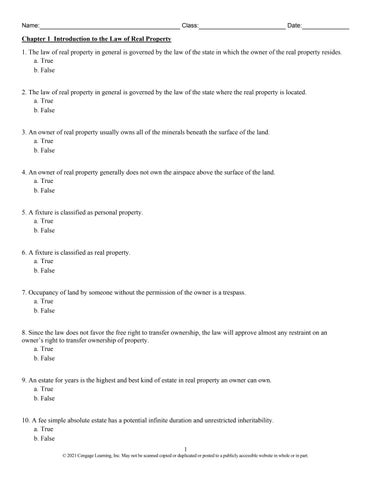
Chapter 1_Introduction to the Law of Real Property 1. The law of real property in general is governed by the law of the state in which the owner of the real property resides. a. True b. False 2. The law of real property in general is governed by the law of the state where the real property is located. a. True b. False 3. An owner of real property usually owns all of the minerals beneath the surface of the land. a. True b. False 4. An owner of real property generally does not own the airspace above the surface of the land. a. True b. False 5. A fixture is classified as personal property. a. True b. False 6. A fixture is classified as real property. a. True b. False 7. Occupancy of land by someone without the permission of the owner is a trespass. a. True b. False 8. Since the law does not favor the free right to transfer ownership, the law will approve almost any restraint on an owner’s right to transfer ownership of property. a. True b. False 9. An estate for years is the highest and best kind of estate in real property an owner can own. a. True b. False 10. A fee simple absolute estate has a potential infinite duration and unrestricted inheritability. a. True b. False 1 © 2021 Cengage Learning, Inc. May not be scanned copied or duplicated or posted to a publicly accessible website in whole or in part.
Name:
Class:
Date:
Chapter 1_Introduction to the Law of Real Property
11. A fee simple on condition subsequent estate automatically expires on the happening or non - happening of the event stated in the deed of conveyance or the will creating the estate. a. True b. False 12. A life estate must always be for the life of the owner. a. True b. False 13. A life estate may be for the life of a person other than the owner. a. True b. False 14. If the owner of a life estate commits waste, the life estate will terminate even though the owner is alive. a. True b. False 15. A life estate owner must share the income generated from the life estate with the owner of the remainder interest. a. True b. False 16. Life estates are transferable during the lifetime of the owner. a. True b. False 17. Life estates are not transferable during the lifetime of the owner. a. True b. False 18. An estate limited in its duration to a fixed period of time is known as a life estate. a. True b. False 19. At common law, an estate at will could be automatically terminated. a. True b. False 20. A promise to make a gift is generally not revocable. 2 © 2021 Cengage Learning, Inc. May not be scanned copied or duplicated or posted to a publicly accessible website in whole or in part.
Name:
Class:
Date:
Chapter 1_Introduction to the Law of Real Property a. True b. False 21. A promise to make a gift is generally revocable. a. True b. False 22. An estate at will is real property that passes by last will and testament. a. True b. False 23. An heir must always be a relative of the decedent. a. True b. False 24. Inheritance is the transfer of ownership of real property when a person dies with a will. a. True b. False 25. Inheritance is the transfer of ownership of real property from a person who dies without a will. a. True b. False 26. The doctrine of riparian rights states that the right to use water is given to the landowner who uses the water first. a. True b. False 27. Appropriation is the doctrine that states that the right to use water is given to the landowner who uses the water first. a. True b. False 28. Appropriation is the doctrine that states that all landowners must share equally in the use of water for domestic purposes. a. True b. False 29. Riparian rights is the doctrine that states that all owners of lands must share equally in the use of water for domestic purposes. a. True b. False 3 © 2021 Cengage Learning, Inc. May not be scanned copied or duplicated or posted to a publicly accessible website in whole or in part.
Name:
Class:
Date:
Chapter 1_Introduction to the Law of Real Property
30. Trade fixtures are fixtures that can easily be traded for another type of property. a. True b. False 31. Trade fixtures are items, such as shelving or counters, installed by a tenant on property to assist the tenant in the conduct of its business. a. True b. False 32. "Color of title" is evidenced by a written instrument such as a deed, court decree, or judgment. a. True b. False 33. A person cannot obtain adverse possession against property that benefits the public. a. True b. False 34. Personal property may include living things such as animals. a. True b. False 35. Personal property does not include living things such as animals. a. True b. False 36. A copyright is tangible property. a. True b. False 37. An automobile is intangible property. a. True b. False 38. A copyright is intangible property. a. True b. False 39. A legal treatise is a code of statutes. 4 © 2021 Cengage Learning, Inc. May not be scanned copied or duplicated or posted to a publicly accessible website in whole or in part.
Name:
Class:
Date:
Chapter 1_Introduction to the Law of Real Property a. True b. False 40. Decisions of trial courts are generally not published. a. True b. False 41. Which of the following is not considered real property? a. Buildings b. Fixtures c. Corn d. Elm tree 42. In determining that an item is a fixture, a court will consider which of the following? a. The extent of the attachment of the item to the building b. The intention of the parties c. The character of the article in its adaptation to the real property d. All of the above 43. The adding together of periods of adverse possession is called: a. Lapping. b. tacking. c. accretion. d. appending. e. none of the above 44. The typical period that a person must possess real property in order to be an adverse possessor is: a. 1 to 3 years. b. 25 years c. 30 years. d. 7 to 20 years e. none of the above 45. In addition to adverse possession being adverse, it must also be: a. public. b. peaceful. c. exclusive. d. continuous. e. none of the above
5 © 2021 Cengage Learning, Inc. May not be scanned copied or duplicated or posted to a publicly accessible website in whole or in part.