Test Bank For Psychological Disorders, 5th edition Deborah C. Beidel Danae L. Hudson Brooke L. Whisenhunt _____________________________________________________________________________ Chapters 1-15
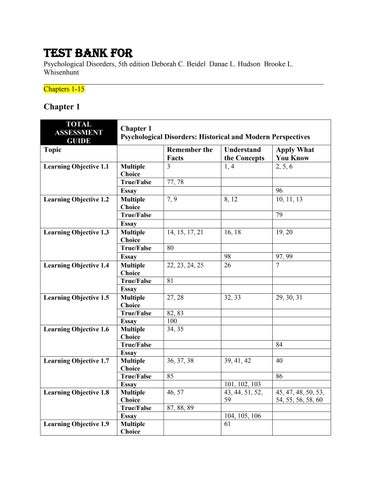
Chapter 1 TOTAL ASSESSMENT GUIDE Topic Learning Objective 1.1
Learning Objective 1.2
Learning Objective 1.3
Learning Objective 1.4
Learning Objective 1.5
Learning Objective 1.6
Learning Objective 1.7
Learning Objective 1.8
Learning Objective 1.9
Chapter 1 Psychological Disorders: Historical and Modern Perspectives
Multiple Choice True/False Essay Multiple Choice True/False Essay Multiple Choice True/False Essay Multiple Choice True/False Essay Multiple Choice True/False Essay Multiple Choice True/False Essay Multiple Choice True/False Essay Multiple Choice True/False Essay Multiple Choice
Remember the Facts
Understand the Concepts
Apply What You Know
3
1, 4
2, 5, 6
8, 12
96 10, 11, 13
77, 78 7, 9
79 14, 15, 17, 21
16, 18
19, 20
98 26
97, 99 7
32, 33
29, 30, 31
80 22, 23, 24, 25 81 27, 28 82, 83 100 34, 35 84 36, 37, 38
39, 41, 42
85 46, 57
40 86
101, 102, 103 43, 44, 51, 52, 59
87, 88, 89 104, 105, 106 61
45, 47, 48, 50, 53, 54, 55, 56, 58, 60
Learning Objective 1.10
Learning Objective 1.11
TOTAL ASSESSMENT GUIDE Learning Objective 1.12
True/False Essay Multiple Choice True/False Essay Multiple Choice True/False
90 67
107 62, 63
64, 65, 66, 68
91, 92 108 69, 70, 71 93
Chapter 1 Psychological Disorders: Historical and Modern Perspectives Essay Multiple Choice True/False Essay
109 72, 73, 74, 76 94
75 95 110
Chapter 1 Psychological Disorders: Historical and Modern Perspectives Multiple Choice 1) The term ―deviance‖ implies __________. A) distress caused to the self or others that is unintentional B) behaving differently from accepted social/cultural norms C) having a mental illness D) engaging in criminal wrongdoing ANSWER: B Difficulty: Moderate Page Ref: 4 Topic: Characteristics and Prevalence Rates of Psychological Disorders LO 1.1: Recall the four characteristics of psychological disorders. Skill: Understand the Concepts 2) Gerry is a night security guard who has worked at the same company for 25 years. He is described as very shy and withdrawn around others. While this behavior is not problematic at work, his relatives find him ―weird‖ and tend to shun him at family gatherings. Despite encouragement by his immediate family to mingle, Gerry hardly speaks to others at these events. According to the goodness of fit concept, Gerry’s behavior would __________. A) not be viewed as a problem at family gatherings B) not be viewed as a problem at work but would be viewed as a problem at family gatherings
C) not be viewed as a problem at all D) only be viewed as a problem if it caused difficulty for his immediate family ANSWER: B Difficulty: Difficult Page Ref: 3 Topic: Characteristics and Prevalence Rates of Psychological Disorders LO 1.1: Recall the four characteristics of psychological disorders. Skill: Apply What You Know 3) The term ―dysfunction‖ implies __________. A) distress caused to the self or others that is unintentional B) interference with important areas of functioning C) having a mental illness D) engaging in criminal wrongdoing ANSWER: B Difficulty: Moderate Page Ref: 4 Topic: Characteristics and Prevalence Rates of Psychological Disorders LO 1.1: Recall the four characteristics of psychological disorders. Skill: Remember the Facts 4) Behavior that _______ is considered to ________. A) harms the self; always be a psychological disorder B) harms others; always be a psychological disorder C) harms others; not involve distress D) harms others; involve distress ANSWER: D Difficulty: Moderate Page Ref: 4 Topic: Characteristics and Prevalence Rates of Psychological Disorders LO 1.1: Recall the four characteristics of psychological disorders. Skill: Understand the Concepts 5) Juan is a first-year student at a local university. He gets up at the same time each day and follows the same pattern: showering and shaving, dressing, and checking his backpack for required books, notebooks, and pens. Early in the first semester, this behavior took approximately 30 minutes. As the semester progressed, Juan spent more and more time checking and rechecking his backpack to make sure he had everything he needed. Toward the end of the semester, Juan was always late for his first class and his grades were worsening because of his checking behaviors. A psychologist might conclude that Juan’s behavior is __________. A) typical for a conscientious student B) dysfunctional but not dangerous C) dysfunctional and dangerous D) dangerous but not deviant ANSWER: B
Difficulty: Difficult Page Ref: 4 Topic: Characteristics and Prevalence Rates of Psychological Disorders LO 1.1: Recall the four characteristics of psychological disorders. Skill: Apply What You Know 6) Paul has frequent fantasies about causing physical harm to others, and he acts on these urges with nonconsenting people he picks up at bars. He is not concerned by these actions, and he reports being very happy and content with his life, relationships, and career. A psychologist might conclude that Paul’s behavior ___________. A) is dysfunctional because it impairs multiple areas of functioning B) interferes with daily functioning C) is deviant but not dangerous D) is deviant and dangerous ANSWER: D Difficulty: Easy Page Ref: 4 Topic: Characteristics and Prevalence Rates of Psychological Disorders LO 1.1: Recall the four characteristics of psychological disorders. Skill: Apply What You Know 7) Which of the following terms is defined as the shared behavioral patterns and lifestyles that differentiate one group of people from another? A) race B) ethnicity C) culture D) group expectations ANSWER: C Difficulty: Easy Page Ref: 5 Topic: Characteristics and Prevalence Rates of Psychological Disorders LO 1.1: Recall the four characteristics of psychological disorders. Skill: Remember the Facts 8) Which statement is TRUE of the original definition of a culture-bound syndrome? A) It is less severe than other forms of mental illness. B) The abnormal behavior is specific to a particular location or group. C) It is usually found only in children. D) The behavior usually requires hospitalization in the home culture. ANSWER: B Difficulty: Easy Page Ref: 5 Topic: Characteristics and Prevalence Rates of Psychological Disorders LO 1.1: Recall the four characteristics of psychological disorders. Skill: Understand the Concepts
9) Except for substance use disorder, the highest rates of psychological disorders are found among persons with the lowest incomes and __________. A) least amount of education B) highest number of siblings C) male gender D) suburban places of residence ANSWER: A Difficulty: Easy Page Ref: 5 Topic: Characteristics and Prevalence Rates of Psychological Disorders LO 1.2: Describe some of the factors that influence the expression and interpretation of psychological disorders. Skill: Remember the Facts 10) William is a well-educated 40-year-old man who has schizophrenia. Originally, he was employed as a computer programmer, but he was fired two months ago because of chronic absenteeism. For the last several weeks he has been experiencing homelessness. He sleeps at night in a cardboard box behind a Dunkin’ Donuts after closing time. Which of the following terms is a hypothesis that could be used to describe William’s current situation? A) downward shift B) downward drift C) downward SES D) downward trajectory ANSWER: B Difficulty: Easy Page Ref: 5 Topic: Characteristics and Prevalence Rates of Psychological Disorders LO 1.2: Describe some of the factors that influence the expression and interpretation of psychological disorders. Skill: Apply What You Know 11) Janet is 5 years old and from a low-income family, and Maria is the same age but comes from a very wealthy family. Which of the following statements is most accurate? A) Maria will develop a psychological disorder and Janet will not. B) Janet will develop a psychological disorder and Maria will not. C) Maria will have a higher chance of developing a psychological disorder than Janet. D) Janet will have a higher chance of developing a psychological disorder than Maria. ANSWER: D Difficulty: Moderate Page Ref: 5 Topic: Characteristics and Prevalence Rates of Psychological Disorders LO 1.2: Describe some of the factors that influence the expression and interpretation of psychological disorders. Skill: Apply What You Know