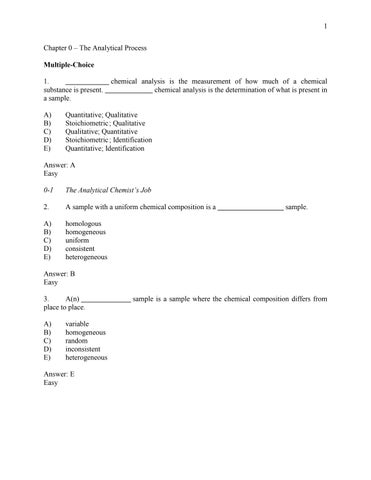
1 Chapter 0 – The Analytical Process Multiple-Choice 1. substance is present. a sample. A) B) C) D) E)
chemical analysis is the measurement of how much of a chemical chemical analysis is the determination of what is present in
Quantitative; Qualitative Stoichiometric ; Qualitative Qualitative; Quantitative Stoichiometric ; Identification Quantitative; Identification
Answer: A Easy 0-1
The Analytical Chemist’s Job
2.
A sample with a uniform chemical composition is a
A) B) C) D) E)
homologous homogeneous uniform consistent heterogeneous
sample.
Answer: B Easy 3. A(n) place to place. A) B) C) D) E)
variable homogeneous random inconsistent heterogeneous
Answer: E Easy
sample is a sample where the chemical composition differs from
2 4.
When extracting a sample with a liquid, the liquid is
A) B) C) D) E)
transferred drained decanted effused dispensed
from the sample.
Answer: C Easy 5.
A(n)
A) B) C) D) E)
orbital shaker vortexer mixer mortar and pestle centrifuge
is used to grind solids into smaller particles.
Answer: D Easy 6. A) B) C) D) E)
is the substance being measured during a chemical analysis. Bulk Lot Sample Analyte Aliquot
Answer: D Easy 7.
The liquid above the packed solid following a centrifugation is the
A) B) C) D) E)
solvonatant analyte serum decanted supernatant
Answer: E Easy
.
3 8.
A(n)
A) B) C) D) E)
slurry colloid gel supernatant allotrope
is a suspension of a solid in a liquid.
Answer: A Easy 9. A) B) C) D) E)
is the series of procedures applied to a sample prior to analysis. Pre-analysis clean up Sample preparation Filler elimination Matrix removal Lot cleaning
Answer: B Easy 10. For separations, the plot of detector response versus time is a(n) and the area under the peak is to the quantity of compound passing through the detector. A) B) C) D) E)
column plot; proportional column plot; inversely proportional chromatogram; proportional chromatogram; inversely proportional absorbance spectrum; proportional
Answer: C Easy
4 11. A(n) is a plot of detector response as a function of analyte concentration. The curve is constructed using containing known concentrations of the analyte of interest. A) B) C) D) E)
analyte curve; response solutions response curve; standard solutions analyte curve; analyte solutions calibration curve; standard solutions response curve; response solutions
Answer: D Easy 12. A) B) C) D) E)
is the process of procuring a representative sample to analyze. Inspection Examination Representation Sampling Partaking
Answer: D Easy 13. Solid-phase extraction is a sample preparation technique. Which of the following statements is(are) NOT true for an aqueous solid-phase extraction? I Solid-phase extraction separates analyte from the sample matrix using a chromatography stationary phase. II An aliquot of the aqueous sample is applied to the solid-phase extraction tube, washing the sample with additional sample and then a water wash. III The analyte sticks to the column and the water wash removes all species that do not adhere to the column. IV An organic solvent is used to wash the analyte from the column. V The organic phase containing the analyte is evaporated to dryness and the solid is dissolved in water, ready for analysis. A) B) C) D) E)
III I II and III IV II
Answer: E Easy
5 0-2
General Steps in a Chemical Analysis
14. occurs when a species other than analyte increases or decreases the analytical signal and makes it appear that the concentration is greater or less than the real concentration. A) B) C) D) E)
Interference Masking Aliquots Disruption Intervention
Answer: A Easy 15. not detected. A) B) C) D) E)
is the transformation of an interfering species into a form that is
Interference Masking Obscurance Cloaking Camouflaging
Answer: B Easy 16.
Which is NOT a general step in the analytical process?
A) B) C) D) E)
Sample Preparation Selecting analytical procedures Make policy Reporting and interpretation Analysis
Answer: C Easy