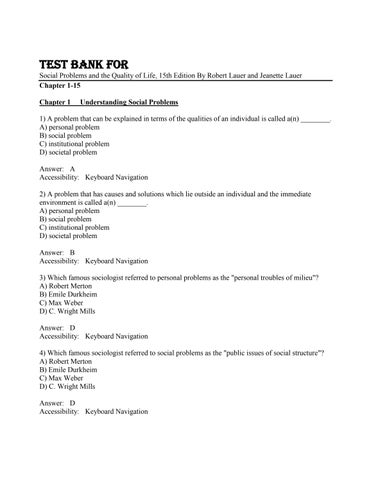
Test Bank For Social Problems and the Quality of Life, 15th Edition By Robert Lauer and Jeanette Lauer Chapter 1-15 Chapter 1
Understanding Social Problems
1) A problem that can be explained in terms of the qualities of an individual is called a(n) ________. A) personal problem B) social problem C) institutional problem D) societal problem Answer: A Accessibility: Keyboard Navigation 2) A problem that has causes and solutions which lie outside an individual and the immediate environment is called a(n) ________. A) personal problem B) social problem C) institutional problem D) societal problem Answer: B Accessibility: Keyboard Navigation 3) Which famous sociologist referred to personal problems as the "personal troubles of milieu"? A) Robert Merton B) Emile Durkheim C) Max Weber D) C. Wright Mills Answer: D Accessibility: Keyboard Navigation 4) Which famous sociologist referred to social problems as the "public issues of social structure"? A) Robert Merton B) Emile Durkheim C) Max Weber D) C. Wright Mills Answer: D Accessibility: Keyboard Navigation
5) If a problem is defined as personal, ________ are employed to cope with the problem. A) individual strategies B) collective strategies C) societal strategies D) professional strategies Answer: A Accessibility: Keyboard Navigation 6) A social problem is defined as a condition or pattern of behavior that: A) validates some other condition or pattern of behavior. B) is caused, facilitated, or prolonged by factors that operate at a single level of social life. C) is defined as compatible with the desired quality of life. D) requires social action to be resolved. Answer: D Accessibility: Keyboard Navigation 7) A sociological theory that focuses on social systems and how their interdependent parts maintain order is called ________. A) structural functionalism B) conflict theory C) symbolic interactionism D) cultural theory Answer: A Accessibility: Keyboard Navigation 8) A theory that focuses on contradictory interests, inequalities between social groups, and the resulting conflict and change is called ________. A) structural functionalism B) conflict theory C) symbolic interactionism D) cultural theory Answer: B Accessibility: Keyboard Navigation
9) A sociological theory that focuses on the interaction between individuals, an individual's perception of situations, and the ways in which social life is constructed through interaction is called ________. A) structural functionalism B) conflict theory C) symbolic interactionism D) cultural theory Answer: C Accessibility: Keyboard Navigation 10) In structural functionalism, a problem involves a system of interdependent parts, including shared expectations about behavior called ________. A) norms B) roles C) contradictions D) values Answer: A Accessibility: Keyboard Navigation 11) The behavior associated with a particular position in the social structure is called a(n) ________. A) norm B) role C) expectation D) function Answer: B Accessibility: Keyboard Navigation 12) Things that are preferred because they are defined as having worth are called ________. A) attitudes B) ideologies C) beliefs D) values Answer: D Accessibility: Keyboard Navigation
13) The arrangement of society into groups that are unequal with regard to such valued resources as wealth, power, and prestige is called ________. A) a stratification system B) culture C) society D) intuition Answer: A Accessibility: Keyboard Navigation 14) Which of the following is true according to the symbolic interactionist approach in sociology? A) A problem involves a system of interdependent parts, including institutions, norms, roles, and values. B) Contradictions and inequalities exist between the parts of a social system and generate conflict between groups. C) A pattern of inequality of wealth, power, and prestige exists in all societies. D) The perspectives of individuals, including their attitudes and ideologies, are important components of the social system. Answer: D Accessibility: Keyboard Navigation 15) A set of ideas that explain or justify some aspect of social reality is called ________. A) an attitude B) an ideology C) a value D) a role Answer: B Accessibility: Keyboard Navigation 16) Which of the following is an assumption of the structural functionalist approach in sociology? A) Society is an integrated system of interdependent parts, bound together by shared values and norms. B) Society is a system of diverse groups, with conflicting values and interests, vying with each other for power, wealth, and other valued resources. C) Society is an arena of interacting individuals who behave in accord with their definitions of situations and who create shared meanings as they interact. D) Society is a system of the perspectives of individuals, including their attitudes and ideologies. Answer: A Accessibility: Keyboard Navigation
17) How does the conflict theory explain social problems generally? A) Problems occur when patterns of social interaction alter the social structural factors. B) A situation or form of behavior becomes a problem when people define it as such. C) Problems are the result of dominance over, and exploitation of, some groups by others. D) Problems arise out of social disorganization, a state in which consensus about norms has broken down. Answer: C Accessibility: Keyboard Navigation 18) How does structural functionalism explain poverty? A) The upper and middle classes oppress and exploit the poor and create ideologies that blame the poor and justify their poverty. B) Political, economic, and educational institutions are not functioning adequately, so that old arrangements are obsolete before new arrangements are in place. C) Poverty became a social problem in the United States when people accepted that people remain poor when they define their poverty as the result of their own deficiencies. D) Upper- and middle-class lawmakers regularly support corporate welfare but reject such welfare ideas for the poor as a guaranteed minimum annual income. Answer: B Accessibility: Keyboard Navigation 19) The ________ uses three broad categories: basic human needs (such as nutrition, medical care, and sanitation); foundations of well-being (health, environmental quality, access to basic knowledge and information); and opportunity (personal rights and freedom, tolerance, access to advanced education). A) World Values Survey B) World Happiness Report C) Human Development Index D) Social Progress Index Answer: D Accessibility: Keyboard Navigation 20) The idea of the globalization of the economy would be measured at what level of social life? A) individual level B) group level C) societal level D) global level Answer: D Accessibility: Keyboard Navigation