Chapter 1: Introduction Chapter revision questions 1. A. B. C. D.
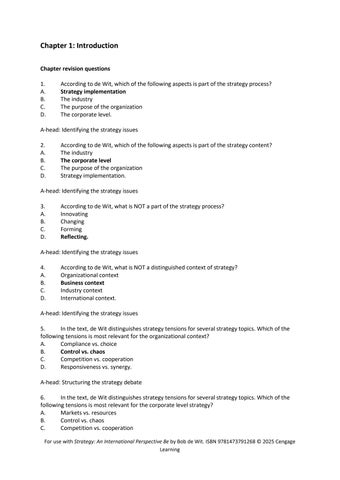
According to de Wit, which of the following aspects is part of the strategy process? Strategy implementation The industry The purpose of the organization The corporate level.
A-head: Identifying the strategy issues 2. A. B. C. D.
According to de Wit, which of the following aspects is part of the strategy content? The industry The corporate level The purpose of the organization Strategy implementation.
A-head: Identifying the strategy issues 3. A. B. C. D.
According to de Wit, what is NOT a part of the strategy process? Innovating Changing Forming Reflecting.
A-head: Identifying the strategy issues 4. A. B. C. D.
According to de Wit, what is NOT a distinguished context of strategy? Organizational context Business context Industry context International context.
A-head: Identifying the strategy issues 5. In the text, de Wit distinguishes strategy tensions for several strategy topics. Which of the following tensions is most relevant for the organizational context? A. Compliance vs. choice B. Control vs. chaos C. Competition vs. cooperation D. Responsiveness vs. synergy. A-head: Structuring the strategy debate 6. In the text, de Wit distinguishes strategy tensions for several strategy topics. Which of the following tensions is most relevant for the corporate level strategy? A. Markets vs. resources B. Control vs. chaos C. Competition vs. cooperation For use with Strategy: An International Perspective 8e by Bob de Wit. ISBN 9781473791268 © 2025 Cengage Learning
D.
Responsiveness vs. synergy.
A-head: Structuring the strategy debate 7. In the text, de Wit distinguishes strategy tensions for several strategy topics. Which of the following tension is most relevant for the strategy formation? A. Logic vs. creativity B. Control vs. chaos C. Deliberateness vs. emergence D. Revolution vs. evolution. A-head: Structuring the strategy debate 8. In the text, de Wit claims to take a dialectical approach. What does the author NOT mention as an advantage of this approach? A. Stimulus for bridging B. Stimulus for motivation C. Stimulus for creativity D. Range of ideas. A-head: Structuring the strategy debate 9. A. B. C. D.
According to the text, what is the strategy tension for the network level of strategy? Profitability vs. responsibility Competition vs. cooperation Control vs. chaos Globalization vs. localization.
A-head: Structuring the strategy debate 10. de Wit discusses the different perspectives that belong to certain strategy topics. To what strategic topic do the following belong: outside-in and inside-out perspectives? A. Organizational context B. Network level strategy C. Corporate level strategy D. Business level strategy. A-head: Structuring the strategy debate 11. The textbook discusses the different perspectives that belong to certain strategy topics. To what strategic topic do the following two perspectives belong: discrete and embedded organizations? A. Organizational context B. Network level strategy C. Corporate level strategy D. Business level strategy. A-head: Structuring the strategy debate
For use with Strategy: An International Perspective 8e by Bob de Wit. ISBN 9781473791268 © 2025 Cengage Learning
12. The textbook emphasizes the importance of an international perspective. What is the motivation for the author to do so? A. Because more companies open subsidiaries abroad B. To question whether theories can be standardized globally C. Because the paradox approach is only acceptable in the West D. Because strategy is less relevant for companies that only operate locally. A-head: Developing an international perspective
For use with Strategy: An International Perspective 8e by Bob de Wit. ISBN 9781473791268 © 2025 Cengage Learning
Chapter 2: Strategizing Chapter revision questions 1. What is, according to de Wit’s textbook, the main issue of strategic thinking? A. The issue of strategic creativeness B. The issue of strategic reasoning C. The issue of strategy intuition D. The issue of strategic cogitation. A-head: The issue of strategic thinking 2. In the text, de Wit distinguishes several levels of the strategic thinking process. Which of the following levels does the author NOT mention? A. Personal level B. Application level C. Operating system level D. Hardware level. A-head: The issue of strategic thinking 3. According to de Wit, which of the following elements of the strategic reasoning process is best described by the following question: “How should the problem be addressed”? A. Identifying B. Diagnosing C. Conceiving D. Realizing A-head: The issue of strategic thinking 4. In the text, de Wit appoints three factors that cause the limitation to human cognitive abilities. Which of the following factors does the author NOT mention? A. Limited information sensing ability B. Limited information processing capacity C. Limited information receiving capacity D. Limited information storage capacity. A-head: The issue of strategic thinking 5. According to de Wit, if the analytic reasoning perspective is correct, what is the best preparation for strategic reasoning? A. To be trained in the scientific tradition B. To be trained like a chess grand master C. To be trained not to rely on routines and habits D. To be trained to explicitly state one’s personal values and aspirations. A-head: Perspectives on strategizing
For use with Strategy: An International Perspective 8e by Bob de Wit. ISBN 9781473791268 © 2025 Cengage Learning
6. According to proponents of the holistic reasoning perspective, why can strategic problems not be tackled analytically? A. Holistic thinking entraps the strategist in the current orthodoxy, allowing them to see the problem more clearly B. Given the fact that people have bounded rationality, a better approach is to accept the limitation and adopt the holistic approach C. Because strategic problems are ‘wicked’, they can easily and objectively be defined D. None of the above. A-head: Perspectives on strategizing 7. What is the assumption made by analytic reasoners about the nature of reality? A. Partially knowable B. Partially creatable C. Entirely creatable D. Entirely unknowable. A-head: Managing the paradox of logic and intuition 8. According to de Wit, what is the major limitation of the analytic reasoning perspective? A. It directs strategists to implement statistical methods in the real life situations B. It forces strategists to break out of the prevailing paradigm C. It entraps strategists in consistent reasoning based on one prevailing paradigm D. It forces strategists to follow formal and fixed rules of reasoning. A-head: Perspectives on strategizing 9. According to proponents of the holistic reasoning perspective, what is essential for strategists? A. To generate new ways of understanding and doing B. To follow procedural rationality C. To perceive strategy making as science D. To identify strengths and weaknesses. A-head: Perspectives on strategizing 10. Which business sector is most likely to demand holistic thinking the majority of the time? A. Accountancy B. Entrepreneurial C. Biotechnology D. Financial management. A-head: Strategic thinking in international perspective
For use with Strategy: An International Perspective 8e by Bob de Wit. ISBN 9781473791268 © 2025 Cengage Learning