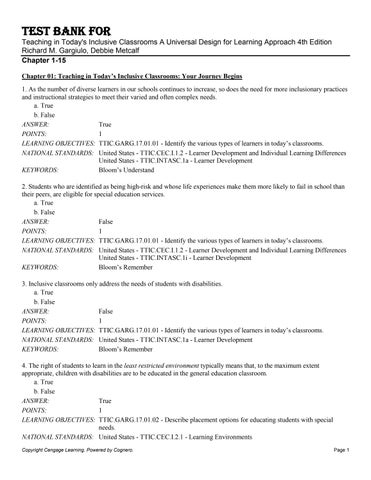
Test Bank For Teaching in Today's Inclusive Classrooms A Universal Design for Learning Approach 4th Edition Richard M. Gargiulo, Debbie Metcalf Chapter 1-15 Chapter 01: Teaching in Today’s Inclusive Classrooms: Your Journey Begins 1. As the number of diverse learners in our schools continues to increase, so does the need for more inclusionary practices and instructional strategies to meet their varied and often complex needs. a. True b. False ANSWER: True POINTS: 1 LEARNING OBJECTIVES: TTIC.GARG.17.01.01 - Identify the various types of learners in today’s classrooms. NATIONAL STANDARDS: United States - TTIC.CEC.I.1.2 - Learner Development and Individual Learning Differences United States - TTIC.INTASC.1a - Learner Development KEYWORDS: Bloom’s Understand 2. Students who are identified as being high-risk and whose life experiences make them more likely to fail in school than their peers, are eligible for special education services. a. True b. False ANSWER: False POINTS: 1 LEARNING OBJECTIVES: TTIC.GARG.17.01.01 - Identify the various types of learners in today’s classrooms. NATIONAL STANDARDS: United States - TTIC.CEC.I.1.2 - Learner Development and Individual Learning Differences United States - TTIC.INTASC.1i - Learner Development KEYWORDS: Bloom’s Remember 3. Inclusive classrooms only address the needs of students with disabilities. a. True b. False ANSWER: False POINTS: 1 LEARNING OBJECTIVES: TTIC.GARG.17.01.01 - Identify the various types of learners in today’s classrooms. NATIONAL STANDARDS: United States - TTIC.INTASC.1a - Learner Development KEYWORDS: Bloom’s Remember 4. The right of students to learn in the least restricted environment typically means that, to the maximum extent appropriate, children with disabilities are to be educated in the general education classroom. a. True b. False ANSWER: True POINTS: 1 LEARNING OBJECTIVES: TTIC.GARG.17.01.02 - Describe placement options for educating students with special needs. NATIONAL STANDARDS: United States - TTIC.CEC.I.2.1 - Learning Environments Copyright Cengage Learning. Powered by Cognero.
Page 1
KEYWORDS:
United States - TTIC.INTASC.3d - Learning Environments Bloom’s Remember
5. What is viewed today as a fundamental right for students with disabilities was, at one time, perceived to be a privilege. a. True b. False ANSWER: True POINTS: 1 LEARNING OBJECTIVES: TTIC.GARG.17.01.04 - Describe the role of the courts in special education. NATIONAL STANDARDS: United States - TTIC.CEC.I.2.1 - Learning Environments United States - TTIC.INTASC.3c - Learning Environments KEYWORDS: Bloom’s Understand 6. The Americans with Disabilities Act is the primary legislation governing special education a. True b. False ANSWER: False POINTS: 1 LEARNING OBJECTIVES: TTIC.GARG.17.01.04 - Describe the role of the courts in special education. NATIONAL STANDARDS: United States - TTIC.INTASC.3c - Learning Environments KEYWORDS: Bloom’s Remember 7. In the case Schaffer v. Weast, the court ruled that placement in a general education classroom with supplementary aids and services must be offered to a student with disabilities prior to considering more segregated placements. a. True b. False ANSWER: False POINTS: 1 LEARNING OBJECTIVES: TTIC.GARG.17.01.04 - Describe the role of the courts in special education. NATIONAL STANDARDS: United States - TTIC.INTASC.3c - Learning Environments KEYWORDS: Bloom’s Remember 8. Under the Education for All Handicapped Children Act (PL 94-142), later to be renamed IDEA, a child must receive a nondiscriminatory assessment from a multidisciplinary team prior to being placed in special education. a. True b. False ANSWER: True POINTS: 1 LEARNING OBJECTIVES: TTIC.GARG.17.01.04 - Describe the role of the courts in special education. NATIONAL STANDARDS: United States - TTIC.INTASC.1a - Learner Development KEYWORDS: Bloom’s Remember 9. The 1997 Amendments to IDEA (PL 105-17) exempted students with disabilities from state- and district-wide assessment programs. a. True b. False ANSWER: False Copyright Cengage Learning. Powered by Cognero.
Page 2
POINTS: 1 LEARNING OBJECTIVES: TTIC.GARG.17.01.04 - Describe the role of the courts in special education. NATIONAL STANDARDS: United States - TTIC.INTASC.1a - Learner Development KEYWORDS: Bloom’s Remember 10. The Rehabilitation Act of 1973 is a civil rights law because Section 504 of the act was specifically intended to protect children and adults against discrimination due to a disability. a. True b. False ANSWER: True POINTS: 1 LEARNING OBJECTIVES: TTIC.GARG.17.01.04 - Describe the role of the courts in special education. NATIONAL STANDARDS: United States - TTIC.INTASC.31a - Learner Development KEYWORDS: Bloom’s Understand 11. Referring to individuals with special needs from a people-first perspective reflects a: a. focus on the disability, not the person. b. belief that teachers must only use politically correct language. c. change in word order and nothing more. d. belief that all students have the potential to learn and are people first and foremost. ANSWER: d POINTS: 1 LEARNING OBJECTIVES: TTIC.GARG.17.01.01 - Identify the various types of learners in today’s classrooms. NATIONAL STANDARDS: United States - TTIC.CEC.I.1.1 - Learner Development and Individual Learning Differences United States - TTIC.INTASC.3e - Learning Environments KEYWORDS: Bloom’s Understand 12. The largest group of diverse learners is students: a. from culturally diverse backgrounds. b. who are gifted or talented. c. with disabilities. d. who are not American citizens. ANSWER: c POINTS: 1 LEARNING OBJECTIVES: TTIC.GARG.17.01.01 - Identify the various types of learners in today’s classrooms. NATIONAL STANDARDS: United States - TTIC.CEC.I.2.1 - Learning Environments United States - TTIC.INTASC.3l - Learning Environments KEYWORDS: Bloom’s Remember 13. Which of the following students would NOT be considered to have a disability as defined by IDEA 2004? a. A student at risk of failing b. A student with emotional disturbances c. A student with autism d. A student with specific learning disabilities ANSWER: a POINTS: 1 Copyright Cengage Learning. Powered by Cognero.
Page 3
LEARNING OBJECTIVES: TTIC.GARG.17.01.01 - Identify the various types of learners in today’s classrooms. NATIONAL STANDARDS: United States - TTIC.CEC.I.2.1 - Learning Environments United States - TTIC.INTASC.3b - Learning Environments KEYWORDS: Bloom’s Understand 14. Which of the following would NOT fall under the Other Health Impairment category? a. Diabetes b. Leukemia c. Schizophrenia d. ADHD ANSWER: c POINTS: 1 LEARNING OBJECTIVES: TTIC.GARG.17.01.01 - Identify the various types of learners in today’s classrooms. NATIONAL STANDARDS: United States - TTIC.CEC.I.1.2 - Learner Development and Individual Learning Differences United States - TTIC.INTASC.1b - Learner Development KEYWORDS: Bloom’s Understand 15. Students who are gifted and talented: a. are considered to have a disability. b. do not require specialized instruction. c. are considered to be exceptional. d. are included in federal special education legislation. ANSWER: c POINTS: 1 LEARNING OBJECTIVES: TTIC.GARG.17.01.01 - Identify the various types of learners in today’s classrooms. NATIONAL STANDARDS: United States - TTIC.CEC.I.1.2 - Learner Development and Individual Learning Differences United States - TTIC.INTASC.1b - Learner Development KEYWORDS: Bloom’s Understand 16. Any child who is exposed to experiences such as domestic violence, substance abuse, child abuse, poverty, and/or homelessness: a. will always become an at-risk student at some point. b. is considered to be a student with a disability c. has an increased likelihood of becoming an at-risk student. d. has the same chance of becoming an at-risk student as a child who was not exposed to such experiences. ANSWER: c POINTS: 1 LEARNING OBJECTIVES: TTIC.GARG.17.01.01 - Identify the various types of learners in today’s classrooms. NATIONAL STANDARDS: United States - TTIC.CEC.I.1.2 - Learner Development and Individual Learning Differences United States - TTIC.INTASC.1b - Learner Development KEYWORDS: Bloom’s Understand 17. A continuum or cascade of service delivery: a. is a new concept introduced by IDEA in 1990. b. is based on the concept that the effective delivery of special education services requires a variety of settings to meet the unique needs of each learner. c. is based on the concept that all special education services, regardless of the level of intensity, should be Copyright Cengage Learning. Powered by Cognero.
Page 4
provided in the general education classroom. d. is based on the concept that the resource room is the best setting for students with disabilities. ANSWER: b POINTS: 1 LEARNING OBJECTIVES: TTIC.GARG.17.01.02 - Describe placement options for educating students with special needs. NATIONAL STANDARDS: United States - TTIC.CEC.I.2.1 - Learning Environments United States - TTIC.INTASC.3d - Learning Environments KEYWORDS: Bloom’s Understand 18. Universal design for learning (UDL): a. was originally developed as a scientific concept to describe the universality of reactions to educational methods. b. is synonymous with the universal inclusion of students with disabilities, both social and academic, with peers who do not have disabilities. c. is seen as a vehicle for ensuring that teachers can meet the needs of students who have widely varying learning requirements in inclusive settings. d. implies that there is one optimal solution for everyone regardless of disability. ANSWER: c POINTS: 1 LEARNING OBJECTIVES: TTIC.GARG.17.01.03 - Explain the concept of universal design for learning (UDL). NATIONAL STANDARDS: United States - TTIC.CEC.I.1.2 - Learner Development and Individual Learning Differences United States - TTIC.INTASC.1a - Learner Development KEYWORDS: Bloom’s Understanding 19. All of the following statements regarding special education litigation and legislation are true, except: a. Litigation often led to legislation, which in turn led to more litigation to interpret and clarify the law. b. Due to litigation, the past 30 years have seen a significant decrease in the educational benefits available to individuals with special educational needs. c. Before the late 1950s, the federal government paid little attention to the education of individuals with disabilities. d. Opportunities for individuals with disabilities have greatly increased with the dramatic growth in special education legislation. ANSWER: b POINTS: 1 LEARNING OBJECTIVES: TTIC.GARG.17.01.04 - Describe the role of the courts in special education. NATIONAL STANDARDS: United States - TTIC.CEC.I.2.1 - Learning Environments United States - TTIC.INTASC.3d - Learning Environments KEYWORDS: Bloom’s Understand th
20. Which court case found that the equal protection clause of the 14 Amendment was violated by ―tracking‖ students based on biased, standardized tests? a. Hobson v. Hansen b. Diana v. State Board of Education c. Pennsylvania Association for Retarded Children v. Commonwealth of Pennsylvania d. Larry P. v. Riles ANSWER: a Copyright Cengage Learning. Powered by Cognero.
Page 5