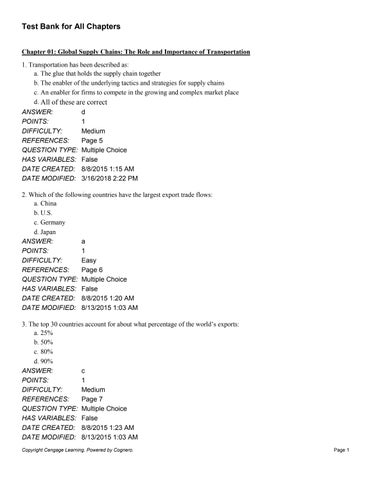
Test Bank for All Chapters Chapter 01: Global Supply Chains: The Role and Importance of Transportation 1. Transportation has been described as: a. The glue that holds the supply chain together b. The enabler of the underlying tactics and strategies for supply chains c. An enabler for firms to compete in the growing and complex market place d. All of these are correct ANSWER: d POINTS: 1 DIFFICULTY: Medium REFERENCES: Page 5 QUESTION TYPE: Multiple Choice HAS VARIABLES: False DATE CREATED: 8/8/2015 1:15 AM DATE MODIFIED: 3/16/2018 2:22 PM 2. Which of the following countries have the largest export trade flows: a. China b. U.S. c. Germany d. Japan ANSWER: a POINTS: 1 DIFFICULTY: Easy REFERENCES: Page 6 QUESTION TYPE: Multiple Choice HAS VARIABLES: False DATE CREATED: 8/8/2015 1:20 AM DATE MODIFIED: 8/13/2015 1:03 AM 3. The top 30 countries account for about what percentage of the world’s exports: a. 25% b. 50% c. 80% d. 90% ANSWER: c POINTS: 1 DIFFICULTY: Medium REFERENCES: Page 7 QUESTION TYPE: Multiple Choice HAS VARIABLES: False DATE CREATED: 8/8/2015 1:23 AM DATE MODIFIED: 8/13/2015 1:03 AM Copyright Cengage Learning. Powered by Cognero.
Page 1
Test Bank for All Chapters 4. The volume of global trade over the course of the last 50 years has: a. Remained almost constant b. Doubled c. Tripled d. Decreased ANSWER: b POINTS: 1 DIFFICULTY: Easy REFERENCES: Page 7 QUESTION TYPE: Multiple Choice HAS VARIABLES: False DATE CREATED: 8/8/2015 1:28 AM DATE MODIFIED: 8/13/2015 1:03 AM 5. There was spectacular growth in global trends after 1990. Why? a. Greater acceptance of foreign produced manufactured products. b. Elimination of trade agreements c. Higher tariffs d. All of these are correct ANSWER: a POINTS: 1 DIFFICULTY: Medium REFERENCES: Page 7 QUESTION TYPE: Multiple Choice HAS VARIABLES: False DATE CREATED: 8/8/2015 1:30 AM DATE MODIFIED: 3/16/2018 2:25 PM 6. The top importer in the world is: a. China b. Germany c. Japan d. U.S. ANSWER: d POINTS: 1 DIFFICULTY: Easy REFERENCES: Page 9 QUESTION TYPE: Multiple Choice HAS VARIABLES: False DATE CREATED: 8/8/2015 1:58 AM DATE MODIFIED: 8/13/2015 1:03 AM 7. Which of the following countries had the largest population in 2014? a. U.S. Copyright Cengage Learning. Powered by Cognero.
Page 2
Test Bank for All Chapters b. China c. India d. Indonesia ANSWER: b POINTS: 1 DIFFICULTY: Easy REFERENCES: Page 13 QUESTION TYPE: Multiple Choice HAS VARIABLES: False DATE CREATED: 8/8/2015 2:00 AM DATE MODIFIED: 8/13/2015 1:03 AM 8. Which of the following countries is expected to have the largest population in 2050? a. U.S. b. China c. India d. Indonesia ANSWER: c POINTS: 1 DIFFICULTY: Easy REFERENCES: Page 13 QUESTION TYPE: Multiple Choice HAS VARIABLES: False DATE CREATED: 8/8/2015 2:02 AM DATE MODIFIED: 8/13/2015 1:03 AM 9. In 2010, what was the approximate percentage of people in the United States who were 65 or older? a. 15% b. 10% c. 5% d. 20% ANSWER: a POINTS: 1 DIFFICULTY: Hard REFERENCES: Page 16 QUESTION TYPE: Multiple Choice HAS VARIABLES: False DATE CREATED: 8/8/2015 2:09 AM DATE MODIFIED: 8/13/2015 1:03 AM 10. In 2030, what is the estimated percentage of the world’s population that will live in urban areas? a. 30% b. 40% c. 50% Copyright Cengage Learning. Powered by Cognero.
Page 3
Test Bank for All Chapters d. 60% ANSWER: d POINTS: 1 DIFFICULTY: Hard REFERENCES: Page 16 QUESTION TYPE: Multiple Choice HAS VARIABLES: False DATE CREATED: 8/8/2015 2:13 AM DATE MODIFIED: 8/13/2015 1:03 AM 11. What area of the world will have the largest number of megacities by 2015? a. United States b. South America c. Africa d. Asia ANSWER: d POINTS: 1 DIFFICULTY: Medium REFERENCES: Page 16 QUESTION TYPE: Multiple Choice HAS VARIABLES: False DATE CREATED: 8/8/2015 2:17 AM DATE MODIFIED: 8/13/2015 1:03 AM 12. What positive outcomes have occurred in the global economy with increase interdependence: a. Lower prices b. Wider availability of goods c. New employment opportunities d. All of these are correct ANSWER: d POINTS: 1 DIFFICULTY: Medium REFERENCES: Page 19 QUESTION TYPE: Multiple Choice HAS VARIABLES: False DATE CREATED: 8/8/2015 2:19 AM DATE MODIFIED: 3/16/2018 2:27 PM 13. On the micro level, global interdependence has: a. Increased competition b. Decreased the level of complexity c. Reduced outsourcing d. Increased product lifecycles ANSWER: a Copyright Cengage Learning. Powered by Cognero.
Page 4
Test Bank for All Chapters POINTS: 1 DIFFICULTY: Hard REFERENCES: Page 19 QUESTION TYPE: Multiple Choice HAS VARIABLES: False DATE CREATED: 8/8/2015 2:24 AM DATE MODIFIED: 8/13/2015 1:03 AM 14. When did the supply chain management concept capture the attention of senior level executives in many organizations: a. 1960’s b. 1980’s c. 1990’s d. 2000’s ANSWER: b POINTS: 1 DIFFICULTY: Easy REFERENCES: Page 19 QUESTION TYPE: Multiple Choice HAS VARIABLES: False DATE CREATED: 8/8/2015 2:28 AM DATE MODIFIED: 8/13/2015 1:03 AM 15. Reverse logistics systems are developed for: a. Returning unacceptable products b. Returning rail box cars c. Eliminating empty back hauls d. Receiving payment from customers ANSWER: a POINTS: 1 DIFFICULTY: Easy REFERENCES: Page 23 QUESTION TYPE: Multiple Choice HAS VARIABLES: False DATE CREATED: 8/8/2015 2:29 AM DATE MODIFIED: 8/13/2015 1:03 AM 16. Forward information in the supply chain is utilized to provide: a. Advanced shipment notices b. Order status c. Inventory availability d. All of these are correct ANSWER: POINTS: DIFFICULTY:
d 1 Medium
Copyright Cengage Learning. Powered by Cognero.
Page 5