Test Bank for Understanding Pathophysiology 6th Edition By: Sue E. Huether; Kathryn L. McCance www.answerdone.com
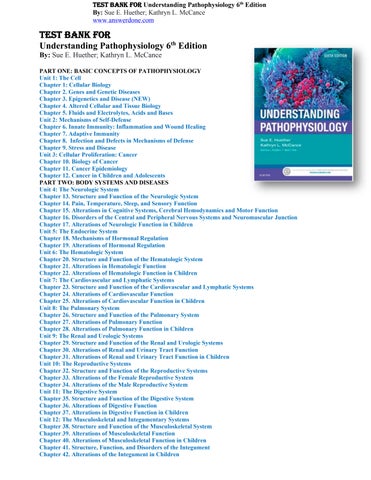
Test Bank for Understanding Pathophysiology 6th Edition By: Sue E. Huether; Kathryn L. McCance PART ONE: BASIC CONCEPTS OF PATHOPHYSIOLOGY Unit 1: The Cell Chapter 1: Cellular Biology Chapter 2. Genes and Genetic Diseases Chapter 3. Epigenetics and Disease (NEW) Chapter 4. Altered Cellular and Tissue Biology Chapter 5. Fluids and Electrolytes, Acids and Bases Unit 2: Mechanisms of Self-Defense Chapter 6. Innate Immunity: Inflammation and Wound Healing Chapter 7. Adaptive Immunity Chapter 8. Infection and Defects in Mechanisms of Defense Chapter 9. Stress and Disease Unit 3: Cellular Proliferation: Cancer Chapter 10. Biology of Cancer Chapter 11. Cancer Epidemiology Chapter 12. Cancer in Children and Adolescents PART TWO: BODY SYSTEMS AND DISEASES Unit 4: The Neurologic System Chapter 13. Structure and Function of the Neurologic System Chapter 14. Pain, Temperature, Sleep, and Sensory Function Chapter 15. Alterations in Cognitive Systems, Cerebral Hemodynamics and Motor Function Chapter 16. Disorders of the Central and Peripheral Nervous Systems and Neuromuscular Junction Chapter 17. Alterations of Neurologic Function in Children Unit 5: The Endocrine System Chapter 18. Mechanisms of Hormonal Regulation Chapter 19. Alterations of Hormonal Regulation Unit 6: The Hematologic System Chapter 20. Structure and Function of the Hematologic System Chapter 21. Alterations in Hematologic Function Chapter 22. Alterations of Hematologic Function in Children Unit 7: The Cardiovascular and Lymphatic Systems Chapter 23. Structure and Function of the Cardiovascular and Lymphatic Systems Chapter 24. Alterations of Cardiovascular Function Chapter 25. Alterations of Cardiovascular Function in Children Unit 8: The Pulmonary System Chapter 26. Structure and Function of the Pulmonary System Chapter 27. Alterations of Pulmonary Function Chapter 28. Alterations of Pulmonary Function in Children Unit 9: The Renal and Urologic Systems Chapter 29. Structure and Function of the Renal and Urologic Systems Chapter 30. Alterations of Renal and Urinary Tract Function Chapter 31. Alterations of Renal and Urinary Tract Function in Children Unit 10: The Reproductive Systems Chapter 32. Structure and Function of the Reproductive Systems Chapter 33. Alterations of the Female Reproductive System Chapter 34. Alterations of the Male Reproductive System Unit 11: The Digestive System Chapter 35. Structure and Function of the Digestive System Chapter 36. Alterations of Digestive Function Chapter 37. Alterations in Digestive Function in Children Unit 12: The Musculoskeletal and Integumentary Systems Chapter 38. Structure and Function of the Musculoskeletal System Chapter 39. Alterations of Musculoskeletal Function Chapter 40. Alterations of Musculoskeletal Function in Children Chapter 41. Structure, Function, and Disorders of the Integument Chapter 42. Alterations of the Integument in Children
Test Bank for Understanding Pathophysiology 6th Edition By: Sue E. Huether; Kathryn L. McCance www.answerdone.com
Chapter 01: Cellular Biology Huether & McCance: Understanding Pathophysiology, 6th Edition MULTIPLE CHOICE 1. A student is observing a cell under the microscope. It is observed to have supercoiled DNA
with histones. Which of the following would also be observed by the student? a. A single circular chromosome b. A nucleus c. Free-floating nuclear material d. No organelles ANS: B
The cell described is a eukaryotic cell, so it has histones and a supercoiled DNA within its nucleus; thus, the nucleus should be observed. A single circular chromosome called a prokaryote contains free-floating nuclear material but has no organelles. REF: p. 2 2. A nurse is instructing the staff about cellular functions. Which cellular function is the nurse
describing when an isolated cell absorbs oxygen and uses it to transform nutrients to energy? a. Metabolic absorption b. Communication c. Secretion d. Respiration ANS: D
The cell’s ability to absorb oxygen is referred to as respiration while its communication ability involves maintenance of a steady dynamic state, metabolic absorption provides nutrition, and secretion allows for the synthesizing of new substances. REF: p. 2 3. A eukaryotic cell is undergoing DNA replication. In which region of the cell would most of
the genetic information be contained? a. Mitochondria b. Ribosome c. Nucleolus d. Nucleus Cytoplasm ANS: C
The region of the cell that contains genetic material, including a large amount of ribonucleic acid, most of the DNA, and DNA-binding proteins, is the nucleolus, which is located within the cell’s nucleus. Mitochondria is associated with cellular respiration, while ribosomes are involved with protein manufacturing. Cytoplasm is a fluid filling that is a component of the cell. REF: p. 2
Test Bank for Understanding Pathophysiology 6th Edition By: Sue E. Huether; Kathryn L. McCance www.answerdone.com
4. Which of the following can remove proteins attached to the cell’s bilayer by dissolving the
layer itself? a. Peripheral membrane proteins b. Integral membrane proteins c. Glycoproteins d. Cell adhesion molecules ANS: B
Proteins directly attached to the membrane bilayer can be removed by the action of integral membrane proteins that dissolve the bilayer. Peripheral membrane proteins reside at the surface while cell adhesion molecules are on the outside of the membrane. Glycoprotein marks cells and does not float. REF: p. 7 5. Which of the following can bind to plasma membrane receptors? a. Oxygen b. Ribosomes c. Amphipathic lipids d. Ligands ANS: D
Ligands are the only specific molecules that can bind with receptors on the cell membrane. REF: p. 9 6. A nurse is reviewing a report from a patient with metastatic cancer. What alternation in the
extracellular matrix would suN ppoR rt thIe dG iagnBo. siC s ofM metastatic cancer? U S N T O a. Decreased fibronectin b. Increased collagen c. Decreased elastin d. Increased glycoproteins ANS: A
Only a reduced amount of fibronectin is found in some types of cancerous cells, allowing them to travel or metastasize. REF: p. 10 7. Which form of cell communication is used to relate to other cells in direct physical contact? a. Cell junction b. Gap junction c. Desmosome d. Tight junction ANS: A
Cell junctions hold cells together and permit molecules to pass from cell to cell. Gap junctions allow for cellular communication between cells. Neither desmosomes nor tight junctions are associated with cellular communication. REF: p. 11