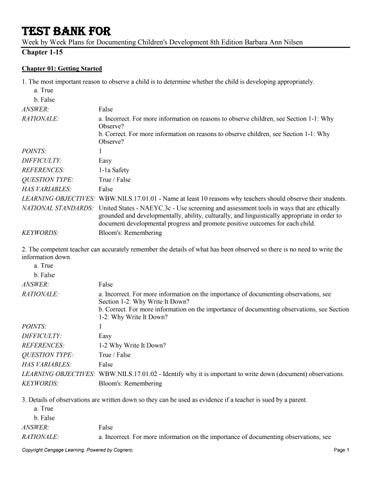
Test Bank For Week by Week Plans for Documenting Children's Development 8th Edition Barbara Ann Nilsen Chapter 1-15 Chapter 01: Getting Started 1. The most important reason to observe a child is to determine whether the child is developing appropriately. a. True b. False ANSWER: False RATIONALE: a. Incorrect. For more information on reasons to observe children, see Section 1-1: Why Observe? b. Correct. For more information on reasons to observe children, see Section 1-1: Why Observe? POINTS: 1 DIFFICULTY: Easy REFERENCES: 1-1a Safety QUESTION TYPE: True / False HAS VARIABLES: False LEARNING OBJECTIVES: WBW.NILS.17.01.01 - Name at least 10 reasons why teachers should observe their students. NATIONAL STANDARDS: United States - NAEYC.3c - Use screening and assessment tools in ways that are ethically grounded and developmentally, ability, culturally, and linguistically appropriate in order to document developmental progress and promote positive outcomes for each child. KEYWORDS: Bloom's: Remembering 2. The competent teacher can accurately remember the details of what has been observed so there is no need to write the information down. a. True b. False ANSWER: False RATIONALE: a. Incorrect. For more information on the importance of documenting observations, see Section 1-2: Why Write It Down? b. Correct. For more information on the importance of documenting observations, see Section 1-2: Why Write It Down? POINTS: 1 DIFFICULTY: Easy REFERENCES: 1-2 Why Write It Down? QUESTION TYPE: True / False HAS VARIABLES: False LEARNING OBJECTIVES: WBW.NILS.17.01.02 - Identify why it is important to write down (document) observations. KEYWORDS: Bloom's: Remembering 3. Details of observations are written down so they can be used as evidence if a teacher is sued by a parent. a. True b. False ANSWER: False RATIONALE: a. Incorrect. For more information on the importance of documenting observations, see Copyright Cengage Learning. Powered by Cognero.
Page 1
Section 1-2: Why Write It Down? b. Correct. For more information on the importance of documenting observations, see Section 1-2: Why Write It Down? POINTS: 1 DIFFICULTY: Easy REFERENCES: 1-2f Document QUESTION TYPE: True / False HAS VARIABLES: False LEARNING OBJECTIVES: WBW.NILS.17.01.02 - Identify why it is important to write down (document) observations. NATIONAL STANDARDS: United States - NAEYC.3a - Understand that assessments (formal and informal, formative and summative) are conducted to make informed choices about instruction and for planning in early learning settings. KEYWORDS: Bloom's: Remembering 4. The teacher should explain to children why they are writing notes about them and act as a literary role model. a. True b. False ANSWER: True RATIONALE: a. Correct. For more information on the importance of recording observations, see Section 12: Why Write It Down? b. Incorrect. For more information on the importance of recording observations, see Section 1-2: Why Write It Down? POINTS: 1 DIFFICULTY: Easy REFERENCES: 1-2e Serve as a Literacy Role Model QUESTION TYPE: True / False HAS VARIABLES: False LEARNING OBJECTIVES: WBW.NILS.17.01.02 - Identify why it is important to write down (document) observations. KEYWORDS: Bloom's: Remembering 5. It does not matter which method of recording is used because they are all useful in recording information. a. True b. False ANSWER: False RATIONALE: a. Incorrect. For more information on different observation methods, see Section 1-3: Why, When, and Who. b. Correct. For more information on different observation methods, see Section 1-3: Why, When, and Who. POINTS: 1 DIFFICULTY: Easy REFERENCES: 1-3a Why Use Different Observation Methods? QUESTION TYPE: True / False HAS VARIABLES: False LEARNING OBJECTIVES: WBW.NILS.17.01.03 - Discuss why it is useful to use different methods to observe and what role you play as an observer. NATIONAL STANDARDS: United States - NAEYC.3a - Understand that assessments (formal and informal, formative and summative) are conducted to make informed choices about instruction and for planning in early learning settings. Copyright Cengage Learning. Powered by Cognero.
Page 2
KEYWORDS:
Bloom's: Remembering
6. Testing is a better way to assess a child’s development because it is standardized. a. True b. False ANSWER: False RATIONALE: a. Incorrect. For more information on child development, see Section 1-4: Building Child Development Portfolios. b. Correct. For more information on child development, see Section 1-4: Building Child Development Portfolios. POINTS: 1 DIFFICULTY: Easy REFERENCES: 1-4b Portfolio Assessment QUESTION TYPE: True / False HAS VARIABLES: False LEARNING OBJECTIVES: WBW.NILS.17.01.04 - Justify using portfolios as an authentic assessment strategy for documenting young children's development. NATIONAL STANDARDS: United States - NAEYC.3a - Understand that assessments (formal and informal, formative and summative) are conducted to make informed choices about instruction and for planning in early learning settings. KEYWORDS: Bloom's: Remembering 7. Observation can be helpful in the prevention of misbehavior. a. True b. False ANSWER: True RATIONALE: a. Correct. For more information on the importance of observations, see Section 1-1: Why Observe? b. Incorrect. For more information on the importance of observations, see Section 1-1: Why Observe? POINTS: 1 DIFFICULTY: Easy REFERENCES: 1-1h Guidance QUESTION TYPE: True / False HAS VARIABLES: False LEARNING OBJECTIVES: WBW.NILS.17.01.01 - Name at least 10 reasons why teachers should observe their students. NATIONAL STANDARDS: United States - NAEYC.3a - Understand that assessments (formal and informal, formative and summative) are conducted to make informed choices about instruction and for planning in early learning settings. KEYWORDS: Bloom's: Remembering 8. Observation’s primary purpose is to tell the family what is wrong with their child. a. True b. False ANSWER: False RATIONALE: a. Incorrect. For more information on the purpose of observations, see Section 1-1: Why Observe? b. Correct. For more information on the purpose of observations, see Section 1-1: Why Copyright Cengage Learning. Powered by Cognero.
Page 3
Observe? POINTS: 1 DIFFICULTY: Easy REFERENCES: 1-1g Communication with the Family QUESTION TYPE: True / False HAS VARIABLES: False LEARNING OBJECTIVES: WBW.NILS.17.01.01 - Name at least 10 reasons why teachers should observe their students. NATIONAL STANDARDS: United States - NAEYC.3d - Build assessment partnerships with families and with professional colleagues. KEYWORDS: Bloom's: Remembering 9. Observations should always be rewritten or typed afterward so they are legible. a. True b. False ANSWER: False RATIONALE: a. Incorrect. For more information on documenting observations, see Section 1-2: Why Write It Down? b. Correct. For more information on documenting observations, see Section 1-2: Why Write It Down? POINTS: 1 DIFFICULTY: Easy REFERENCES: 1-2 Why Write It Down? QUESTION TYPE: True / False HAS VARIABLES: False LEARNING OBJECTIVES: WBW.NILS.17.01.01 - Name at least 10 reasons why teachers should observe their students. KEYWORDS: Bloom's: Remembering 10. All of the following are valid reasons for observing children EXCEPT to: a. determine the best way to provide guidance. b. decide about future classroom activities. c. determine how to help a child who is struggling with an activity. d. determine how smart a child is. ANSWER: d RATIONALE: a. Incorrect. For more information on the purpose of observations, see Section 1-1: Why Observe? b. Incorrect. For more information on the purpose of observations, see Section 1-1: Why Observe? c. Incorrect. For more information on the purpose of observations, see Section 1-1: Why Observe? d. Correct. For more information on the purpose of observations, see Section 1-1: Why Observe? POINTS: 1 DIFFICULTY: Easy REFERENCES: 1-1 Why Observe? QUESTION TYPE: Multiple Choice HAS VARIABLES: False LEARNING OBJECTIVES: WBW.NILS.17.01.01 - Name at least 10 reasons why teachers should observe their students. Copyright Cengage Learning. Powered by Cognero.
Page 4
NATIONAL STANDARDS: United States - NAEYC.3a - Understand that assessments (formal and informal, formative and summative) are conducted to make informed choices about instruction and for planning in early learning settings. KEYWORDS: Bloom's: Remembering 11. The teacher uses assessment to: a. document how many days the child has missed school. b. gather information and document a child’s skills and development. c. analyze development of a particular child. d. evaluate the progress of an entire classroom. ANSWER: b RATIONALE: a. Incorrect. For more information on the purpose of assessments, see Section 1-1: Why Observe? b. Correct. For more information on the purpose of assessments, see Section 1-1: Why Observe? c. Incorrect. For more information on the purpose of assessments, see Section 1-1: Why Observe? d. Incorrect. For more information on the purpose of assessments, see Section 1-1: Why Observe? POINTS: 1 DIFFICULTY: Easy REFERENCES: 1-1i Measure Progress, Assessment, Evaluation QUESTION TYPE: Multiple Choice HAS VARIABLES: False LEARNING OBJECTIVES: WBW.NILS.17.01.01 - Name at least 10 reasons why teachers should observe their students. NATIONAL STANDARDS: United States - NAEYC.3c - Use screening and assessment tools in ways that are ethically grounded and developmentally, ability, culturally, andlinguistically appropriate in order to document developmental progress and promote positive outcomes for each child. United States - DAP.4b - Using Appropriate Assessment Methods. KEYWORDS: Bloom's: Remembering 12. A teacher uses written recordings to: a. to remember what has been heard in the classroom. b. remember what has been observed outside of the classroom. c. compare development of one child to another. d. compare development of a child from one observation to the next. ANSWER: d RATIONALE: a. Incorrect. For more information on the purpose of written recordings, see Section 1-2: Why Write It Down? b. Incorrect. For more information on the purpose of written recordings, see Section 1-2: Why Write It Down? c. Incorrect. For more information on the purpose of written recordings, see Section 1-2: Why Write It Down? d. Correct. For more information on the purpose of written recordings, see Section 1-2: Why Write It Down? POINTS: 1 DIFFICULTY: Easy REFERENCES: 1-2 Why Write It Down? QUESTION TYPE: Multiple Choice Copyright Cengage Learning. Powered by Cognero.
Page 5