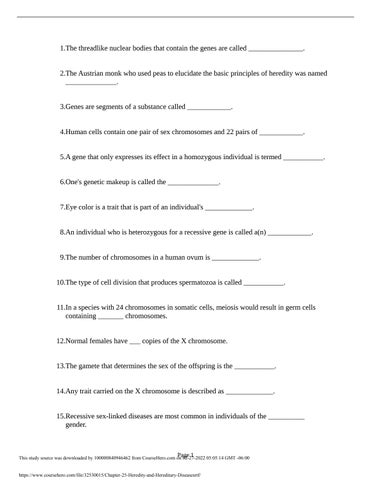
1.The threadlike nuclear bodies that contain the genes are called _______________. 2.The Austrian monk who used peas to elucidate the basic principles of heredity was named ______________. 3.Genes are segments of a substance called ____________. 4.Human cells contain one pair of sex chromosomes and 22 pairs of ____________. 5.A gene that only expresses its effect in a homozygous individual is termed ___________. 6.One's genetic makeup is called the ______________. 7.Eye color is a trait that is part of an individual's _____________. 8.An individual who is heterozygous for a recessive gene is called a(n) ____________. 9.The number of chromosomes in a human ovum is _____________. 10.The type of cell division that produces spermatozoa is called ___________. 11.In a species with 24 chromosomes in somatic cells, meiosis would result in germ cells containing _______ chromosomes. 12.Normal females have ___ copies of the X chromosome. 13.The gamete that determines the sex of the offspring is the ___________. 14.Any trait carried on the X chromosome is described as _____________. 15.Recessive sex-linked diseases are most common in individuals of the __________ gender.
Page 1
This study source was downloaded by 100000840946462 from CourseHero.com on 02-27-2022 05:05:14 GMT -06:00
https://www.coursehero.com/file/32530015/Chapter-25-Heredity-and-Hereditary-Diseasesrtf/
16.Traits determined by more than one gene pair are termed ____________. 17.A change in the DNA sequence of a gene is an example of a(n) ____________. 18.Any disorder present at the time of birth is termed _________________. 19.A baby with six fingers has a condition called __________. 20.Down syndrome results from an extra copy of chromosome ____. 21.A complete family history designed to elucidate the inheritance of a particular disease is called a(n) _________. 22.The prenatal screening method that extracts fetal cells from the fluid surrounding the fetus is called __________. 23.A picture of chromosomes lined up in pairs is a(n) _______________. 24.A genetic disease that can be controlled by large doses of thiamin and dietary control is ______________. 25.The word part –cele means __________ 26.The units of heredity are called A) DNA B) proteins C) genes D) enzymes 27.Chromosomes contain A) genes B) DNA C) alleles
Page 2
This study source was downloaded by 100000840946462 from CourseHero.com on 02-27-2022 05:05:14 GMT -06:00
https://www.coursehero.com/file/32530015/Chapter-25-Heredity-and-Hereditary-Diseasesrtf/
D)
All of the answers are correct.
A) B) C) D)
28.A recessive gene is only found on the X chromosome only alters the phenotype in homozygous individuals only alters the phenotype in heterozygous individuals never alters the phenotype
A) B) C) D)
29.An individual that is heterozygous for a completely dominant trait is a carrier will show the dominant phenotype will show the recessive phenotype will show a phenotype intermediate between the dominant and recessive phenotypes
A) B) C) D)
30.An example of genotype is heterozygous alleles height brown eyes gender
31.If a person is a carrier for a particular disease, A) the disease must be dominant, and the person's genotype must be heterozygous B) the disease must be recessive, and the person's genotype must be heterozygous C) the disease must be dominant, and the person's genotype must be homozygous recessive D) the disease must be recessive, and the person's genotype must be homozygous dominant 32.The skin cells of the elephant contain 56 chromosomes. How many chromosomes will an elephant spermatozoon contain? A) 56 B) 23 C) 46 D) 28 33.The platypus has five pairs of sex chromosomes and 21 pairs of autosomes. When a platypus cell undergoes meiosis, how many chromosomes will the daughter cells have? A) 5 B) 21 C) 26
Page 3
This study source was downloaded by 100000840946462 from CourseHero.com on 02-27-2022 05:05:14 GMT -06:00
https://www.coursehero.com/file/32530015/Chapter-25-Heredity-and-Hereditary-Diseasesrtf/
D)
52
A) B) C) D)
34.A normal male has the genotype XX XY XXY XXX
A) B) C) D)
35.An individual with the genotype XO would most likely be male female both male and female neither male nor female
A) B) C) D)
36.Which of the following is NOT a sex-linked trait? hemophilia red-green color blindness testicles cystic fibrosis
37.Which of the following is NOT true of sex-linked disorders? A) They are transmitted from mother to son. B) They appear almost exclusively in males. C) They are usually recessive traits. D) They are usually carried on the Y chromosome. 38.Eye color is determined by three pairs of genes. Its mode of inheritance is best described as A) multifactorial B) sex-linked C) recessive D) dominant
A) B) C) D)
39.The ability of a particular gene to determine phenotype can be altered by environmental factors gender other genes All of the answers are correct.
Page 4
This study source was downloaded by 100000840946462 from CourseHero.com on 02-27-2022 05:05:14 GMT -06:00
https://www.coursehero.com/file/32530015/Chapter-25-Heredity-and-Hereditary-Diseasesrtf/
40.Which of the following is true of multifactorial traits? A) They always cause disease. B) They are inherited from fathers only. C) They are determined by more than one gene pair. D) They are inherited from mothers only. 41.A chemical that causes a chromosome to break is called a(n) A) mutation B) talipes C) mutagen D) karyotype
A) B) C) D)
42.All mutations are harmful the result of an agent changes in the genotype All of the answers are correct.
A) B) C) D)
43.A disorder that is congenital but NOT hereditary is fetal alcohol syndrome cystic fibrosis Huntington disease albinism
44.Duchenne muscular dystrophy results from a defect in the dystrophin gene and is detectable at birth. This disorder is best described as A) congenital, nonhereditary, and nongenetic B) noncongenital, hereditary, and genetic C) congenital, hereditary, and genetic D) congenital, nonheriditary, and genetic
A) B) C) D)
45.Huntington disease is congenital, nonhereditary, and nongenetic noncongenital, hereditary, and genetic congenital, hereditary, and genetic congenital, nonheriditary, and genetic
A) B)
46.Trisomy 21 is usually congenital, nonhereditary, and nongenetic noncongenital, hereditary, and genetic
Page 5
This study source was downloaded by 100000840946462 from CourseHero.com on 02-27-2022 05:05:14 GMT -06:00
https://www.coursehero.com/file/32530015/Chapter-25-Heredity-and-Hereditary-Diseasesrtf/