Pharmacology Final Study Guide FINAL EXAM
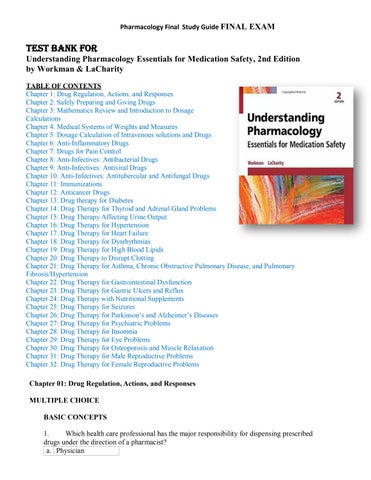
Test Bank for Understanding Pharmacology Essentials for Medication Safety, 2nd Edition by Workman & LaCharity TABLE OF CONTENTS Chapter 1: Drug Regulation, Actions, and Responses Chapter 2: Safely Preparing and Giving Drugs Chapter 3: Mathematics Review and Introduction to Dosage Calculations Chapter 4: Medical Systems of Weights and Measures Chapter 5: Dosage Calculation of Intravenous solutions and Drugs Chapter 6: Anti-Inflammatory Drugs Chapter 7: Drugs for Pain Control Chapter 8: Anti-Infectives: Antibacterial Drugs Chapter 9: Anti-Infectives: Antiviral Drugs Chapter 10: Anti-Infectives: Antitubercular and Antifungal Drugs Chapter 11: Immunizations Chapter 12: Anticancer Drugs Chapter 13: Drug therapy for Diabetes Chapter 14: Drug Therapy for Thyroid and Adrenal Gland Problems Chapter 15: Drug Therapy Affecting Urine Output Chapter 16: Drug Therapy for Hypertension Chapter 17: Drug Therapy for Heart Failure Chapter 18: Drug Therapy for Dysrhythmias Chapter 19: Drug Therapy for High Blood Lipids Chapter 20: Drug Therapy to Disrupt Clotting Chapter 21: Drug Therapy for Asthma, Chronic Obstructive Pulmonary Disease, and Pulmonary Fibrosis/Hypertension Chapter 22: Drug Therapy for Gastrointestinal Dysfunction Chapter 23: Drug Therapy for Gastric Ulcers and Reflux Chapter 24: Drug Therapy with Nutritional Supplements Chapter 25: Drug Therapy for Seizures Chapter 26: Drug Therapy for Parkinson’s and Alzheimer’s Diseases Chapter 27: Drug Therapy for Psychiatric Problems Chapter 28: Drug Therapy for Insomnia Chapter 29: Drug Therapy for Eye Problems Chapter 30: Drug Therapy for Osteoporosis and Muscle Relaxation Chapter 31: Drug Therapy for Male Reproductive Problems Chapter 32: Drug Therapy for Female Reproductive Problems
Chapter 01: Drug Regulation, Actions, and Responses MULTIPLE CHOICE BASIC CONCEPTS 1. Which health care professional has the major responsibility for dispensing prescribed drugs under the direction of a pharmacist? a. Physician
Pharmacology Final Study Guide FINAL EXAM b Nurse practitioner . c. Licensed nurse d Pharmacy technician .
ANS: D The physician and nurse practitioner have the major responsibility for prescribing drugs, not dispensing them. The licensed nurse has the primary responsibility for administering drugs, although under some circumstances a licensed nurse may dispense prescribed drugs but this is not his or her major responsibility in drug therapy. The pharmacy technician has the major responsibility of dispensing prescribed drugs under the direction of a licensed pharmacist. DIF:
Cognitive Level: Remembering
REF: p. 3
2. Which term describes the effect of a drug that improves body function? a. Side effect b Intended action . c. Adverse reaction d Idiosyncratic response .
ANS: B The purpose of drug therapy is to take a drug to prevent, reduce, or correct a health problem. This response is any drug’s intended action also known as a therapeutic response. DIF:
Cognitive Level: Remembering
REF: p. 3
3. Which type of drug name is “owned” by the company that manufactures it? a. Generic name b Chemical name
Pharmacology Final Study Guide FINAL EXAM . c. Category name d Trade name .
ANS: D The chemical name is a drug’s exact chemical composition. The generic name is the name assigned to the drug by the U.S. Adopted Names Council and is not owned by anyone. The category name refers to the type of drug (what it does or what it is used for) and is not an actual drug name. The trade name (brand name) is the name provided and owned by a specific drug’s manufacturer. DIF:
Cognitive Level: Remembering
REF: p. 4
4. Which drug or drug class is a “high alert” drug? a. Penicillin b Insulin . c. NSAIDs d Calcium .
ANS: B A high alert drug is one in which harm is likely to result if given at the wrong dose, to the wrong patient, or not given to the correct patient. Drugs classified as high alert drugs include potassium, narcotics (opioids), insulin, cancer chemotherapy drugs, and heparin (or any drug that strongly affects blood clotting). Penicillin, NSAIDs, and calcium are not considered high alert drugs. DIF:
Cognitive Level: Remembering
REF: p. 4
5. What is the term for a drug that has the same action as a naturally occurring body hormone or enzyme? a. Agonist b Blocking agent . c. Chemical d Duplicator .
ANS: A A drug agonist is an extrinsic drug that activates the receptor sites of a cell and mimics the actions of naturally occurring body substances (intrinsic drugs). A blocking agent is a drug
Pharmacology Final Study Guide FINAL EXAM antagonist. A chemical would not necessarily be a drug at all. A duplicator is not a pharmacologic term. DIF:
Cognitive Level: Remembering
REF: pp. 6-7
6. Which term describes how the body affects drug activity? a. Drug potency b Pharmacodynamics . c. Therapeutic effect d Pharmacokinetics .
ANS: D The term pharmacokinetics refers to drug metabolism and how the body changes a drug. Pharmacodynamics refers to how a drug works to change body function. Drug potency refers to how strongly or to what degree a drug exerts its effects. The therapeutic effect is closer to pharmacodynamics, meaning how a drug works to change body function. DIF:
Cognitive Level: Remembering
REF: p. 10
7. In the United States, which group is responsible for enforcing established standards for drug manufacturing? a. U.S. Pharmacopeia b National Institutes of Health . c. Food and Drug Administration d Association of Pharmaceutical Manufacturers .
ANS: C The standards for drug manufacture are established by the U.S. Pharmacopeia. These standards are enforced by the Food and Drug Administration. Neither the National Institutes of Health nor the Association of Pharmaceutical Manufacturers has any authority to enforce drug standards. DIF:
Cognitive Level: Remembering
REF: p. 5
8. Which factor is a major disadvantage of the transdermal drug delivery route? a. Only a prescriber can administer drugs by the transdermal route. b Transdermal drugs must be sterile rather than clean. . c. First pass drug loss by this route is the most extensive. d Drug absorption is dependent on adequate circulation.
Pharmacology Final Study Guide FINAL EXAM .
ANS: D Once a transdermal drug moves through the skin, it must enter the bloodstream to reach its target tissue. If circulation is poor to the area where the transdermal drug is applied, very little, if any, of the drug will reach its target tissue. DIF:
Cognitive Level: Remembering
REF: p. 12
9. How are intrinsic drugs different from extrinsic drugs? a. Intrinsic drugs are made by the body, whereas extrinsic drugs are made outside the body. b Intrinsic drugs are administered by the parenteral route, whereas extrinsic drugs are . administered by the oral route. c. Extrinsic drugs can only be applied to the skin or mucous membranes, whereas intrinsic drugs are taken internally. d Extrinsic drugs require a prescription for administration, whereas intrinsic drugs are . available over-the-counter.
ANS: A Intrinsic drugs are the hormones, enzymes, and other chemicals made by the body that change cell activity. Extrinsic drugs are manufactured from chemical, animal, or plant sources and must have a means of entering the body in order to change cell activity. DIF:
Cognitive Level: Understanding
REF: p. 3
10. A patient asks why his drug to control high blood pressure has only one generic name and two different trade names. What is your best response? a. “Most drugs have different trade names that indicate different dosages.” b “The two different trade names indicate that one is a more pure and safer drug than the . other.” c. “The generic name is the actual official drug name and the trade name is a brand owned by a specific manufacturer.” d “If you have insurance, you can get the trade name drug, which is usually more expensive . than the generic named drug.”
ANS: C The generic name is the name assigned to the drug by the U.S. Adopted Names Council and is not owned by anyone. The trade name (brand name) is the name provided and owned by a specific drug’s manufacturer. More than one manufacturer can make and sell the same drug at the same time under a different trade name. Regardless of trade name, all drugs that have the same generic name must be alike in their chemical composition and strength. DIF:
Cognitive Level: Applying or Higher
REF: pp. 3-4