Academy of Sciences Malaysia Strategic Plan 2026-2030
2026
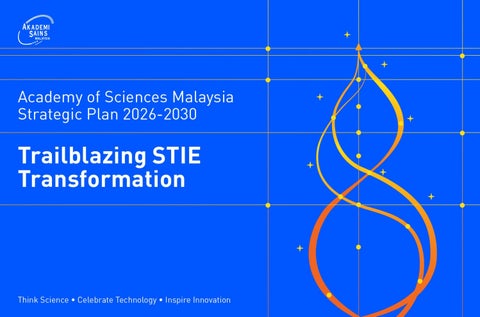
Cover Design Rationale Academy of Sciences Malaysia Strategic Plan 2026-2030 The visual identity is inspired by the flame of a torch, symbolising knowledge, independent thought leadership and the drive to forge new pathways. The interconnected nodes and grid represent the 5 Goals, 6 Strategies and 6 Transformation Priorities, reflecting alignment and connectivity. The 6 nodes positioned along the outer grids represent ASM’s networks. The ascending flame-like pathways embody “Accelerating Growth through Independent Thought,” representing ASM’s journey from ideas to influence and impact, towards becoming a “STIE Transformation Trailblazer.” The 8 sparks represent ASM’s 8 core values that guide our journey. Together, the flame, pathways and sparks convey a sense of momentum, inspiration and impact, where ideas ignite action, and action creates a trail for others to follow.
Academy of Sciences Malaysia Strategic Plan 2026-2030 ©Academy of Sciences Malaysia 2026 All Rights Reserved. No part of this publication may be reproduced, stored in a retrieval system, or transmitted in any form by any means, electronic, mechanical, photocopying, recording or otherwise without prior permission in writing from the Academy of Sciences Malaysia. Academy of Sciences Malaysia Level 20, West Wing, MATRADE Tower Jalan Sultan Haji Ahmad Shah off Jalan Tuanku Abdul Halim 50480 Kuala Lumpur, Malaysia www.akademisains.gov.my
CONTENTS
06
08
10
12
14
22
23
24
25
26
28
29
30
31
33
Executive Summary
Our Journey and Progress
Our Values
ASM Strategic Plan 2026 - 2030
Our Strategy of Change
Our Vision, Our Mission & Our Goals
Conclusion
Foreword
Our Methodology
Our Strategies
Glossary
Introduction
Our Philosophy
Our Transformation Priorities
References
EXECUTIVE SUMMARY As the Academy of Sciences Malaysia (ASM) enters its fourth decade, we are renewing our commitment to help Malaysia apply science and technology to create an innovation economy that will enable the attainment of a more prosperous, sustainable and inclusive future. Since its establishment in 1995, ASM has evolved from supporting governmentmandated initiatives and mobilising scientific expertise. Today, ASM is a trusted strategic partner, national Thought Leader and Changemaker, bringing independent scientific expertise to national priorities. Our ASM Strategic Plan 2026–2030 takes the next step in strengthening our role as a STIE Transformation Trailblazer, contributing to a progressive, harmonious, and prosperous society.
Addressing Malaysia’s complex challenges requires a multi-sector approach. ASM brings together scientists, government, industry, researchers, international partners, and communities to identify priorities, understand emerging risks and opportunities, and develop credible options for action. Guided by our philosophy of Accelerating Growth through Independent Thought Leadership, we turn bold ideas into evidence-based policies to deliver lasting progress for society and the economy. At the heart of this is a Dare-to-Disrupt mindset: the courage to imagine what could be, question what has always been, and turn bold ideas into meaningful, lasting progress. Guided by strategic foresight, we will look beyond today’s challenges to anticipate what lies ahead, while remaining firmly anchored in the aspirations and needs of people, society, and the economy. The Strategic Plan is a networked, outward-looking and impact-oriented organisational model that strengthens connections across ASM and its wider ecosystem we serve. This model will leverage on cross-sector collaboration to identify priorities, anticipate future needs and formulate evidence-based and impact-driven solutions. Our ambition is to create a clearer pathway from evidence and insight to policy, implementation, and impact. This means going beyond recommendations by working with partners to translate evidence into practical action, strengthen coordination, and enable effective delivery. Our Strategic Plan is anchored by 6 Strategic Pathways:
Independent Advice
Stronger National and Global Influence
MissionOriented Initiatives
Clearer STIE Communication
An Agile and Well-Governed Institution
Sustainable Capability
STIE Communication
Talent Empowerment
Science Diplomacy
These pathways will be delivered through 6 Transformation Priorities:
Strategic Advisory and Foresight
Game-Changing Science for Projects Society
Our success will be measured by better decision-making, stronger partnerships and actionable solutions with tangible benefits. By combining independent thought leadership with active collaboration, ASM will continue to turn knowledge into impactful outcomes for Malaysia and beyond. 6
Our Strategic Plan transforms independent thought leadership into strategic influence and transformative impact, positioning ASM as an STIE Transformation Trailblazer in shaping Malaysia’s STIE future.
7
FOREWORD BY ASM PRESIDENT As ASM enters its fourth decade, we do so with more humility, greater clarity of purpose and a stronger sense of responsibility. In 1995, Malaysia’s leading scientific minds came together to establish ASM around a simple conviction: that science must serve the nation. Three decades on, that conviction has not changed. What has changed is the world in which we pursue this conviction. We have grown with Malaysia’s science, technology, innovation and economy (STIE) ecosystem and we understand more deeply today what it takes to shape it. Today, that system is more dynamic and more complex than ever. The challenges we face are interconnected, cutting across disciplines, sectors and communities. Complex challenges such as climate resilience, food and water security, public health, the digital economy and the future of work cannot be addressed by any one ministry, discipline or company on its own. Progress requires integration, alignment, coherence and a clear appreciation that change in one part of the system affects the whole. Over the past 30 years, we have learned that transforming how a country works takes time and must be approached with persistence and discipline.
8
ASM has focused its contribution on providing evidence-based advice to inform national decisionmaking. But we must be clear: advice alone is not enough. A recommendation that remains on a shelf changes nothing. The real measure of our work lies in execution: how ideas are translated into impactful outcomes that matter to the nation. This Strategic Plan signals a decisive shift.
ASM will move beyond asking
“what should be done” to demonstrating “how it can be done”.
One of ASM’s enduring strengths is our consistency. Our independence allows us to look beyond short-term cycles and keep our focus on Malaysia’s long-term priorities. This allows us to remain steadfast on addressing long-term national priorities. We will ensure that our work does not end with recommendations but continues through to implementation. Turning that long-term commitment into results requires discipline in follow-through, clarity in priorities, and a stronger attention on execution. We will collaborate with partners to realise our recommendations. We will focus on areas where targeted actions can create wider impact, and where coordination across stakeholders can unlock purposeful progress. We will ensure that our work does not end with publication but continues through to delivery. Our role is to connect and to catalyse: uniting government, industry, academia, and civil society to act with shared purpose through a mission-oriented approach. This is not purely a technical exercise. It requires champions in government, industry, universities, and communities who can carry ideas forward and mobilise others to act.
ASM has earned something many organisations spend years building: legitimacy and trust. Our challenge now is to translate that trust into greater clarity, utility, and visibility, enabling more people to understand our role, apply our work, and see ASM as a trusted national Thought Leader and Changemaker. We must enhance the visibility of our contributions. ASM has touched many lives, often without being seen. Greater visibility is not about recognition. It is about building more trust, strengthening partnerships, and extending the reach of our work. We have often said that ASM builds from within and deploys beyond. We will strengthen our own expertise so that we can put it to work for the nation. Now, we take the next step towards delivering real impact as a transformation trailblazer. The ASM Strategic Plan 2026–2030 is therefore not just a statement of intent. It is a commitment. To move from ideas to action, from recommendations to results, and from thought leadership to lasting national impact. We invite our Fellows, our partners in government and industry, and every Malaysian to join us. Let us dare to imagine what Malaysia can become, and then, together, make it happen. Academician Datuk Dr Tengku Mohd Azzman Shariffadeen FASc 9
INTRODUCTION The year 2025 marked an important milestone in the journey of ASM as we celebrated our 30th Anniversary. It was a moment to reflect on three decades of contributions to Malaysia’s STIE landscape and, equally, to look ahead with renewed purpose and ambition.
Over three decades, ASM has evolved significantly in scope and impact. We have grown from a government initiative into a trusted and influential partner at national, regional, and international levels. Through evidence-based policy inputs, strategic foresight, thought leadership, and stakeholder engagement, we have strengthened Malaysia’s STIE ecosystem and informed decision-making on key national priorities. Beyond policy advice, ASM actively contributes science-based perspectives to national committees shaping Malaysia’s sustainable development, competitiveness, and societal well-being. Central to this mission is our expanding community of expertise from academia, research institutes and industry. ASM started with 50 Founding Fellows in 1995 and now spans eight disciplines across Senior Fellows, Fellows, Recipients of Top Research Scientists Malaysia, the Young Scientists Network, and Associates nationwide. As we enter our fourth decade amidst rapid global change, addressing Malaysia’s complex challenges requires connecting knowledge to action and mobilising expertise for tangible outcomes. The ASM Strategic Plan 2026–2030 aims to drive this transformation, sharpening our focus and expanding our capacity to deliver meaningful impact. nchored by our Strategy of Change, the Strategic Plan outlines our goal to drive STIE transformation A for a progressive and sustainable society. This represents a deliberate shift: from generating recommendations to enabling implementation; from shaping discourse to mobilising collective action; and from influencing policy to delivering measurable national impact. Our commitment to providing independent, credible, and evidence-based STIE advice remains fundamental. At the same time, we will continue to leverage on our convening power, strategic partnerships, and transdisciplinary expertise to bring knowledge and action across the STIE ecosystem. Guided by our vision and mission, we will continue to advance Malaysia’s STIE agenda through thought leadership, policy influence, innovation, capacity building, and collaboration. As Malaysia navigates global challenges, we champion STIE as key enablers of sustainable development, economic resilience, and societal prosperity. Building on thirty years of progress, ASM’s key focus is on turning knowledge into action and insight into measurable impact.
10
11
1995: ASM’s Establishment
• United Malaysia’s leading scientific minds to shape the national STI landscape.
ASM JOURNEY & PROGRESS A journey of 31 years and its impacts. Over the years, our growth, reach, and contribution to Malaysia’s agenda have been built on key milestones, creating a strong foundation for our next transformation. As we move forward, we remain committed to driving innovation, influencing policy, and fostering collaboration to keep STIE central to Malaysia’s development.
12
2005: Build STI Awareness
• Appointed 50 Foundation Fellows to guide national STI strategies and support scientific progress.
• Expanded as Science Communicator through initiatives such as Pameran Sains Islam and Science Expeditions.
2000: Communicate Science with Society
• Engaged the public and raise awareness of science and technology. • Inspired young people to pursue science through the National Science Quiz, later rebranded as the National Science Challenge (NSC) and the National Nobel Laureate Programme. • Built research capacity and strengthened Malaysia’s global scientific presence through the Scientific Advancement Grant Allocation (SAGA) and the Malaysian Antarctic Research Programme.
• Connected science with society and highlighted its practical in everyday life. • Attracted Malaysian scientific talent through Brain Gain Malaysia (BGM) to contribute to local research.
2020: STIE Solutions as a Changemaker
2010: Transition to a Think Tank
• Evolved into a National STI Think Tank, as a central voice in shaping Malaysia’s STI policy and development agenda. • Strengthened STI application, nurtured future scientists, and advanced scientific knowledge through the ASM Mega Science Study, the Young Scientists Network (YSN-ASM), the ASM Science Journal.
• Shifted as a Changemaker, moving beyond advisory to implementation through initiatives such as the 10-10 MySTIE Framework and Malaysia Open Science Platform (MOSP). • Strengthened cross-sectoral collaboration through initiatives such as i-Connect, facilitating Malaysian industries to develop innovative homegrown products and solutions using science and technology.
Towards a progressive, harmonious, prosperous and sustainable society
• Expanded public engagement and science communication through e-estidotmy and the ASM Podcast, nurturing curiosity among students, bringing science and mathematics closer to society, and sharing STIE topics in an accessible way.
2015: Influence National STIE Agenda as a Thought Leader
2025 Onwards: STIE Transformation Trailblazer
• Laid the foundation for Malaysia towards becoming a Progressive Malaysia by 2050 through “The Envisioning Malaysia 2050” reports.
• We continue to shape national policies, drive technological advancement, and ensure our country’s competitiveness on the global stage.
• Positioned ourselves as a Thought Leader in the STIE landscape through flagship reports such as “Science Outlook” and “the Emerging Science, Engineering and Technology (ESET) Study”.
• By 2030, we set our goals to lead Malaysia’s transition into a hightech nation by positioning ourselves as a STIE Thought Leader and Transformation Trailblazer.
13
OUR STRATEGY OF CHANGE
14
Our Strategy of Change is built on a simple proposition: ASM can become an STIE Transformation Trailblazer by transforming how we organise, mobilise knowledge, set priorities, and turn evidence into action. Between 2026 and 2030, we will embed a more network-based, outward-looking, and impact-oriented way of working, connecting expertise, policy influence, implementation, and learning in a continuous cycle of transformation.
OUR STRATEGY OF CHANGE: Converging Networks
A networked organisational model that converges strategic leadership, expertise and execution to create impact for Malaysia and beyond. •
ASM Council Highest decision-making body
•
ASM Expert Network Expert guidance and thought leadership
•
ASM Working Committees and Task Forces Focus on key priorities and initiatives
•
ASM Management Strategising, planning, c oordinating, monitoring, reporting
•
ASM Analysts & Execution Team Delivery and impact Internal Network Connects ASM’s leadership, expertise, and teams for coordinated action. External Network Connects ASM to stakeholders, partners, and broader ecosystems 15
OUR STRATEGY OF CHANGE: Converging Networks
As ASM enters its next phase of growth as Malaysia’s STIE Transformation Trailblazer, we are adopting a network-based, outward-looking and impact-oriented organisational model anchored in collaboration, trust, impact and shared vision.
Like an orbital system, each network has a distinct role while remaining interconnected through continuous communication, collaboration and knowledge exchange. This gives ASM the governance, consistency, and agility needed to respond to increasingly complex national challenges. At the centre is the ASM Council, providing strategic leadership, governance and institutional stewardship. Around it, the ASM Working Committees and Task Forces, ASM Expert Network, ASM Management, and ASM Analysts and Execution Team work together to mobilise transdisciplinary expertise, translate strategic direction into priorities, and turn those priorities into action. Our network also extends to ministries and agencies, academic and research institutions, industry, professional bodies, international partners, communities and society. Each is connected to its own networks, knowledge hubs, expertise, data and institutional experience. ASM therefore acts as a convener and a contributor, enabling two-way flows of knowledge, evidence, and perspectives. This convergence and expansion of networks creates shared visions and enables the generation of collective knowledge, thus enhancing foresight and strengthening the impact of our contribution. As an STIE Transformation Trailblazer, ASM navigates uncertainty and creates new pathways in emerging strategic spaces. By combining credible and future-oriented leaders who are able to mobilise networks, ASM connects knowledge to action to catalyse transformative impact for Malaysia and beyond.
16
Box Article:
Case Study on ASM’s Network-Based Approach to Create Transformative Impact ASM develops studies and strategic initiatives by activating its interconnected network of governance, expert leadership, execution capability and stakeholder partnerships around issues of national importance. This network-based approach enables diverse expertise, evidence, and perspectives to converge around a shared priority. ASM project may begin in two ways: The ASM Council, Expert Network or wider stakeholder ecosystem identify strategic or emerging issues, where independent scientific insight can contribute to national development.
1 The Council assesses a proposed project’s strategic relevance, value, and alignment with ASM’s mandate.
2 The Council establishes an oversight mechanism (Steering Committee, supported by Task Forces, Working Groups, or Sub-Committees). Chairs are appointed from ASM’s Expert Network based on the expertise, credibility and foresight required to guide the work.
A ministry, agency, or strategic partner engages ASM to address an identified priority.
3 ASM Management, Analysts, and Execution Team translate strategic direction into an implementable programme of work. This allows the Chair and expert committees to focus on intellectual leadership, critical analysis, and developing recommendations.
4 The project team then activates ASM’s wider stakeholder ecosystem, engaging external networks. This brings together scientific evidence, policy perspectives, industry experience, and societal needs. A two-way exchange.
5 Stakeholders contribute practical insights and challenge assumptions from their own networks and experience based on the emerging findings and perspectives. This way, knowledge is continuously tested, refined, and strengthened.
As findings emerge, they undergo transdisciplinary scrutiny and validation. The oversight committee provides a platform to challenge the evidence, analysis, and recommendations from multiple disciplinary and strategic perspectives. The strength of an ASM project therefore lies in its methodology and ability to bring together the right leadership, expertise, and stakeholders. The project ultimately produces strategic outputs such as publications, frameworks, programmes or recommendations that translate evidence and diverse perspectives into credible, actionable outcomes. ASM’s network-based model creates a continuous cycle of knowledge exchange, learning, and impact. Evidence, insights and recommendations flow back into the wider network to inform policy development, programmes, investment decisions, research priorities and future initiatives. In this way, ASM’s network-based model creates a continuous cycle of knowledge exchange, learning and impact, rather than a one-way stakeholder engagement process. 17
OUR STRATEGY OF CHANGE: Driving Impact
Building on our network-based organisational model, our Strategy of Change is guided by a simple belief: STIE must be deliberately connected to national development priorities, policy decisions, implementation and measurable impact. As an STIE Transformation Trailblazer, ASM will identify priority development challenges, convenes expertise, generates evidence-based solutions, influence policy and strategy, support implementation, monitors impact, and uses new learning to shape the next cycle of transformation. Where strategic or emerging areas demand leadership and established pathways do not yet exist, ASM is prepared to claim the space. This brings together the right expertise, champions new ideas, and forges pathways that others can co-create, advance, and build on. In this cyclical process, evidence leads to action, action generates learning, and that learning flows back into ASM and its wider networks to strengthen what comes next. Embedded in our institutional culture and way of working, the Strategy of Change will remain a living process, enabling ASM to respond to changing national needs, sharpen its advice and continuously strengthen its capacity to deliver long-term impact. 18
OUR STRATEGY OF CHANGE:
Mobilising Networks To activate this cycle of change, ASM mobilises its stakeholder ecosystem around its role as an honest broker: a trusted, independent and neutral institution supported by its network of Fellows, Young Scientists Network, Associates, External Subject Matter Experts, Recipients of Top Research Scientists Malaysia, and ASM Management.
Rather than generating knowledge in isolation, we will enable knowledge co-creation and coordinated responses to strengthen the relevance, adoption, and impact of policies, strategies, and interventions. By engaging diverse stakeholders, we will advance collaborative, sustainable, and responsible solutions that create lasting value for people and planetary well-being, while safeguarding the needs of future generations. This Strategic Plan is grounded on the belief that complex national challenges cannot be addressed by any single organisation. Lasting impact will require us to harness the collective strengths of the STIE ecosystem through trusted partnerships, transdisciplinary collaboration, and coordinated action towards a shared national agenda.
Our networks are further strengthened through strategic partnerships across the STIE ecosystem, with stakeholders categorised as: •
STIE Decision-Making Authority: ministries and government agencies;
•
R&D Collaborators: universities, public research institutions, industry players, and international partners;
•
End-users and Beneficiaries across industries, the public sector, and society; and
•
Planet Earth as the interconnected life-support system on which all development depends.
Together, we will facilitate evidence-informed dialogue, foster collaboration across fragmented sectors, and build consensus around shared national priorities.
*List is non-exhaustive 19
OUR STRATEGY OF CHANGE:
Identifying Priorities Building on this foundation, our Strategy of Change will be shaped by two complementary approaches: convergence and divergence. Through convergence, we will strengthen our topdown STIE Impacting Policies & Strategies role by responding to national areas of concern and supporting ministries, government agencies, and decision-makers with evidence-based insights, strategic foresight, and policy recommendations. This is where our expertise can be mobilised to frame complex or emerging challenges, assess policy options, and contribute to informed decisionmaking and national direction. In this role, we will clarify areas of concern by translating scientific knowledge and multidisciplinary expertise into strategic advice to guide policy and strategy development. Through divergence, we will take a bottom-up Policy for STIE Impacting Society role by translating policy direction into practical pathways for change. This includes identifying strategic interventions, shaping implementation options, and determining where ASM can add the greatest value based on our resources, capabilities, partnerships, and level of effort. In selected cases, we also move beyond advice to “do”, especially where demonstration, piloting, or strategic intervention is needed to catalyse change. 20
Across both approaches, we will embed feedback loops to remain adaptive, responsive, and grounded in continuous learning. This will progressively strengthen our ability to operate as a national Thought Leader and Changemaker that connects evidence to policy, policy to action, and action back to learning.
OUR STRATEGY OF CHANGE:
1
STIE Decision-Making Authority
2
Implementing Agency
3
4
Planet Earth
Enabling Implementation As these priorities move into action, this Strategic Plan focuses on strengthening the transition from planning to execution. We will enable implementation by working closely with stakeholders and decision-makers, implementing agencies, and end-users across sectors and beyond our ecosystem to create impacts. We will support governance, facilitate inter-agency coordination, and advocate for the mobilisation of resources, talent, and infrastructure.
Priority needs of each stakeholder 1 Enabling conditions (Governance structure) • Cost & budget • Talent development • Change management • Infrastructure
In this context, ASM will increasingly act as a trailblazer, ensuring alignment and accountability across initiatives. This Plan is guided by the principle that well-structured, adequately resourced implementation mechanisms are critical to achieving meaningful and sustained outcomes.
2 Implementation plan • Who to do what, by when, at what cost • Inter-agency collaboration framework • Communication plan • Metrics to measure outcomes/ impacts
3
These interventions are aimed at strengthening cross-sector collaboration, accelerating the translation of research into application, increasing technology adoption and innovation, and enabling evidence-based policymaking. Together, these outcomes will contribute to a more integrated, agile, and highperforming STIE ecosystem, better equipped to address national priorities. Recognizing that national development relies on planetary health, our Strategic Plan harnesses STIE to advance societal and economic growth while safeguarding the planet for future generations.
Technology adoption programme • Readiness level assessment • Training of Trainers-structured process • Troubleshooting advisory services • Performance reporting process
4
*List is non-exhaustive
Humanity’s life support system • Ecological balance & planetary boundaries • Regeneration of natural capital • Resilience against environmental shocks • Sustainable resource cycles • Intergenerational sustainability 21
OUR METHODOLOGY
22
We developed the ASM Strategic Plan 2026–2030 through a structured three-phase process designed to ensure a robust, evidence-based, and forward-looking strategic direction. The process brought together organisational insights, stakeholder perspectives, and strategic analysis to shape a focused and impactful plan. These will guide ASM’s priorities and actions for the next five years. The development was also informed by the Return on Value (ROV) and branding exercises, which provided insights into ASM’s strategic positioning, relevance, and impact. Together, these efforts strengthen ASM’s role as a dynamic, influential and trusted institution in advancing its mission and vision.
OUR PHILOSOPHY
Accelerating Growth through Independent Thought Leadership At the heart of this change is ASM’s philosophy of ‘Accelerating Growth through Independent Thought Leadership’. It reflects a Dare-to-Disrupt mindset: challenging limiting assumptions, questioning entrenched practices, and advancing bold, evidence-based solutions that can accelerate Malaysia’s STIE progress. ASM’s long-standing credibility, independence, and scientific excellence provide the foundation for this role. Supported by its expert network, strategic partnerships, foresight capabilities, and trusted institutional position, ASM is uniquely placed to connect knowledge, policy, and practice across government, industry, academia, and society.
23
OUR VALUES Our values, SCIENTIA, define who we are and how we create impact. They guide our decisions, shape our culture, and influence how we engage with stakeholders. By embodying these values in all that we do, we build trust, strengthen collaboration, and contribute meaningfully to Malaysia’s long-term development and societal well-being.
SOCIETY-BASED Advance STIE to improve quality of life ensuring no community is left behind S
ACTION-ORIENTED Turn initiatives into workable solutions that bring about sustainable change
IMPACTFUL Deploy new & better ways for impactful outcomes
A
SCIENTIA
I
TRANSPARENT Strengthen clear communication and open engagement to build trust, alignment and shared understanding
C
T
NETWORK-CENTRIC Strong and active expert network that can produce real impacts on the ground 24
I
E
N
CREDIBLE Uphold trusted, high-quality and decision-ready insights
INDEPENDENT Track & provide input on systemic issues without fear or favour
EVIDENCE-BASED Ground decisions in rigorous analysis, foresight, and cross-disciplinary knowledge
OUR GOALS OUR VISION
Building on this foundation, this Strategic Plan resets our aspirations, priorities, and areas of focus as we strengthen our contribution to Malaysia’s STIE agenda. It provides a coherent framework to guide decision-making, resource allocation, and stakeholder engagement over the coming years. Anchored by a clear Vision, Mission, and strategic Goals, the Plan is designed to maximise our impact while ensuring that we remain responsive to evolving national needs and global developments. Together, these aspirations, priorities, and guiding principles provide a strong foundation for creating lasting impact and advancing a future that is progressive, harmonious, prosperous, and sustainable society.
A Science, Technology, Innovation, and Economy (STIE) Thought Leader and Changemaker for a progressive, harmonious, prosperous, and sustainable society.
Deliver credible, independent and forward-looking STIE advisory grounded in scientific excellence and future intelligence
Lead mission-oriented initiatives to translate science into national impact
Develop multipotential talent and nurture national champions across disciplines
OUR MISSION
To catalyse transformative impact through STIE for the progress of society and global community
Enhance impactful strategic partnership and promote effective STIE communication
Build a resilient institution through strong governance, financial robustness, and effective knowledge stewardship
25
OUR STRATEGIES
To deliver greater impact and fulfil our mandate, we have identified six strategic pathways that will to guide our priorities and actions over the planning period. Together, these pathways provide a framework for strengthening our contribution to the STIE ecosystem and advance national development. As an Independent institution, ASM will provide evidence-based advice without fear or favour, helping to improve policies and practices. As an Influential partner, ASM will expand its leadership, partnerships, and collaborations across national and global platforms. As a Pacesetter, ASM will champion mission-oriented and open innovation initiatives that address national and regional needs.
1
2
3
Independent
Influential
Pacesetter
Commitment:
Commitment:
Commitment:
Aim:
Aim:
Thriving as an independent & impactful Thought Leader in STIE
We share independent, research-based advice to guide better decisions and drive systemic change.
Improved policies and practices that lead to sustained improvement for stakeholders and communities. 26
Expanding ASM’s influence as a trusted partner and preferred point of reference in all STIE matters at national and global level
We will lead in shaping STIE policy and use our expertise to guide important initiatives.
Policies and initiatives that are effective, well-designed, and deliver positive results for stakeholders and communities.
Driving effective advocacy by championing mission-oriented approaches that are transformative and impactful for the nation and global
We commit to championing the strategic foresight and drive mission-oriented initiatives to advance STIE agenda.
Aim:
A strengthened STIE landscape where missionoriented initiatives deliver real impact and opportunities to societal well-being.
As a Catalyst, ASM will strengthen STIE communication, advocacy and science diplomacy so that scientific knowledge reaches the right audiences and supports better decisions. As an Agile organisation, ASM will strengthen governance, digital adoption and monitoring and evaluation capabilities. As a Sustainable institution, ASM will preserve knowledge, strengthen intellectual capital, cultivate talent and build financial resilience.
4
5
6
Catalyst
Agile
Sustainable
Commitment:
Commitment:
Commitment:
Aim:
Aim:
Strengthening and expanding STIE communication, advocacy & science diplomacy as a central catalyst to foster meaningful engagement with policy-makers, industry and societies
We improve how STIE communicates to share knowledge with policymakers, industry, and the public. Knowledge from STIE reaches the right people, helping decisions, innovation, and public awareness.
Embracing agility through innovation, adaptability, and principled action by practicing good governance, professionalism, ethics & human-centric values
We build a resilient and agile organisation that uses digital tools to deliver real impact while upholding good governance and professionalism. A future-ready and trusted organisation that delivers impact with agility and professionalism.
Building a sustainable and progressive ASM through knowledge preservation, futures intelligence, foresight and a culture of lifelong learning
We build long-term sustainability by strengthening our intellectual capital and using datadriven approaches to enhance efficiency and organisational agility.
Aim:
An adaptive, efficient organisation that can sustain long-term success. 27
The six Transformation Priorities translate the aspirations of the ASM Strategic Plan 2026–2030 into focused areas for action. They provide the practical direction for how ASM will strengthen its capabilities, mobilise its networks and resources, and turn strategic intent into meaningful outcomes.
Steering Evidence-based Strategic Advisory, Foresight & Policy Influence Strengthening national decision-making through credible evidence and strategic foresight to translate evidence into actionable insights and influence decision-making
Leading Game-Changing STIE Missions Transform high-potential ideas and innovations into actionable solutions that deliver significant and measurable outcomes.
Together, they form the delivery backbone of the Strategic Plan, ensuring that ASM’s efforts are purposeful, coordinated and measurable as we progress towards becoming a STIE Transformation Trailblazer and creating lasting impact across the STIE ecosystem.
OUR TRANSFORMATION PRIORITIES
Advancing Science Diplomacy and Global Influence Advancing global partnerships, policy engagement, and thought leadership to position STIE as a trusted voice in science and innovation.
28
Advancing Science into Solutions for Every Community Driving strategic collaborations that translate research into real-world national benefit.
Reimagining STIE Communications Strengthening effective communication to amplify STIE achievements, connect stakeholders, and inspire greater engagement. Building Nurturing Champions for Malaysia’s STIE Future Cultivating talent through targeted skill development and leadership to produce quality leaders shaping STIE’s future.
Our Strategic Plan transforms independent thought leadership into strategic influence and transformative impact, positioning ASM as an STIE Transformation Trailblazer in shaping Malaysia’s STIE future.
29
CONCLUSION Accelerating growth through independent thought leadership means moving beyond insight to action. As an independent and trusted partner grounded in credibility, legitimacy, and trust, ASM will translate knowledge into meaningful impact, shaping national discourse while challenging the assumptions and practices that constrain Malaysia’s progress. This demands a deliberate shift from recommendations to action, from dialogue to implementation, and from policy influence to measurable impact. By harnessing its convening power, transdisciplinary expertise and strategic partnerships, ASM will bridge knowledge and action across the STIE ecosystem. Through the Strategic Plan 2026–2030, ASM embraces a Dare-to-Disrupt mindset and strengthens its role as a network-based, outward-looking, and impact-oriented transformation trailblazer. By questioning entrenched norms, reframing national priorities, and championing bold, evidence-based approaches, ASM will help catalyse a more adaptive, future-ready, and impact-driven STIE ecosystem for Malaysia.
30
ACKNOWLEDGEMENT COMMITTEE Chairperson Professor ChM Dr Noorsaadah Abd Rahman FASc Members Professor Dato’ Dr Jafri Malin Abdullah FASc Datuk Fadilah Baharin FASc Professor Dr Mohd Basyaruddin Abdul Rahman FASc Professor Dr Rauzah Hashim FASc Dr Zainal Ariffin Ahmad FASc Professor Chai Lay Ching Professor Dr Cheah Phaik Kin
ASM Press Abdullah Aidy Aldahar, Senior Executive Ilham Raudhah Syazwani Mohd Razman, Editor Creative Production & Design Unit Mohd Najmie Mohd Yusoff, Senior Executive Naina Afifi Rosly, Graphic Designer Marketing and Communication Unit Najib Mohd Idris, Senior Executive Syakirah Nurizzati Mohd Hood, Public Relation Executive Siti Sarah Abd Rahman, Public Relation Executive
EDITORS
Professor Dr Stefanie Shamila Pillai FASc Professor Dr Surinderpal Kaur FASc
ASM MANAGEMENT
Hazami Habib FASc, Former Chief Executive Officer Nitia Samuel, Chief Strategy Officer Seetha Ramasamy, Chief Operating Officer Dharshene Rajayah, Chief International Affairs and Communication Division STI Strategic Studies, Analytics & Partnership Nurul Rahimah Abu Bakar, Analyst Nabilla Abdul Muttalib, Analyst Hasnatul Fitriah Abd Rahim, Analyst
31
GLOSSARY TERM
DEFINITION
Advocacy
The process of influencing policymakers, stakeholders, and targeted audiences to address a specific issue and attain a particular outcome. Advocacy is not a scientific art. However, it requires strong evidence, data, and facts supported by research.
Changemaker
An implementer of ideas and a bridge between science and society, who drives national transformation by intentionally solving social or environmental problems for the good of all. A changemaker is motivated to act, found the self-permission to create impact and understands that meaningful change requires not only a plan but also the will and commitment to execute it.
Foresight
A forward-looking approach aimed at identifying future trends, challenges, and opportunities. It goes beyond prediction by supporting the development of scenarios and policy options that enable government, industry, and society to make informed, strategic, and resilient decisions.
Future intelligence
The future-related knowledge that informs decision-making, planning, strategy, and innovation processes about the coming changes, challenges, and opportunities. It is a key component of all successful decision-making, strategy work, and innovation. It provides its users with analytical knowledge about future changes, trends, and their potential impacts.
Future readiness
The organisational capacity to anticipate emerging trends, adapt to changing conditions, and proactively shape desired futures. Unlike traditional strategic planning that often focuses on predictable scenarios, future readiness embraces uncertainty and complexity as fundamental conditions of modern business.
Global
The scale or conditions in which economies, societies, and cultures are interconnected through a worldwide network of communication, transportation, and trade, with effects on the environment, culture, political systems, economic development, prosperity, and human well-being across societies around the world.
Mission-oriented
An approach that mobilises multiple sectors, actors, and instruments around a clearly defined national grand challenge, delivered through a mission with a time-bound horizon and measurable outcomes (Mazzucato et al., 2024). It is a strategic framework that aligns science, technology, policy, finance and industry towards solving complex societal challenges through coordinated action.
Multipotentialite talent
A person with many interests and creative pursuits. It stems from the word multipotentiality, which is a psychological and educational term used to describe people who display aptitudes across multiple disciplines.
National
Patterns within the boundaries of a specific country. Governments, organisations, and researchers often use this scale to develop policies or analyse social and economic conditions.
32
GLOSSARY TERM
DEFINITION
Postnormal times
The in-between period where old orthodoxies are dying, new ones have not yet emerged, and nothing really makes sense. To have any notion of a viable future, we must grasp the significance of this period of transition, which is characterised by three Cs: complexity, chaos, and contradictions. These forces propel and sustain postnormal times, creating uncertainty and different kinds of ignorance that make decision‑making problematic and increase risks to individuals, society and the planet.
Regional
A distinct area or space defined by one or more shared characteristics, such as natural, cultural, economic, political, or social features. It can describe a small part of a country or a much larger area that crosses national boundaries.
Research, Development, Commercialisation, Innovation and Economy (RDICE)
An integrated ecosystem of interconnected activities that translate knowledge into market-ready, high-value solutions. RDICE spans the full continuum from research and development to innovation, commercialisation, and the economy, with a strong emphasis on demand-driven, market-oriented outcomes. It aims to enhance productivity, growth, and competitiveness while bridging the gap between academic R&D and STI-based enterprises, in support of national aspirations.
Science diplomacy
The use of scientific interactions among nations to address the common problems facing humanity and to build constructive, knowledge-based international partnerships. It encompasses three interrelated dimensions: informing foreign policy objectives with scientific advice (science in diplomacy), facilitating international science co (diplomacy for science) and using science co to improve international relations between countries (science for diplomacy).
Science, Technology, Innovation and Economy (STIE)
The fundamental influence of Science, Technology & Innovation (STI) on the economy and its impact on societal development. STIE highlights the importance of an ecosystem approach as an engine for nation building.
Scientific excellence
The ability of a scientist or an institution to impact a field of study by producing major change, leading other scientists to ask new questions and generate new, important, and useful contributions to knowledge using new methodologies. In this sense, scientific excellence does not only include excellence in research but also excellence in connecting science to society, in teaching and mentoring scientists, in science management, and in providing science advice to policymakers, among other roles that translate knowledge into meaningful impact
STIE communication
The practice of informing, educating, sharing wonderment, and raising awareness of STIE-related topics, covering STIE outreach (typically conducted by professional scientists to non-expert audiences) and STIE “in-reach” (expert-to-expert communication from similar or different scientific backgrounds).
Thought Leader
One of the foremost authorities in a particular area of specialisation, whose ideas and opinions influence other people, resulting in that individual or organisation being the go-to source for that expertise.
33
REFERENCES Academy of Sciences Malaysia (ASM) 2023, ASM annual report 2022: Changemaker, Academy of Sciences Malaysia, Kuala Lumpur, Malaysia. Academy of Sciences Malaysia (ASM) n.d., Implementing mission-oriented strategy, unpublished draft, Academy of Sciences Malaysia, Kuala Lumpur, Malaysia. Biderman-Gross, F. 2023, ‘What it really means (and takes) to become a thought leader’, Forbes, 19 April, viewed 22 April 2026, https://www.forbes.com/councils/ forbesagencycouncil/2023/04/19/what-it-really-means-and-takes-to-become-a-thought-leader/ Cambridge Dictionary n.d., ‘Thought leader’, Cambridge Dictionary, Cambridge University Press & Assessment, Cambridge, UK, viewed 22 April 2026, https://dictionary.cambridge.org/ dictionary/english/thought-leader Covey, S.R. 1989, The 7 Habits of Highly Effective People: Restoring the Character Ethic, Free Press, New York. Global- Letter to the Editor: What it means to be Global. Ruth A. Roberts et al. (2012). Toxicological Sciences, 127(1), 313–314. https://doi.org/10.1093/toxsci/kfs079 Global Young Academy (GYA) n.d., ‘Scientific excellence’, Global Young Academy, Halle (Saale), Germany, viewed 22 April 2026, https://globalyoungacademy.net/activities/scientific-excellence/ Khan, I. n.d., ‘Future readiness: The complete guide for 2025 and beyond’, Ian Khan, viewed 22 April 2026, https://www.iankhan.com/future-readiness-the-complete-guide-for-2025-andbeyond/ Kuosa, T. & Stucki, M. (eds) 2021, Futures Intelligence: How to turn foresight into action, Futures Platform, Helsinki, Finland, viewed 22 April 2026, https://www.prsinstitute.org/downloads/ related/social-sciences/futures/FuturesIntelligence.pdf Lazuka-Nicoulaud, E., Naidoo, K., Gross, K., Marcano Williams, J. & Kirsten-Coleman, A. 2022, ‘The power of advocacy: Advancing vision for everyone to meet the Sustainable Development Goals’, International Journal of Public Health, vol. 67, Article 1604595, doi:10.3389/ijph.2022.1604595. Malaysian Science and Technology Information Centre (MASTIC) n.d., STI foresight’, Ministry of Science, Technology and Innovation, viewed 22 April 2026, https://mastic.mosti.gov.my/masticcore-service-sti-foresight/ Mazzucato, M., Doyle, S. & Kuehn von Burgsdorff, L. 2024, Mission-oriented industrial strategy: Global insights, IIPP Policy Report no. 2024/09, UCL Institute for Innovation and Public Purpose, London, UK, viewed 31 July 2026, https://www.ucl.ac.uk/bartlett/public-purpose/policy-report-2024-09
34
REFERENCES Ministry of Science, Technology and Innovation (MOSTI) 2021, National science, technology and innovation policy (NSTIP) 2021–2030, Ministry of Science, Technology and Innovation, Putrajaya, Malaysia. Ministry of Science, Technology and Innovation (MOSTI) 2025, National RDICE roadmap, Ministry of Science, Technology and Innovation, Putrajaya, Malaysia. Sardar, Z. 2010, ‘Welcome to postnormal times’, Futures, vol. 42, no. 5, pp. 435–444, doi:10.1016/j.futures.2009.11.028. Science Communication in Practice: A Malaysian Perspective with Global Relevance. A Training-of-Trainers Module. Academy of Sciences Malaysia. Royal Society & American Association for the Advancement of Science (AAAS) 2010, New frontiers in science diplomacy: Navigating the changing balance of power, RS Policy Document 01/10, The Royal Society, London, UK, viewed 22 April 2026, SPC_report_Inside_RS1619_Science diplomacy _Jan10.indd. TutorChase n.d., ‘Levels of scale: Global, regional, national, local’, AP Human Geography notes, TutorChase Ltd, viewed 22 April 2026, https://www.tutorchase.com/notes/ap/humangeography/1-6-1-levels-of-scale-global-regional-national-local University of San Diego n.d., ‘What is changemaking?’, Changemaker HUB, University of San Diego, San Diego, CA, viewed 22 April 2026, https://www.sandiego.edu/changemaker/about/mission-vision.php. Wapnick, E. 2018, How to be everything: A guide for those who (still) don’t know what they want to be when they grow up, HarperOne, New York, NY. Vuković, D & Kochetkov, DM 2017, ‘Defining region’, R-Economy, vol. 3, no. 2, pp. 76–81, doi:10.15826/recon.2017.3.2.009. Zucco, F. 2014, Assessing excellence, review, GENIS LAB project, Associazione Donne e Scienza, Rome, Italy, viewed 22 April 2026, https://eige.europa.eu/sites/default/files/genis-lab_reviewassessingexcellence.pdf.
35