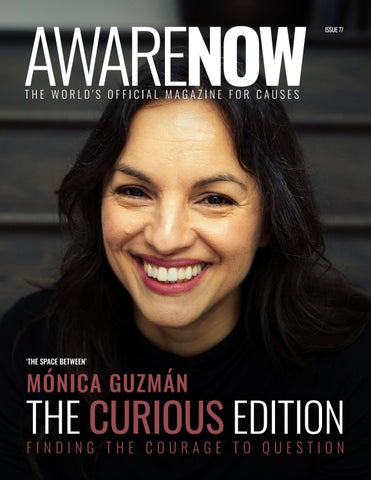
AWARENOW
ISSUE 77
THE WORLD'S OFFICIAL MAGAZINE FOR CAUSES
‘THE SPACE BETWEEN’
MÓNICA GUZMÁN
THE CURIOUS EDITION FINDING THE COURAGE TO QUESTION
THE CURIOUS EDITION ON THE COVER:
MÓNICA GUZMÁN
AwareNow Magazine is a monthly publication produced by AwareNow Media™, a storytelling platform dedicated to creating and sustaining positive social change with content that inspires and informs, while raising awareness for causes one story at a time.
006 CURIOUS JACK MCGUIRE
008 THE STRENGTH OF THE PACK DUFF ARCHIE
044 PERMISSION TO BE SARAH J. BARTHOLOMEW
054 WHAT WE DO WITH MS NICK GUARINO
072 THE REHABILITATION OF TRYING ALEX SEARLE
076 WHAT WE REFUSE TO MISS CHERYL SCHABERG
016 THE SPACE BETWEEN
060 THE OTHER SIDE OF THE NEST
086 WHEN I’M GONE
MÓNICA GUZMÁN
ELIZABETH BLAKE-THOMAS
BURT KEMPNER
028 A COUPLE TAKES ON MS DAN & JENNIFER DIGMANN
066 MORE THAN CHANCE SIMA RIED, RENEE CORNWELL, SONJA MONTIEL
088 WHAT WE GROW TOGETHER JORDAN HANKWITZ
SUBSCRIBE FOR FREE: AWARENOWMEDIA.COM/SUBSCRIBE www.IamAwareNow.com
Be curious, not judgmental. Walt Whitman
Curiosity is more than a desire to know. It’s the courage to question what we believe, challenge what we assume, and consider that there may be more to the story than what we’ve been told. In a world divided by uncertainty and desperate for something to trust, perhaps the bravest thing we can do is remain open to being surprised.
ALLIÉ McGUIRE CEO & Co-Founder of AwareNow Media Allié McGuire began her career as a performance poet, transitioned into digital storytelling as a wine personality, and later produced the Hollywood Film Festival. Now, as co-founder of AwareNow Media, she uses her platform to elevate voices and champion causes, connecting audiences to stories that inspire change.
JACK McGUIRE President & Co-Founder of AwareNow Media Jack McGuire’s career spans the Navy, hospitality, and producing the Hollywood Film Festival. Now, he co-leads AwareNow Media with Allié, focusing on powerful storytelling for worthy causes. His commitment to service fuels AwareNow’s mission to connect and inspire audiences.
WAIVER/DISCLAIMER
The views and opinions expressed in AwareNow are those of the authors and do not necessarily reflect the official policy or position of AwareNow Media. Any content provided by our columnists or interviewees is of their opinion and not intended to malign any religion, ethnic group, political group, organization, company, or individual. Stories shared are not intended to vilify anyone or anything. Their intent is to make you think. * Please note that you may find a spelling or punctuation error here or there, as our Editor-In-Chief has MS and lost vision in her right eye. That said, she still has perfect vision in her left and rocks it as best as she can. www.IamAwareNow.com
Perhaps the greatest threat to humanity is not what we don’t know, but what we are no longer willing to question. JACK MCGUIRE
CO-FOUNDER OF AWARENOW MEDIA Photo Credit: Arian Fernandez 6
www.IamAwareNow.com
‘REFINED & DEFINED’ EXCLUSIVE COLUMN BY JACK MCGUIRE
CURIOUS
WHEN UNDERSTANDING MATTERS MORE THAN BEING RIGHT In a world increasingly divided by what we believe, perhaps what can unite us is what we’re willing to learn. Jack McGuire leads a short exploration of curiosity not simply as a desire for knowledge, but as an act of compassion. In the space between what we know and what we have yet to understand lies an opportunity to become more human. curious: (adjective) having the courage to question what we know, the humility to accept what we don’t, and the compassion to understand what others experience. We live in a time when opinions are louder than questions, assumptions travel faster than facts, and being right often seems more important than being human. What if we became more curious than critical? What if we listened to understand rather than respond? What if we questioned our own convictions as often as we questioned those of others? Curiosity is essential to the Human Cause. It allows us to see beyond labels, look past differences and discover the humanity in those we may not understand. We don’t have to agree with one another to learn from one another. Perhaps the greatest threat to humanity is not what we don’t know, but what we are no longer willing to question. Stay curious. Stay compassionate. Stay human. AwareNow more than ever.
AwareNow Podcast
CURIOUS Written and Narrated by Jack McGuire https://go.awarenowmedia.com/podcast/curious
TAP/SCAN TO LISTEN
7
www.IamAwareNow.com
The strength of the pack is the wolf; the strength of the wolf is the pack. DUFF ARCHIE
FOUNDER OF EXPEDITION MS 8
www.IamAwareNow.com
‘EXPEDITION MS’ EXCLUSIVE COLUMN BY DUFF ARCHIE
THE STRENGTH OF THE PACK WHAT IT MEANS TO MOVE TOGETHER
Some of life’s most profound lessons are learned long before we understand their significance. In this deeply personal reflection, Duff Archie traces the wisdom of his high school crosscountry coach through seasons of friendship, loss, grief, and growth, discovering that strength is as much about those who stand beside us as it is about what we carry within ourselves. With humor, heart, and remarkable honesty, he challenges the romantic notion of the lone wolf and reminds us that perhaps the greatest measure of strength is not how far we can go alone, but how faithfully we show up for one another. Nobody remembers their yearbook quote. You might think you do. Crack open a mental image of yours, and you’ll probably find something Dr. Seuss-adjacent, or a line from The Great Gatsby that felt profound at seventeen and now just reads as “vibes, man”. At Episcopal High School, my classmates went with Emerson, Thoreau, and something Leonardo DiCaprio’s character from the movie Blood Diamond said. Standard issue, you know? I picked three, actually. Writing this, I had to remind myself of two of them: an Oasis lyric, and a line from a man who’d once sailed around the world alone. The one that stuck, however, was Rudyard Kipling. For the strength of the Pack is the Wolf, and the strength of the Wolf is the Pack. Some sayings attach themselves to your life long before you understand why. The first time I heard that was as a freshman at Episcopal, colloquially known as the Holy Hill, sitting under the large loblolly pine near the track in the late-August heat, wearing my new, stiff issue, the gray cotton tee with maroon ‘EPISCOPAL’ block letters on the front and black shorts required for every practice. Cicadas humming, the air carried that particular DC heaviness people insist on describing with the phrase it’s not the heat, it’s the humidity, as if that distinction has ever made anyone less sweaty. Head Coach, Mr. Joseph A. Halm stood at the bottom of the hill with his three assistant coaches, lean and ginger-haired, already locked in, with the mix of eagerness and seriousness of purpose that made even an easy run feel like it mattered. “All right gang,” he said. “We’re just going to start out easy today. A nice meat and potatoes run.” A meat and potatoes run meant exactly what it sounded like: a steady 25-to-35-minute jog, with no sprints, no intervals, and nothing clever. We split into small groups, ran the perimeter of the school grounds, and came back in one piece. Mr. Halm was out there for every meet, calling out times, words of encouragement, or just being a steady presence, giving you the look that said he knew you could give it your all. He was intense but never theatrical. He expected effort, honesty, and for you to run your own race well, a personal record mattered to him as much as a finishing place did. Whether you were heading to a Division I program or grinding it out in the back of the pack at thirty minutes flat, if you ran the best race in you, he was equally, genuinely thrilled. 9
www.IamAwareNow.com
…if you ran the best race in you, he was equally, genuinely thrilled. DUFF ARCHIE
FOUNDER OF EXPEDITION MS 10
www.IamAwareNow.com
He’d traverse the course with us, the woods on the first mile, the dry pond on the second, back up the hill on the third. He wanted to run alongside us. Junior year, before the State Championships, we watched Without Limits together, the Steve Prefontaine film with Donald Sutherland as Head Coach, Bill Bowerman. Mr. Halm was the Bowerman of Episcopal: before every meet he’d gather us arm-in-arm for a speech, the way Bowerman did in the film. Spoiler Alert: Steve Prefontaine dies. In his eulogy at the end, Bowerman states: “The real purpose of running isn’t to win a race. It’s to test the limits of the human heart.” Mr. Halm lived what he asked of us without ever sounding like he was reading from a plaque on the wall. Which was why, when he said something, it tended to stick. The Kipling quote came from him. He said it before meets, at practice, and when he wanted you to take team training seriously. I filed it in my yearbook and figured I was done with it. It was lunchtime on the second-to-last Sunday of July 2014, the midpoint between my recent EHS graduation and the upcoming freshman year of college, and I was enjoying my midday break from work at the Washington Sailing School. Distractedly scrolling through Twitter, I came across an odd tweet from @REAL_EHSprobs, the unofficial Twitter page for campus gossip. Rest in peace Mr. Halm, you will be greatly missed. My heart stopped. A horrible, haunting feeling crept up my spine. No. This has to be some sick joke. I quickly checked friends’ Twitter pages to verify credibility. Nothing. Okay, good. Maybe it’s just a really bad joke. I texted my best friend and former roommate, Sam Armm. “Did Mr. Halm really die?” “I’m afraid so,” Sam replied. I looked up from my phone. I couldn’t move. I looked at the food in front of me. I couldn’t eat. He’d died in his sleep of a genetic heart condition, the morning after an ordinary Adirondack hike, a trail he’d done hundreds of times. He left behind a wife and three kids; his oldest, Abby, had been a star on the cross-country team the year above me. He was, genuinely, one of the strongest men I knew. Looking back, that was probably my first encounter with grief, though I didn’t have a word for those feelings at eighteen. The world kept moving, and so did I. But that Kipling quote kept showing up. It’s in cross-country scoring: you run your own race, alone, lungs burning, and your finishing place converts straight into points for the team. First place is worth 1 point, second is worth 2, and the places of your top 5 runners are summed; the lowest total wins. One of the most individual acts turns out to be one of the most collective. You’re racing for yourself and for everyone else in the same stride. The strength of the pack is the wolf; the strength of the wolf is the pack. It’s in rock climbing: a 5.11 route is harder than a 5.9 and worth more, and the team score is just everyone’s hardest climb stacked together. And it’s in high school dinghy racing. In spring, with DC Sail, I’d race a 420 or FJ sailboat against others from across the DMV, Annapolis, and the whole upper-Bay, while every result I posted folded quietly into the organization’s standings. We were simultaneously racing for ourselves, as we were for DC Sail as a whole. It took me a decade to notice I’d been running the same equation my whole adolescence, and longer still to realize it’s never really been about sports at all: at some point the pack stopped being something I ran with and became something I needed.
11
www.IamAwareNow.com
What I learned in that booth was that the support that is actually needed is often the least expressed kind. DUFF ARCHIE
FOUNDER OF EXPEDITION MS 12
www.IamAwareNow.com
It’s February 2018. My mom had just sat my brother, Ben, and me down at Taqueria el Poblano in Del Ray with the EDSS scale printed out, the clinical rating system for MS progression, and spoke the word ‘terminal’ in the same room we opened Christmas presents a few weeks earlier. What happened next was pure serendipity. Connor Gribbon, one of my closest friends from Episcopal, and later my co-founder at OffWeGo, coincidentally happened to be home that same weekend. We ended up at O’Connell’s in Old Town Alexandria: the hometown Irish pub, all dark wood and brass globe lights, up in one of the worn wooden booths on the balcony, looking down over the bar. For a bar whose average Saturday night decibel level would make your Apple Watch scream, this was an oddly still evening. Music playing over the loudspeakers, sure, but no live band or dancing hooligans. I basically dumped the whole thing on him. The deterioration was old news by then. The timeline was not. The fact that we were suddenly talking weeks was new. The fact that my life, which until that weekend had mostly consisted of college, natural ambition, and the ordinary narcissism of being in your early twenties, now had Grief coming out of the corner of the Command Center where it had silently slept all along, growing in size with each new passing. Mr Halm - a genetic heart condition - July 2014 • My mom’s sister, Aunt Nancy - ALS - December 2016 • My paternal grandmother, Carol Archie - a heart attack - June 2017 •
All gone in the span of a little over three and a half years. Either way, Connor listened. He didn’t lunge for a silver lining or tell me everything happens for a reason, which is fortunate, because that’s the one thing that would’ve sent me out the door faster than he could say ‘Another round?’ He stayed where he was, sitting across the table, leaning in on the edge of the booth, being fully present, letting me say things as many times as I needed to say them, in whatever dumb, circular, shocked way I could make out. What I learned in that booth was that the support that is actually needed is often the least expressed kind. Sometimes it looks like a friend staying put while you come apart. That, too, was the pack. After he died, that circle widened. We held the memorial service at Christ Church Alexandria, where I was baptized and where my dad had spent years as Acolyte Master, and I as an acolyte. No receiving line afterward, thank God, the introvert in me would never have survived it. I’ve never once met anyone eager to ‘step right up,’ like a widowed carnival barker to shake your cousin’s twice-removed hand because they shared a few words with Dearest at a family barbecue fifteen years ago. At the reception, my mom, my brother, and I just drifted to different corners and let people find us. And of course they did, enough that I kept looking up and seeing just how many had decided, with their calendars and their cars and their feet, that this was where they were supposed to be that day. Former colleagues. Family friends. Episcopal people. Sailing people. Work people. A whole minibus of Episcopal students drove down for Ben. A client of Mom’s flew in from California. People from one part of our life standing awkwardly but kindly next to people from another part, all of them suddenly in the same room because one man had occupied such a large place in ours. Each of us, it turned out, had a pack of our own, and that day, all of them showed up at once. It is one thing to know, abstractly, that your family is loved. It is another to watch that love park itself in rows, sign a guest book, bring food to your house, stand around in uncomfortable shoes, and make small talk in hushed voices because there is no version of this situation in which anyone knows exactly what to say. 13
www.IamAwareNow.com
Later, back at the house, the pack got tighter, family, the few closest friends, the church’s grazed-over catering trays balanced on the kitchen counter. By evening, nobody had actually eaten a real meal, and everyone was starving. One of my maternal cousins had ordered two pizzas for her four little kids and left them on the counter. The man who ate them has, technically, no relation to me at all: my paternal cousins’ uncle, their mother’s brother, family-by-thirty-years-of-showing-up. He saw pizza. He reasonably assumed that the pizza was for the room. He’d worked through a solid stack of a four-year-old’s dinner before anyone caught on, and when someone finally did, it was my uncle, my mom’s sister’s husband, grandfather to the very kids whose dinner was vanishing, who looked over and said, flat as a board, “Must be good. Easy as taking candy from a baby.” It was the most Archie thing that had happened in days, and the culprit wasn’t even technically an Archie to begin with. I spent a half-second turning to share it with the one person who’d have loved it most, before I remembered his chair was empty. Dad would have been telling that story for years. That was the pack too: chaotic, half of it not even related to us, and there anyway. The older I get, the more suspicious I am of the lone wolf as a concept. He’s always had a better branding team than the pack. He photographs well. Looks decisive. Self-contained. A little dangerous. Great mascot for about half the bad male behavior on the internet and at least a third of the worst startup advice. But as an operating philosophy, it falls apart quickly. Illness is not a lone wolf activity. Grief is not a lone wolf activity. Marriage isn’t. Family isn’t. Building anything serious isn’t. The problem with support systems is that they don’t send a warning when they start to go. They just get thinner. It’s easier than it should be to let months go by. You think of someone while unloading the dishwasher. You think, I should call Bob, I haven’t talked to him in forever, and then dinner needs attention or work spills into the evening, and you tell yourself tomorrow would be better because tomorrow you’ll have more time and a better headspace. Then tomorrow becomes sometime next week, and next week becomes a season, and all of a sudden, you’re relying emotionally on people you haven’t actually spoken to in months. Adulthood thins things by inches. The pack is not the people who say they’d do anything for you. The pack is the people who are already moving their chairs. Part of adulthood, I think, is deciding whether you’re doing the same for them. I keep coming back to sailing partly because of this. Not because it makes for a neat metaphor, though it does. Because it’s one of the few things I know that makes interdependence impossible to romanticize. The boat or ocean doesn’t care about your intentions. You either show up for each other, or it stops working. There’s no ‘single-handing’ it, despite some seriously strong solo sailors. Sir Robin Knox-Johnston, the first person ever to sail alone, nonstop, around the world, has spent a lifetime correcting people who turn up wanting to conquer an ocean. “The ocean doesn’t notice you,” he tells them. “You don’t conquer an ocean; you survive one.” You survive it by respecting that it is vastly, permanently stronger than you, and by taking care of everyone else in the boat. Which is the truest thing I’ve heard anyone say about twenty years of Primary Progressive MS. Nobody conquered it. There was no war and no beating it, the scale ran exactly as it was always going to run. There was only survival, halfstep by half-step, with a whole crew of people quietly pulling their chairs in close. You don’t beat the ocean. You don’t beat the disease. You respect the size of the thing, and you don’t face it alone. 14
www.IamAwareNow.com
AwareNow Podcast
THE STRENGTH OF THE PACK Written & Narrated by Duff Archie https://go.awarenowmedia.com/podcast/the-strength-of-the-pack
TAP/SCAN TO LISTEN
A few months ago, Connor’s younger sister McKenna posted a fundraising page for the 2026 New York City Marathon. She’s running for the Brain Aneurysm Foundation, for her mom, who survived a surprise rupture and had to relearn how to speak and move. Her goal was $6,000, and the donations came fast. I donated and texted back, The Archies ❤ the Gribbons - such an important cause. And then, because running a marathon for this had made me think of it and McKenna is also an EHS Alum, I sent her the line. Mr. Halm used to quote Rudyard Kipling to us before every meet, I wrote. For the strength of the pack is the wolf, and the strength of the wolf is the pack. Hope it inspires you like it’s inspired me. She wrote back that she loved it, and it’d already started to feel true. In the first twenty hours alone, donations from all over had pulled her within $1,200 of her goal, people giving for her, for her mom, or both, and she said she felt newly empowered heading into training. She blew past it that week and kept going, last I checked, almost four times what she’d asked for. Mr. Halm has been gone twelve years. The line he used to push a pack of gasping freshmen up the Holy Hill is still out there working, still getting someone to run a little harder than she thought she could. I filed it in my yearbook at eighteen and figured I was done with it. I had that exactly backwards. It was never done with me. ∎
Learn more about Duff and Expedition MS: www.expeditionms.org Explore and subscribe to his Substack: awaywego.substack.com DUFF ARCHIE Founder of Expedition MS www.expeditionms.org Duff Archie is a writer and lifelong sailor whose essays move between the water and the living room, racing and yacht deliveries on one side, family and chronic illness on the other. He spent twenty years watching his father, Tim, live with Primary Progressive MS, and much of his work turns on what that taught him: that disability is more often a design problem than a tragedy, that humor is how a family survives a long decline, and that grief doesn't end so much as change shape. He's the founder of Expedition MS, a global sailing-and-storytelling nonprofit for the MS community, where every crew is mixed and every port is a community stop. His writing lives in the ordinary adjustments that hold people together when the body stops cooperating.
15
www.IamAwareNow.com
Let’s just be human… MÓNICA GUZMÁN
AUTHOR, JOURNALIST, FOUNDER & CEO OF RECLAIM CURIOSITY Photo Courtesy: Mónica Guzmán 16
www.IamAwareNow.com
EXCLUSIVE INTERVIEW WITH MÓNICA GUZMÁN
THE SPACE BETWEEN
THE POWER OF CURIOSITY IN A WORLD DIVIDED What happens when the people we love see the world in ways we struggle to understand or agree with? For Mónica Guzmán, a journalist, author of I Never Thought of It That Way, and the liberal daughter of conservative parents, that question has become both deeply personal and profoundly purposeful. Through her work with Reclaim Curiosity and A Braver Way, Mónica invites us to consider a possibility that feels both simple and radical: perhaps the most important conversation we can change is the one we’re having with ourselves. ALLIÉ: Before curiosity became the heart of your work, it was something you had to practice at home. Growing up as the daughter of conservative parents, when did you first realize that loving someone and understanding them weren't necessarily the same thing? MÓNICA: There were many moments. One that comes to mind was in high school when I realized my position on abortion, which lines up with the American left, was very much not my parents' position on abortion. And my mother
THE SPACE BETWEEN EXCLUSIVE INTERVIEW WITH MÓNICA GUZMÁN BY ALLIÉ MCGUIRE
CLICK, TAP OR SCAN
TO WATCH NOW
17
www.IamAwareNow.com
Once we adopt a certain description of a group, it can become way too easy to believe a whole package of things about one individual that may not be true at all. MÓNICA GUZMÁN
AUTHOR, JOURNALIST, FOUNDER & CEO OF RECLAIM CURIOSITY Photo Courtesy: Mónica Guzmán 18
www.IamAwareNow.com
MÓNICA: (continued) was an activist on the other side. So we would have tearful conversations. She would come home from volunteering at counseling centers to a daughter who she thought believed something really, really terrible. That's when I realized that loving my mother was an invitation to try to understand her, and that it would be a lifelong process. I still don't fully understand how she can believe what she believes about abortion, and she does not fully understand how I can believe what I believe. But if you were a fly on the wall during our conversations about it, they're pretty amazing. We can get pretty constructive. We can get pretty creative. We find common ground, even on such a divisive issue. Both sides want fewer unplanned pregnancies. Okay, what can we do about it? So there's this way in which we've opened ourselves up to each other, beginning with the fact that we've somehow accepted that the other person is not going to change their mind. That allows for some pretty incredible conversations, where we can even try to be really persuasive, but know that even if the other person doesn't change, they're still our mother, they're still our daughter. We're still a family. ALLIÉ: Yeah, because you see so many times where friends and families are completely torn apart, not speaking to each other, not talking to each other. And the fact that you're able to overcome that, to your point, to say, "I will accept that you will not change, and that's okay.” MÓNICA: And in fact, it was my mother who first came to that. She's told me that for those three or so days after she learned my position when I was in high school, she couldn't sleep because she kept thinking, "I need to change my daughter. I have to, for her own soul.” But over time, she talked to my dad. She had a lot of grounding moments with herself. And she realized, "I love my daughter. I have to let her change on her own, but I can try to understand her, and I can be really honest with her. I can bring exactly how I feel to her.” And that's what she did. She never made me feel ashamed for what I believed. She always accepted it, but she also never hid what she believed. And that, I think, is the secret sauce. That's the magic. That's the amazing. ALLIÉ: Yeah, amazing. Yeah, yeah. And just being able to meet each other where the other person is and say, "I will agree to disagree with you. Love you, don't agree with you." And that's hard. MÓNICA: Yeah. And it can be really hard. Boy, she could tell you. Boy, it got intense. ALLIÉ: Believe it. You know, you've spent years helping people talk across their differences. But I'm curious about the conversations we have inside our own heads. What's something you've had to perhaps unlearn about the way you see people who disagree with you? MÓNICA: A lot of it is about labels for me. Once we adopt a certain description of a group, it can become way too easy to believe a whole package of things about one individual that may not be true at all. So, for example, I have met people all across the political spectrum, far left to far right, everything in between, independents, moderates. I know lots of folks who have voted for our current president. I know people all around the right. And there's one person, Rick, who I once described to somebody else as a supporter of the current president. He had voted for him. And Rick wrote to me afterward and said, "You know what, Mónica? I need to clarify this with you. Just because I voted for him doesn't actually mean I support him. And I just didn't feel seen by you when you referred to me that way. So I just want you to know that's something maybe you can ask me more about.” And so what I had done is something that in my book I called "chaining," which is when you see or hear one thing, right? So I heard this person voted for the president, and then in my head I made loads of assumptions, because I happen to be on the other political side, about what that means. 19
www.IamAwareNow.com
Fear is a physical thing. And once fear freezes your body or makes it lash out, once it takes over, you cannot be curious. MÓNICA GUZMÁN
AUTHOR, JOURNALIST, FOUNDER & CEO OF RECLAIM CURIOSITY Photo Courtesy: Mónica Guzmán 20
www.IamAwareNow.com
“When it comes to dealing with fear, the only strategy is about capacity. You have to figure out where your capacity begins and ends.” MÓNICA: (continued) A lot of those assumptions turned out to be wrong, as they turned out to be wrong for so many people, especially in the very beginning of my own journey through this. And there are examples all across. I've heard from so many people about the same thing. It's when you take this description, this label of a group of people, and you accidentally, unwittingly, sometimes unconsciously apply it to an individual. And you draw conclusions about that person that may not be true at all. You have to apply curiosity, but you can't apply curiosity until you've noticed the assumption. ALLIÉ: Yes. Because sometimes, oftentimes, probably more often than not, we are totally unaware of the assumption even existing. It's just like a bias that comes with it that we're totally blind to. So let's talk about the fact that we're living in a time when disagreement can feel like a threat to belonging. What have you discovered about the fear that lives underneath so much of our division? MÓNICA: A lot. I think if I could rewrite my book now, fear would play much more of a starring role. I talk a lot about how certainty is the arch-villain to curiosity, because if you think you know, you won't think to ask. You'll have killed a bunch of questions before they had a chance to come out and teach you something because of all these conclusions you made too early. But fear is really, really tough on curiosity too, because you can't wonder about something you think is out to get you. If you're being chased by a bear, you're not going to wonder how fuzzy it is and stop and give it a little touch. You're going to get the hell out of there, right? ALLIÉ: For sure we're going to get the hell out of there! MÓNICA: So fear saves us. We're all descendants of people who ran away from the bear. And it's a superpower in and of itself. But fear also shuts off our creativity, our reflective, slow judgment. It is about survival. It takes those resources and puts them into the parts of our brain that are ready to fight, or fly away, or freeze, or even fawn. Try to soothe the nice doggy, nice doggy, back away from ourselves in order to reduce a threat. These are the trauma responses. These are the threat responses. Fear is a physical thing. And once fear freezes your body or makes it lash out, once it takes over, you cannot be curious. You can’t. So when it comes to dealing with fear, the only strategy is about capacity. You have to figure out where your capacity begins and ends. I always hear from people who say, "I can't talk to that person who believes that thing. Even thinking about it stresses me out.” And I'm like, "Great. That's not where you practice curiosity. That is beyond your capacity right now.” 21
www.IamAwareNow.com
We have to be more curious, or we will get lost. MÓNICA GUZMÁN
AUTHOR, JOURNALIST, FOUNDER & CEO OF RECLAIM CURIOSITY Photo Courtesy: Mónica Guzmán 22
www.IamAwareNow.com
MÓNICA: (continued) So what is your edge? Where's a place where you're a little concerned, it's a little heated, but it's not overwhelmingly so? Then, with that person or on that topic, you absolutely can get curious. What you don't want is to always have conversations that are only in what people call your comfort zone, totally at the center of your capacity, because you will not grow it. You will not grow your capacity. And in such a divided world, that's what we need the most. So it's not about, "I'm going to talk to the most evil person I can think of tomorrow, in my head." Right? I'm not going to do that. I'm going to talk to somebody who I know I have a relationship with, but they believe this one thing. One thing. I'm going to engage in that conversation in small doses. It doesn't have to be all at once. I'm going to get to know them. I'm going to do it as a human. And over time, with low-risk exposures, what people find over and over again is that there's a difference between what they imagined somebody was or believed, the story they told themselves that they projected onto this other person, that their fear was motivating them to believe, and the actual story of that person, who they really are. We all are so desperate to be seen and understood by the people around us. And it sucks to live scared. It stinks to be scared of our neighbors and so many people across the country. So what fear does is it traps us in this cycle where we're judging each other more while we're engaging each other less. And so we just get away from each other. And you have to ask yourself, we're judging each other more, we're engaging each other less. What the heck are our judgments based on? They're based on our projections and our imagination, because they're not based on actual engagement with each other and who each other really is. So we're believing all the stories in the media that's already designed to trigger our emotions and get us to share. We have to be more curious, or we will get lost. We will get lost, and we will be blinded to who other people really are, what our debates are really about. We will lose our ability socially to solve our problems. But we will also damage relationships that mean a lot to us. So, high stakes for how to deal with fear. ALLIÉ: Yeah, and I want to go back to the labels a bit, to say that one label does not define the whole person. And everything that goes with that label, like you were saying, they're not chained to that. In I Never Thought of It That Way and your conversations with people across the political spectrum, you've seen what happens when curiosity replaces certainty. Can you share a moment when someone's willingness to listen genuinely challenged what was possible? MÓNICA: We had a recent episode with a mother and daughter from the Midwest, a Catholic mother, Sharon, and her daughter Anne-Marie, who is lesbian. And they told the story of when Anne-Marie came out to a Catholic family that included priests, that included a father who was known in his community for the way he upheld Catholic beliefs. Very traditional. So it was a big deal in that family. A big rupture. Folks didn't know how to talk to Anne-Marie anymore. But Sharon didn't want to let go of her daughter. 23
www.IamAwareNow.com
When there’s a rupture, there can also be repair. MÓNICA GUZMÁN
AUTHOR, JOURNALIST, FOUNDER & CEO OF RECLAIM CURIOSITY Photo Courtesy: Mónica Guzmán 24
www.IamAwareNow.com
“In this divided world, whoever is underrepresented in your life is going to be overrepresented in your imagination.” MÓNICA: (continued) So they talk in the episode about this very awkward phase where they didn't know what was going to happen. They didn't know if they could repair the relationship. They didn't know if there was going to be a future for them. But they did agree to meet for breakfast every weekend. And they sat at this restaurant and stared at each other. They said what they could. A couple of times, Anne-Marie got up and walked off, right? And Sharon remembers a time when she had said something that apparently was the wrong thing to say. And Anne-Marie did walk out of the restaurant. And Sharon thought, "I've lost her. I'm trying, and I think I've lost her. I'm trying to be honest about what I believe, and I'm trying to love my daughter.” Then Anne-Marie walked back in. And Sharon was so relieved… so relieved. The two of them talk about how difficult that struggle was to fully accept and embrace each other for who they were while still holding on to their own convictions. Anne-Marie wrestled a lot with her own Catholic beliefs and who she was discovering herself to be. It's listening to oneself. It's listening to those around us, even when you have no idea where you're headed, even when you think you might say the wrong thing. And you will. You will. But hopefully, somehow, you're enough in the moment with each other that when there's a rupture, there can also be repair. We're messy human beings. We're not perfect AI who are just incredibly empathetic listeners, but also not real, with needs and flaws. And yeah, it's a precious thing we're able to do. It's not easy, but it really does change everything. ALLIÉ: Well, and I love that example too, because I think it speaks to the fact that if we can just share space, even if we don't know what to do with it, just be there, you know? And that commitment, that commitment just to share that space and to live in uncertainty, which then allows for curiosity, to your point. MÓNICA: Exactly. Sometimes that's enough. That takes courage in and of itself, just to be present. I often say that in this divided world, whoever is underrepresented in your life is going to be overrepresented in your imagination. So just the step of being with whoever you're afraid of, whoever you think might be a threat, whoever represents something you think is bad in your own head, is already a big, curious step forward. And it doesn't all need to be argued out in words. Sometimes it's gestures. Sometimes it's doing things together. We have research that shows that all the time. A funny thing I do is when I'm talking to someone, especially someone with whom I might be disagreeing, and we're in person, I always look for seats that are angled like 45 degrees to each other at coffee shops. 25
www.IamAwareNow.com
MÓNICA: (continued) Because that way, you're not just facing each other, right? With the eye contact sometimes seeming threatening, you can look off. You can look off in a way and kind of come back to yourself and feel grounded, and then come back to the person. And you can both do that. So there are all these ways that we can actually set up contexts that allow curiosity to be easier, even when the person represents something we imagine to be bad. ALLIÉ: Love that. Just all the nuance, the little things that we can do to create this space that makes it feel a bit safer. So one more thing I wanted to discuss with you today, Mónica, is that so much of your work is about changing how we see each other. But I wonder if the deeper transformation is in how we see ourselves… Who do we have the possibility of becoming when we no longer need to be right in order to feel secure in what we believe? MÓNICA: Mm-hmm. Mmm, delicious question. I think that's it. That's the core of it. A lot of practices in what is called bridge building, pluralism, this sort of work about connecting with folks who disagree with us, focus on what you say to others, how you think about others. But to your point, it really does begin with, do you have a healthy relationship with yourself as a political thinker and actor? Now, a lot of people think, "Politics? Ew. Nothing to do with it. I don't want to.” I understand that, but really, at the root, politics is just the art and science of thriving together as people. We are social creatures. We're not going to get away from that. One way or another, you are a participant in a political thing, right? So the thing that you are able to become is useful, powerful, strong. Useful. A lot of my journey, frankly, in trying to figure out what these tools are that I can share with others is also about discovering them for myself. I grew up passive. I grew up shy. I grew up sometimes not aware of my own power, and even convincing myself I didn't have any because, boy, confrontation and conflict! But also because I hated to be wrong. I hated it. I was like the straight-A student. I was the Hermione Granger from Harry Potter. If I didn't have the right answer, I wasn't going to ask the question. I wasn't going to offer myself up at all. So boy, being able to embrace intellectual humility, being able to think, "You know, I look forward to being wrong. If through conversation with someone I learn that I'm wrong, I will then be right. Wouldn't I rather be right sooner?” But what's most important to me, the truth or my own beliefs? Well, if it's the truth, then I better expose myself to different ways of seeing and thinking and knowing, so that it's more likely that through that diversity of exposure, I can see the world as it truly is and not as I imagine it to be. Then I can be useful. And this is really important because I think of it as political wellness, the practice of staying grounded in what you believe so that you can act with integrity on what you believe, and so that you can stay open and receptive to what other people believe, right? And not just dismiss everything you hear because it's not yours. Then you can be useful in a divided time and in any time, because you won't be vulnerable to hopelessness and despair. You'll see your own power at every moment. And no matter what is going on in your community, you will be of use. Because you won't be so overwhelmed. You won't be knocked sideways. If there is something that is truly dangerous, you won't just shut down. You'll find the place where you meet yourself at the edge of your capacity, and you'll do what you can, right? So to be useful in this world, rather than despairing, rather than numb, because a lot of folks feel numb, rather than reactive and rash and reckless and contributing to the noise that makes all this worse. I think a lot of people want that. Because that also delivers a fulfilling life, right? A life where you feel, "All right, whatever's going on, I've got my corner of it, and I'm going to do what I can." 26
www.IamAwareNow.com
AwareNow Podcast
THE SPACE BETWEEN Exclusive interview with Mónica Guzmán https://go.awarenowmedia.com/podcast/the-space-between
TAP/SCAN TO LISTEN
ALLIÉ: Yeah. I love that. I just think I need you talking me off these ledges on the daily, honestly, Mónica. It just makes so much sense, and why does it have to be so complicated? Maybe it just doesn't. MÓNICA: Yeah, it's not complicated. It's true. But it's back to what you said about fear. Fear makes it seem so hard and makes us actually avoid the very thing we should be doing, which is meeting ourselves at our edge and challenging ourselves. That's the only way to make this world less scary. ALLIÉ: Yeah. And again, it does go to a choice. I mean, what if we were to choose to not be afraid? "I choose to not be afraid of this anymore. I'd like to just explore it and figure it out.” I choose to explore. I choose to be curious. MÓNICA: Yeah. Just explore… just be curious. Including if something ends up really scaring you and you have to walk away. Later, be curious about, "Okay, what happened? What data, what new information do I have about myself and where my abilities are and what the next step should be?” Everything can come back to curiosity. If you end up getting angry and rash and reckless, well, what happened there? Again, aim your curiosity within yourself. What was it I was trying to protect that became so urgent that I sort of fell out of consciousness and agency and into this place where my emotions dictated my actions? What happened there? Who do I need to apologize to? That's fine. We can apologize, right? A lot of us are so afraid we're going to say the wrong thing and that that's the end of the world. I think that's part of the problem, honestly. It's not the end of the world. These are relationships. Of course things are going to go wrong. It's fine. We can repair. ALLIÉ: It's called being human, I guess. MÓNICA: Yeah, that's it. Again, we're not AI, thank goodness. Let's just be human, all right? Let's own it. It's fine. ∎
Learn more about Mónica: www.moniguzman.com Find & follow on Instagram: @moniguzman Get I Never Thought Of It That Way: www.moniguzman.com/book
27
www.IamAwareNow.com
You keep going, because this game doesn’t end. DAN DIGMANN
CO-FOUNDER OF A COUPLE TAKES ON MS Photo Courtesy: Dan & Jennifer Digmann 28
www.IamAwareNow.com
EXCLUSIVE INTERVIEW WITH DAN & JENNIFER DIGMANN
A COUPLE TAKES ON MS TWO LIVES, ONE LOVE & A SHARED MISSION
Some friendships are built on shared interests, others on shared experiences, and then there are those built on a shared determination to make a difference. My friends Dan and Jennifer Digmann know what it means to live with MS, love through MS, and fight for a better future for everyone affected by it. As fellow advocates who have taken our stories from personal conversations to the halls of Congress, we sit down to talk about the love that keeps us going, the work that keeps us fighting, and the belief that our voices, together, can change lives. ALLIÉ: Jennifer and Dan, I love that your story began at a National MS Society event, of all places. You both already knew what it meant to live with MS, but you had no idea you'd find each other along the way. So I want to start there. When you think back to that first meeting, what do you remember most about the moment your lives crossed paths? I want to hear from each of you on this. JENNIFER: What I remember is that it was an event I had planned with a group of women, and it was intended for women. The idea was for women to reclaim the things they had put on hold after being diagnosed with MS.
A COUPLE TAKES ON MS EXCLUSIVE INTERVIEW WITH DAN & JENNIFER DIGMANN BY ALLIÉ MCGUIRE
CLICK, TAP OR SCAN
TO WATCH NOW
29
www.IamAwareNow.com
When you get older, you realize the small stuff kind of doesn’t matter. JENNIFER DIGMANN
CO-FOUNDER OF A COUPLE TAKES ON MS Photo Courtesy: Dan & Jennifer Digmann 30
www.IamAwareNow.com
“I never realized I was going to go down there trying to win over a girl and impress her.” JENNIFER: (continued) I had just started using a wheelchair, so it was especially important to me. I had felt like I kind of had my MS under control, but then to lose that part of me, I really needed that event. And so I sit down at a table to start the discussion, and there's this handsome man sitting there! That's what I remember. I was nervous. I didn't know his story. I didn't know who he was with. Honestly, he was so cute, and I was a little nervous. DAN: Yeah, and for me, they forgot to put on the invitation that the event was supposed to be for women only! I saw it and thought it looked interesting, but getting from Mount Pleasant to Frankenmuth on a Saturday morning, I'm thinking, "You've got to get up pretty early to get down there." So I wasn't going to go. But because they started having more men register for the event, the programs manager for the MS Society called me. Just because I'm a man, she thought, "Well, you might be interested in going.” So I showed up because it sounded interesting. She was at the registration table, and she told me to sit at this table Jennifer was leading. I didn't know who Jennifer was, but she was like, "Oh, you're both younger, you both have MS, and you both lead self-help groups." I was leading the one in Alma, and Jennifer was leading the one down in Flint. And honestly, Allié, when she came up to the table, I was taken with her from that moment. You're just like, "I want to know her story.” So yeah, you go to an event thinking you're just going to learn something, but I never realized I was going to go down there trying to win over a girl and impress her. ALLIÉ: Oh my goodness. I think I just need a moment with this… This is such a beautiful story! To begin there, and then to see all that you've done and the life you've created together, which is so beautiful. One thing I love about you both is that you never pretend MS is easy. Relationships aren't easy. MS isn't easy. But you also never let it have the final word. Behind the advocacy, the appearances, and everything people see, what's something about your life together that most people would never know? DAN: That's a great question, Allié. JENNIFER: I think there isn't much, because we're really open about how tough it is and how much we dislike the disease, but also how empowered we are by our advocacy and sharing our story. One thing people probably don't know, and I always look to my writer/editor husband to make sure I'm saying things grammatically correctly, is that we have days where we just chill. I think it was Saturday or Sunday, we woke up, we had some things to do, but we decided to sit and binge television shows. And I joked with you before we started this interview, Allié, that when you get older, you realize the small stuff kind of doesn't matter.
31
www.IamAwareNow.com
The damn disease makes me miss out on things. I’m not going to let it win and make me miss out even more. JENNIFER DIGMANN
CO-FOUNDER OF A COUPLE TAKES ON MS Photo Courtesy: Dan & Jennifer Digmann 32
www.IamAwareNow.com
“I don’t think it necessarily makes you scared, but I think it makes you more gracious.” JENNIFER: (continued) We realize now that weekends are our time to recharge. Tonight, we ate dinner, and we'll probably put our pajamas on and watch football in bed. We're active, but we also know the importance of that restful self-care. What about you, Dan? DAN: Because you asked what people wouldn't know about us, I think there's something about always putting on a brave face. We never sugarcoat the realities of what we're facing, but there's always this awareness that what we have won't last forever. With this disease, it's like us going to Florida, going to DC, doing things, but then realizing how quickly that can change. And I always use baseball analogies, but Cal Ripken Jr. set the Major League record for consecutive games played. He always said he never played scared, because the second you start playing scared, that's when things go bad. So sure, it's always in your mind that things could turn quickly with this disease. I had to have surgery earlier this year, and that made us realize just how quickly things can change. I don't think it necessarily makes you scared, but I think it makes you more gracious. You have more gratitude. You're grateful for what you have. And I think, at some level, you end up overdoing it because you're like, "Well, I feel good today, so I need to keep going.” I can't tell you how many times we don't get to bed until 12:30 or 1:00 in the morning and then have to get up at 6:00. We wear ourselves down until we just can't move anymore because we're trying to make the most of everything. JENNIFER: And I think that's true. We do sometimes disagree. DAN: What?! JENNIFER: I know! I think Dan's surgery is a really good point. Since then, we're more reliant on help from my caregiver, Jen, just to do activities of daily living. We use the sit-to-stand lift, which we never did before. So while we still have those stupid moments when we don't get enough rest, we do pay for it now, and we try to make up for it. Maybe one thing where Dan and I disagree, or where MS treats us differently, is that I'm a little bear cub. I like my sleep, and I get grumpy if I don't get enough of it. Dan can stay up watching comedy, and I can sleep right next to him, and I'm happy! I think our sleep hygiene is a lot better, but we still have our moments when we're not so good.
ALLIÉ: Well, it's hard. It's hard to slow down sometimes when you want to go so fast, and there's so much to do and so much to give. But to hold yourself back, that takes strength. JENNIFER: And I still think, because we have MS, there's always that FOMO. You're just like, "The damn disease makes me miss out on things. I'm not going to let it win and make me miss out even more.” I'm going to push myself, maybe beyond my limits, but I don't want to miss out more than I have to. 33
www.IamAwareNow.com
My biggest fear is karma. DAN DIGMANN
CO-FOUNDER OF A COUPLE TAKES ON MS Photo Courtesy: Dan & Jennifer Digmann 34
www.IamAwareNow.com
ALLIÉ: Yeah, for sure. JENNIFER: Would you say you feel the same way? DAN: Are you talking to me or Allié? JENNIFER: Both of you! I mean, because I just wonder if it… DAN: My biggest fear is karma. I don't want to stop and say, "Oh, I don't feel like it," when deep down… I always say that if you wake up in the morning, and if I lie in bed, lay in bed, whatever is grammatically correct, and I have to sit there and debate whether I'm sick enough to go into work. If you're debating it, shut up, get up, and go to work. Because you know that when you're sick, you're sick. You don't even question it. I never want to call in sick just because I feel lazy or use that as an excuse. Jennifer talks about FOMO, and I'm always afraid of karma. I'm also always thinking about other people who have MS who would kill to have my problems. And not that they know me, but I think it would be such a slap in the face to somebody else who would love to have the opportunity to get up and go to work. So I'm grateful. ALLIÉ: Yeah. And I hear you both. It's that need, that desire to go and do what you can. That feeling of, "I'll be damned if I'm going to miss out on this. I'm not going to let this disease keep me from it. How dare you, MS?” JENNIFER: Exactly! DAN: Exactly. ALLIÉ: But then, like you said a moment ago, Jennifer, we do pay the price. So it becomes a cost analysis, right? It's always this balancing act, this constant assessment of where we are. I've noticed that I've become more aware of myself. I've been able to see where I am in ways I don't think I could before. MS has caused me to stop and say, "Okay, here you are." Do you guys feel that way? Like you're able to see where you are now in ways you couldn't before? JENNIFER: Yeah. DAN: Totally. ALLIÉ: So the three of us have had those moments when we've shared our stories with legislators, whether we're sitting across from them in Washington, DC, or meeting through a computer screen, hoping they'll understand what's really at stake. My question for you both is, was there ever a specific conversation, a meeting, something someone said that stayed with you long after the meeting was over? Have either of you had a moment where you were just like, “Wow"? JENNIFER: I think about that recent interaction with Congressman Moolenaar. My caregiver, Jen, will talk about it, too. When we met with the congressman, he was heading into session, and he looked at me. I appreciated it because, to be honest, we don't always see eye to eye politically. But he looked at me and said, "Now, as I go, is there anything you want me to remember?” 35
www.IamAwareNow.com
JENNIFER: (continued) And I said, "See this face? When you vote, remember this face. Remember what this disease does.” And he said, "Okay, I will.” I'm sure he probably forgot it and voted otherwise, but it was the fact that I was able to look at a legislator and say something like that. I felt comfortable, and I felt like maybe it resonated with him. ALLIÉ: Yeah. DAN: I think for me, it wasn't necessarily what happened during the meetings when we were in DC or down in Lansing. It was when we saw legislators in real life. We were at a Great Lakes Loons game, sitting in our seats, and Congressman Moolenaar was sitting right behind us. It's almost like, not that you corner them, but you get to have these conversations. Ever since then, every time we go to DC, he references our love of baseball. That's something we share. Or when we're at a concert here in town, out at the casino, and we see our state congressman there, and he remembers us. We can have that conversation. All of a sudden, it's no longer just a political connection. It's like, "We're neighbors. We live here. We do the same things you do.” It makes me feel that much closer to them. Our experiences are pretty shared, and I feel like they hear us a little more, or at least pay more attention. Again, we're not always on the same political spectrum, so to speak, but could that be the thing that gets us in the door and keeps us present in their minds? JENNIFER: Keeps that conversation going. ALLIÉ: I love both of those examples. Jennifer, for you, it's about actually being seen. And Dan, it's about being seen in the same spaces they are. Being seen as equals in this environment, in this life. It's about creating that connection. 36
www.IamAwareNow.com
“On some level, you’re always in competition with the disease. If I don’t show up when I fully could, then I feel like the disease has gotten the best of me.” JENNIFER: Yeah. And furthermore, Dan had done something, too. I think it was Senator Hauck at the time, our state senator, and I saw him at Meijer, our local grocery store. It was so funny. We were in the milk section, and he's like, "Yeah, I just got something from Dan today. I will look at that.” I mean, how cool is that? ALLIÉ: No, but that's the thing! It's when it becomes real, when it's a real interaction. So much of our lives involve these digital engagements. When we can physically meet each other in a space, or find each other in a space, how cool is that?! I love meeting with you guys digitally all the time, but when I get to squeeze you and hug you… JENNIFER: Yes, yes, yes! That's why it's going to be so awesome when we see each other in a few weeks. ALLIÉ: I know! I'm excited for it… Something I think about often is how much of ourselves we give to this work, even on days when MS has already taken so much of our energy. So my question is, what keeps you showing up and speaking out when sometimes it would be so much easier not to? DAN: I think what keeps me showing up is remembering what it was like when I was first diagnosed. All you wanted, all that would help you, was to see somebody like you doing things. I remember when I was first diagnosed, they would say more women than men get MS. Well, I wanted to see a man who was like me, my age, still working, still doing things. I think we continue to show up because I want to be out there and be present. I've had the disease for 26 years, but I'm also married. You hear all these stories about marriages not working out, and I want to show that there's still life beyond MS, even after the diagnosis. I always say that, on some level, I don't feel like I really came to life until after I was diagnosed with MS. So I continue to show up and be present for other people, but I also do it for myself. I do it for that 27-year-old me who was wondering, "Where will I be in 26 years?” Well, look at where you are. Look at what you're doing. Everything is still possible. I think that's why we continue to show up. You want to live your best life, with or without MS. On some level, you're always in competition with the disease. If I don't show up when I fully could, then I feel like the disease has gotten the best of me. 37
www.IamAwareNow.com
DAN: (continued) So you keep going, because this game doesn't end. ALLIÉ: Yes. This game doesn't end. And isn't that a statement? Isn't that powerful? JENNIFER: That's the truth. DAN: How about you? JENNIFER: I remember shortly after we had gotten married, we had a very dear member of our support group who we both thought the world of. She didn't have the confidence to speak out. She didn't feel comfortable. She didn't realize the power in her story. And so when we would talk, and even to this day when I go before legislators, I think of her. I think of all the MS crap she had to deal with and what she didn't feel comfortable doing. So in the back of my mind, I think of her, and I want to share my story. And I know Dan feels the same way. We have members of our support group who don't do that, and we're really lucky to have these opportunities and to be able to speak out. Someday, if either one of us loses our ability to do it, we hope other people will keep talking. People like you, people like Fox. Just keep talking. I always joke that we're going to talk about MS until they cure it just to shut us up! Because they will find a cure. They’ll say they’re tired of all this orange at the White House. Just get those people away. Cure the damn disease! ALLIÉ: Cure the damn disease! I love that. I want to end with something that means a lot to me personally, because I truly believe none of us can do this alone. When you think about all the people you've met, that we've met, the friendships made, and the change we're all still working toward, what does the power of the word "us" mean to you? JENNIFER: Us. Well, I think "us" is Dan and me. That's us. We always joke, well, not joke, but early on, when we would talk about multiple sclerosis, we'd say it should be multiple sclerosis because of all the connections we've made. It's been 30 years for Dan and me, and we've met so many incredible people, whether they're friends, fellow advocates, fellow storytellers, neurologists, physical therapists, or caregivers. We've just made so many connections. DAN: And I think of "us" as how closely connected the MS community is. Anytime Jennifer and I go speak at an event, you talk to somebody and have that conversation. That's the beauty of the disease, if we can say that. It's because we've all had those experiences of unexplained symptoms, the MRIs, everything. We can all relate. Maybe it's not the exact same experience, but we can relate. And in that chance meeting, even if you talk to somebody for just a minute, you always have that connection. 38
www.IamAwareNow.com
AwareNow Podcast
A COUPLE TAKES ON MS Exclusive Interview with Dan & Jennifer Digmann https://go.awarenowmedia.com/podcast/a-couple-takes-on-ms
TAP/SCAN TO LISTEN
DAN: (continued) Five, 10, 15, 20 years from now, you can say, "Yeah, we met. We talked at this event. I have MS.” We're instant friends, companions, because we have that shared connection. They say you don't get MS until you get it, and all of us get it. Jennifer and I are living examples of how the disease impacts everybody differently. I don't know what it's like to no longer be able to walk, but at the same time, I can relate to things the disease has taken from me and what that feels like.So there's that level of empathy and compassion you have for another person. That's “us." Even online, you connect with somebody on Facebook, and you don't know who they are, but you get their story, and you don't forget it. Because we were all there once ourselves. And that makes the world a lot smaller. ∎
Learn more about Dann & Jennifer: A COUPLE TAKES ON MS acoupletakesonms.com Find & follow on Instagram: @a_coupletakesonms
39
www.IamAwareNow.com
Miles to go before we sleep…
Every one is a part of everyone.
FIND STORIES, STATS & SUPPORT
FOR THE CAUSES THAT TIE US ALL TOGETHER WWW.TABLEOFCAUSES.COM
It’s through the messiness and the mistakes that we get to course-correct. SARAH J. BARTHOLOMEW
ACTRESS, DANCER & SOMATIC VOICE COACH Photo Credit: Jinni J. 44
www.IamAwareNow.com
EXCLUSIVE INTERVIEW WITH SARAH J. BARTHOLOMEW
PERMISSION TO BE
RECLAIMING THE PARTS OF OURSELVES WE’VE LEARNED TO HIDE We spend so much of our lives learning how to be seen that we sometimes forget what it feels like to simply be ourselves. For actress, dancer, and somatic voice coach Sarah J. Bartholomew, expression is more than an art form; it’s an invitation to explore the parts of ourselves that too often go unheard, unseen, or uncelebrated. From portraying quiet strength on screen to creating spaces where people can move, play, and find their voices without judgment, Sarah reminds us that perhaps the most powerful performance of our lives begins when we stop performing altogether. ALLIÉ: Sarah, you've spent so much of your life expressing yourself through movement, music, and storytelling. But I'm curious about the person behind all of that. When you take away the roles, the choreography, the expectations, and even the audience, who is Sarah? And has that answer changed over the years? SARAH: Very good question. ALLIÉ: Deep. We're starting deep, girl.
PERMISSION TO BE EXCLUSIVE INTERVIEW WITH SARAH J. BARTHOLOMEW BY ALLIÉ MCGUIRE
CLICK, TAP OR SCAN
TO WATCH NOW
45
www.IamAwareNow.com
I think what’s really underneath there is curiosity and a desire… SARAH J. BARTHOLOMEW
ACTRESS, DANCER & SOMATIC VOICE COACH Photo Credit: Jinni J. 46
www.IamAwareNow.com
“… you get to face a lot of scary things within yourself. I find that to be a very exhilarating and hyper-present space.” SARAH: I'm like, how dare you? This is why I do this, so I don't have to be exposed. No, it's a beautiful question. And I think exactly what you said at the end is the truth of it. It's changed a lot over the years. I think what's really underneath there is curiosity and just a desire to understand as much as I can about this existence through this vessel that we're in. And I find that through expressive arts, whether you're performing in front of people or not, you get to learn so much about yourself, humanity, and the world. Through that, you get to face a lot of scary things within yourself. I find that to be a very exhilarating and hyper-present space. I think that's what's underneath all of the expressions. That's the driving force underneath all of them. ALLIÉ: Yeah. I love that. SARAH: But it's such a good question. I feel like I'm going to be thinking about that for a long time now and finding a lot of different answers. ALLIÉ: I love something you just shared, and it was that term, 'hyper-present.' I've said this before. We're human beings, but it's so hard to just be. We're like human doings, you know? To just be present, to share a moment, to be there, is really a difficult place to be. Something I find beautiful about Sparkle Pop Dance is that it seems to be about so much more than dancing. You're creating a space where people can show up exactly as they are without needing to be polished or perfect. So, I'm curious. What have the people in that room taught you about the things we carry, the things we hide, and what happens when we finally give ourselves permission to let all that go? SARAH: That made me emotional. Because the people who show up in that space, in that room, on a weekly basis are just some of the most special humans I've ever shared space with in my life. We have this weekly ceremony together where we get to be completely unhinged within ourselves, to return to your five-year-old self who's just prancing around the living room, not having a care in the world about how you're being perceived. It's just the magic of expression. I don't even like to call them my students because I feel that I'm the student with them in the room. Absolutely. Sometimes I walk into the space and I'm like, "Man, I'm so closed off today. I don't want to be witnessed, even as a teacher guiding this room today." But then everybody comes in just ready to rock and roll. And so, there's this synergy, this big reciprocity, this energy exchange. I think that's what's been so interesting about how the arts can be a part of your life. It doesn't have to be something that's performance-based at all. It can really just be a meditation, a connection with other humans. I find that the strongest way I connect with people is through movement. And even though we don't talk that much with words all the time in that community, we communicate. ALLIÉ: We communicate. Well, I heard you loud and clear from the segments that I've watched. I was hearing you and feeling you. It's awesome. SARAH: Yeah, it's a special space. ALLIÉ: So, let's switch gears to something else that's very special. As a somatic voice coach, you work with people to connect with their voices through their bodies, which I find fascinating. I think so many of us spend our lives being 47
www.IamAwareNow.com
Being able to share that with others is where I feel like I’m really in alignment. SARAH J. BARTHOLOMEW
ACTRESS, DANCER & SOMATIC VOICE COACH Photo Credit: Jinni J. 48
www.IamAwareNow.com
I found that for people to be able to find their essence within their voice, there needed to be a physical component. ALLIÉ: (continued) told, directly or indirectly, to quiet ourselves, to make ourselves smaller, or to be something that we're not. What have you discovered about the connection between finding our voice and finding ourselves? SARAH: It's the same thing. It's not separate at all. It's one and the same. I started teaching dance at a very young age, and then I started teaching voice later in my life. I found that for people to be able to find their essence within their voice, there needed to be a physical component. Obviously, the postures and technique and all that stuff are beautiful where and when they need to be. But I was drawing a lot of people in who were wanting to reclaim a part of themselves. As they uncovered maybe the bolder, brighter, deeper, even sometimes quieter parts of their voice, I got to witness what happened. I knew this could happen, but I learned through the process rather than just being told that it could happen. Everybody I was working with would come back and give me feedback like, "This is changing my day-to-day life, how I'm showing up in relationships, how I'm showing up for my job, how I'm showing up in my own personal expression." Sometimes it would actually help people break those addictive patterns of thought and stop dimming a part of themselves. I just found that to be so special. And again, like we were saying before, I learned so much about myself from them because sometimes I can give this medicine better than I can receive it myself. Hearing about the benefits from somebody I'm sharing this with, I'm like, "Right, right, right! This is why this is so awesome. Thank you for reminding me.” ALLIÉ: It's incredible work that you do. Have there been moments in your own life when you've had to fight to reclaim your own voice? SARAH: Absolutely. I feel like there are big pillar moments where there's been a big death and rebirth and reclamation. And then I also feel like, for me, that's a lifelong process because it's ever-changing. It's about how I want to show up in the world. I never want to box myself in. I want to allow myself to shift on my own terms. There was a big point in my life a couple of years ago where I found that work to be so transformational for myself. Being able to share that with others is where I feel like I'm really in alignment, in my pocket of what I'm supposed to be doing in this lifetime. I find that it's very... I don't know how to say it in this tense. Alchemic? It's alchemy. I'm like, how do I say this? ALLIÉ: No, I like alchemic. I think that's awesome. Let's go with that. SARAH: I don't know if it's real. We can decide it is. Who knows? But I feel like you get to really transform yourself through it. And like we said before, you're coming back to yourself as well. You're transforming, you're shedding, but then you're just getting more and more centered without demanding any sense of perfection from yourself through it. I think that's what's also very beautiful about it. Through both the somatic voice work and Sparkle Pop, I encourage everybody to be messy when they want to be. Just let it be messy. Just let it be ugly, and that's okay. ALLIÉ: Yeah, it's okay. That's why some of the ugly cries are the best cries, because you're being real and you're not trying to cry in a pretty way. Just everything, everywhere. 49
www.IamAwareNow.com
There was this dance happening where life was imitating art in some ways. SARAH J. BARTHOLOMEW
ACTRESS, DANCER & SOMATIC VOICE COACH Photo Credit: Jinni J. 50
www.IamAwareNow.com
“When you’re in those points of discomfort and fully accepting that, you grow so much.” SARAH: We don't know how to cry hot. Who knows how to do that? I don't know. Some people know how to do that, and I'm like, "Wow, that's beautiful. You're so beautiful right now.” ALLIÉ: A beautiful crier. Yeah, I'm hella ugly crier. That's all right, though. I’ll take that. I want to touch on Claudia in The Chosen because there's something powerful about a woman whose strength isn't necessarily loud. From what you've shared about her journey, she's reaching a point where she has to make a choice for herself, even when that choice comes at a cost. I'm curious how playing a woman navigating that kind of courage has challenged or changed your own understanding of what it means to stand up for yourself, especially when doing so means walking away from something. SARAH: Yeah. Good question. I was literally talking about this with my acupuncturist this morning because she's such a badass. We were talking about how sometimes you just have to accept that a chunk of your life, whether it's days, weeks, months, or years, is just going to be more uncomfortable. And that discomfort can come on many levels, right? Obviously, there are adjustments that need to happen through that. But when you're in those points of discomfort and fully accepting that, you grow so much. It's like when the caterpillar is in the cocoon, and it's gooey and disgusting, and you're just in the darkness. You get to be closer and closer to your own soul, to the deepest parts of you, and you build a lot of trust within yourself. Even if you're messing it all up, even if you're just like, "Wow, I am not killing it right now." It's through the messiness and through the mistakes that we get to course-correct and go, "Okay, actually, I'm going to do it differently next time." Or not, you know? As I was getting to know Claudia, I was at a lot of points in my own life where I hit limits, where I had to go, "Okay, we have to not exist this way anymore. I'm done with repeating this pattern." I have to get very, very uncomfortable and step into the unknown and have no guardrails right now. And Claudia, considering where she's been, her upbringing, and being a woman who's been very protected and doesn't fully know what's out there, knows that she can trust herself, even if it's terrifying. I think that was something we helped each other with. There was this dance happening where life was imitating art in some ways, right? I was figuring that out for myself, and she was figuring it out for herself, and I was like, "Girl, I got you." ALLIÉ: I love that so much. And that word, 'trust,' right? To be able to trust yourself and the comfort and confidence that come with that. It's almost like stepping back into your power when you feel the most powerless, when you can find that trust even when you don't know the answer. SARAH: Totally. And especially for her, as she stands up for herself, it doesn't mean that anything around her is necessarily going to support her trust in herself or her own truth. But through her perseverance with what she knows, she's constantly stepping closer and closer to herself, which is terrifying sometimes. ALLIÉ: Sometimes it's scary as hell. Absolutely it is. Jumping off the cliff, right? SARAH: Yes. Jumping off the cliff. 51
www.IamAwareNow.com
AwareNow Podcast
PERMISSION TO BE Exclusive Interview with Sarah J. Bartholomew https://go.awarenowmedia.com/podcast/permission-to-be
TAP/SCAN TO LISTEN
ALLIÉ: Sarah, when you look at all the different ways you show up in the world, whether you're acting, singing, dancing, teaching, or just bringing people together, I see this beautiful thread of curiosity, as you mentioned earlier when we first started, and connection. And it makes me wonder something. We spend so much of our lives trying to figure out who we're supposed to become. But what if we're asking the wrong question? What if it's less about becoming someone new and more about remembering who we've always been? What do you think about that? SARAH: Yeah, I love that. And I find that to be true over and over again, especially because we're not onedimensional. There are so many different parts of us, and there's so much to discover. Maybe some people walk through life and never feel like they're being dimmed or closed off or boxed into something. I don't know. But I think it's inevitable that people will hit those points where they're like, "Wait a minute. I don't know if that works for me." Or, "I've been doing it this way, and I don't want to do it that way anymore." I think it's this pendulum, this ebb and flow of discovering and coming back. I feel like I'm at a point in my life where my curiosity is taking me back to a lot of nostalgic things, where I'm allowing myself to just lean into what brought me joy when I was younger. And again, like I mentioned with Sparkle Pop and even with the somatic voice work, a lot of it really is just remembering. Because everybody knows. Everybody has it in there, you know? It is interesting because sometimes people will come into the class, and they're not ready to remember yet. That comes out in certain ways, and I just go, "I hope you come back because it's there for you.” ALLIÉ: Right. It's uncomfortable. It's vulnerable. SARAH: It's uncomfortable. It's vulnerable. It feels like you're throwing up emotionally. But that remembering is there for you. And I feel like these spaces of movement and voice and art and all of that are just vessels to find it within yourself and through connection. ∎
Find & follow Sarah on Instagram: @sarahjbartholomew
52
www.IamAwareNow.com
Instead of just talking about it, let’s try to do something about it. NICK GUARINO
FOUNDER OF MS LIFE Photo Credit: Nick Guarino 54
www.IamAwareNow.com
EXCLUSIVE INTERVIEW WITH NICK GUARINO
WHAT WE MAKE OF MS
TURNING A PERSONAL DIAGNOSIS INTO A SHARED PURPOSE At 21, Nick Guarino was studying abroad in Italy when an unexpected diagnosis of multiple sclerosis changed the way he imagined his future. For years, he tried to keep MS in the background of his life, until he began to recognize that the connection he had been missing might be something he could create for others. Today, as the founder of ms life, Nick is turning his own experience into a community built on belonging, understanding, and the simple power of knowing you’re not alone. ALLIÉ: Before MS entered your life, Nick, who was the 21-year-old version of you studying abroad in Italy? Tell me about that guy. NICK: I think I was just your typical college student, trying to have fun, hang out with friends, and enjoy life as much as possible. Being in Italy, I was trying to take it all in and learn a little bit, but more than anything, I wanted to enjoy the experience. I was just your typical college student trying to get good grades, finish with a degree, and move forward from there.
WHAT WE MAKE OF MS EXCLUSIVE INTERVIEW WITH NICK GUARINO
CLICK, TAP OR SCAN
TO WATCH NOW
55
www.IamAwareNow.com
You’re not alone. People are there for you, and we're here for you. NICK GUARINO
FOUNDER OF MS LIFE Photo Credit: Nick Guarino 56
www.IamAwareNow.com
ALLIÉ: All right. But then MS came along. When you heard the words "multiple sclerosis" for the very first time, what did you fear losing most? I know we feel a lot of things when we hear those words, but what scared you the most in that moment? NICK: To be totally honest with you, I was in the doctor's office with my mom when we were told I had MS. We both got emotional, and I just didn't know what that meant for me. I had to Google what MS was. There was so much going through my head. I was younger at the time, so I was wondering, "How is this really going to affect my life moving forward?" The first thing I thought, to be totally honest with you, was, "Am I going to be in a wheelchair tomorrow?" Everything I knew about MS, from the internet and everything else, made me think I would end up in a wheelchair and that maybe my life wouldn't be that great moving forward. Maybe I was just stubborn, and I didn't know enough about the disease. But that's what I thought right away. ALLIÉ: Yeah, and I think that's the first thing you do, right? You Google it. You try to figure it out because it's completely foreign to you until it's, well, until it's not. You spent years trying to make MS a footnote in your story rather than the headline. What did keeping it at a distance cost you? Did it cost you something to push it away for a while? NICK: I'm still trying to answer that question, to be honest with you. It's something I'm still thinking about, and I don't regret my decision. I think at that point in my life, I needed to step away from it and not have it be associated with me. Or at least I thought I did. I don't really think anything was taken away. With that said, now that I'm getting more involved in the space, understanding more, and connecting with people, I'm glad I'm here. Maybe 10 years ago, it would have been more beneficial to start getting involved in this space and trying to help people who were going through similar things to what I went through. But at the time, I think I needed to distance myself from it. ALLIÉ: Yeah, and I think everyone's journey is so different and so unique. So, to your point, that's what you needed. You needed that distance right then. You weren't ready for it, perhaps. NICK: Exactly. I think it made sense at the time. I go back sometimes and think about what might have happened if things had been different. What if I had graduated and hadn't moved to New York City? What if I had focused more on starting something related to MS or just being more involved in the space? But I try not to go back too much. I don't want to dwell on that period of my life. So, to answer your question, I don't think I lost anything necessarily. I'm just glad I'm in the space now. ALLIÉ: Well, welcome to this space. So, what was it that changed within you that made you want to create ms life, the very kind of community you once struggled to find? What made you want to do that? NICK: I think there were a few things. COVID happened in 2020, and I was living in New York City at the time. I came back to Connecticut, and I just felt it was the right opportunity. COVID was such a terrible time. We were going through this period where people didn't necessarily know what to do. In 2021, I met my now wife, who was my girlfriend at the time. I thought if there was ever a time to make a change or a switch in my career, it would be then. We were talking about it every night, and eventually, it was like, "Okay, well, instead of just talking about it, let's try to do something about it." And so we did. We started ms life. Those were some of the factors that led me to it. I think when I was in the city, I just didn't necessarily have the confidence to start it. I was younger, and that also plays a role, right? I think all those factors led me to it. ALLIÉ: Okay, so let's dive into that a little more. For those who have never heard of ms life before, what is it? NICK: At a very high level, we started as an online platform and community, and we focus on three pillars. The first is an online forum for people who are living with or affected by MS. They can go to the platform, ask questions, provide answers to others, and talk about their experiences. Community is one of our core pillars, and that's where we initially started. We also have an educational pillar. We share monthly newsletters, and those could be about anything. We try to pick topics every month that maybe some members of the forum have talked about, or something my wife and I have discussed where we think, "We should write this month's newsletter about that." That's always interesting, and we get good feedback there. Another thing within that educational pillar is our product page. We try to feature products or partner with brands that help individuals with MS. For instance, Cadense shoes. 57
www.IamAwareNow.com
It’s not easy, and it never will be, but when you have a supportive community behind you, that makes all the difference. NICK GUARINO
FOUNDER OF MS LIFE Photo Credit: Nick Guarino 58
www.IamAwareNow.com
AwareNow Podcast
WHAT WE MAKE OF MS Exclusive Interview with Nick Guarino https://go.awarenowmedia.com/podcast/what-we-do-with-ms
TAP/SCAN TO LISTEN
ALLIÉ: Yes! I love Cadense. NICK: Yeah, exactly! Those shoes are good for foot drop and can be helpful for people with MS. We try to feature products that help individuals with MS on that page. I've found it helpful myself, and it's always nice when people email us saying how one of the products could be helpful to them. The last pillar is active living. I used to play sports growing up, and it's definitely a little more difficult now. Maybe it's because I'm a little older, but even something like dribbling a basketball is really tough because of the tingling in my hands. We try to support active living, though. Just getting out, getting up, getting off the couch, turning off the TV, and being active. We've done a few events. We've done a pickleball event and a Spartan Race, and we want to do more events that promote active living. We also want to team up with sports organizations. I think that's something we could do moving forward. So, those are the three pillars of ms life. It's been great so far. We also partnered with the National MS Society last year. If you go to their website, you'll see ms life listed as a community, which is great. Again, at the end of the day, it's all about helping people who are affected by MS. ALLIÉ: Awesome. I think the more hubs we can have for those of us who live with MS, the better. So, thank you for creating one to do what needs to be done. There was one more question I had for you today, Nick. If that 21-year-old version of you walked into the ms life community today, what do you hope he would find? NICK: When I was 21, I didn't have anyone to turn to or talk to about MS. You're going through a change, right? And you have no one to talk to about it, which was tough, to be honest with you. Now, with this community, whether you're younger or whatever age you are, having people there who know what you've gone through because they've been through it themselves, I think that's comforting. And that's the end goal, right? We just want people to feel comforted and happy and understand that other people have gone through this. You're not alone. People are there for you, and we're here for you. We want everyone to feel supported through everything they're going through. It's not easy, and it never will be, but when you have a supportive community behind you, that makes all the difference. ∎
Learn more about ms life: www.mslifecommunity.com
59
www.IamAwareNow.com
Whatever life transition you’re going through, recognize that it’s okay to stop and feel it… ELIZABETH BLAKE-THOMAS
STORYTELLER, PHILANTHROPIST & OFFICIAL AMBASSADOR FOR HUMAN TRAFFICKING AWARENESS 60
www.IamAwareNow.com
‘MEDICINE WITH WORDS’ EXCLUSIVE COLUMN BY ELIZABETH BLAKE-THOMAS
THE OTHER SIDE OF THE NEST ON LETTING GO, FINDING FREEDOM & BEGINNING AGAIN AT 48
There is no prescribed age for beginning again, nor is there a universal blueprint for navigating change. As Elizabeth Blake-Thomas prepares to leave the home she shares with her daughter, she confronts the unexpected emotional realities of separating from her safe person while navigating life as a newly diagnosed autistic woman. Her story is a tender reminder that growth doesn’t always require a leap of faith; sometimes, a single microstep is enough. We’ve all heard the term “flying the nest.” It’s normally used when describing the time our children leave home to move on to their next stage of adulthood. This could be due to them attending university or perhaps leaving home to live with a partner or get married. Especially in today’s climate, I think children are staying at home longer and even coming back because they can’t afford to set up on their own, so this flying of the nest may happen more than once. Well, what if this was inverted? What if the parents flew the nest? To say my life has been quite unconventional is an understatement. I generally do things backwards, totally different from the “normal” timeline of existence. In fact, it’s fair to say my arrival on this earth was pretty unconventional as well, so it basically set the tone for my style of living over the last 48 years. I recently recognized that my style of living has also been affected by my neurodivergence, which, by the way, up until a year ago, I didn’t even know existed. I am autistic, and the funny thing is, not one of my friends questioned it when I told them. It was as if they all knew this about me, and I was actually the only one in the dark. This diagnosis came about because of a huge loss that I experienced and had no idea how to handle. My grieving wasn’t ticking any of the “normal” boxes, and it led me to get my diagnosis. To say it’s been life-changing is an understatement. Yes, I have grieved, am grieving, and will continue to grieve the little girl, the teenager, and even the young mum who didn’t know why she behaved in certain ways and couldn’t handle certain things. But now, the middle-aged woman has been given a new lease on life, and it has afforded me the freedom to be and feel in ways I wouldn’t have thought possible. The freedom I feel is beyond anything I could have imagined. However, it has come with a darker side. I am now aware of why change affects me so much. I am also aware of each of my emotions in a heightened way and why I feel everything so deeply. The one I am feeling especially deeply at the moment is guilt. Let me explain further. I am 48, and my entire world and existence are changing. I feel like I am literally being thrown into a snow globe and tossed around. It’s actually quite ironic that I’ve chosen a snow globe because I really don’t like the cold. But I’ll stick with it for now. I had the most perfect life (for me). I lived with my daughter (in her house) in LA. I was a film director, having directed over 20 features. I had written 50 children’s books. I had my baby, soulmate, and best friend, a four-legged Maltese called Chai, who went everywhere with me, and I had given two TED Talks. I had friends, I had a routine, and I knew how I wanted my life to look. I had removed virtually all decision-making from my life, and I knew how each day would play out. This included the clothes I wore, where I went to work, who I surrounded myself with, what I ate, and how I divided my time throughout the day. Simplicity was the key. Also, being a slow-living advocate, minimalist, and vegan helped reduce the number of decisions I had to make each day. 61
www.IamAwareNow.com
You’re not alone. ELIZABETH BLAKE-THOMAS
STORYTELLER, PHILANTHROPIST & OFFICIAL AMBASSADOR FOR HUMAN TRAFFICKING AWARENESS 62
www.IamAwareNow.com
In fact, even now, I can look back at the life I’ve lived and recognize so many factors that make my diagnosis so obvious. So, back to the snow globe analogy. All of this is being shaken up. First, my Maltese left me and became my guardian angel instead, followed by the realization that I probably can’t sleep on my daughter’s sofa bed in her living room for much longer. (She is 24, and although she loves me and we are brilliant roomies, this will eventually need to change.) The industry I’m in leaves a bit of a bad taste in my mouth, and sometimes it’s hard to find the joy. I try, I really do. However, it has changed over the last decade, and as a female director at my age, it’s not that easy to find directing work. I have, therefore, moved into development and supporting my daughter, who is the CEO of our production company. I have become much more aware of who I want to surround myself with to reduce my stress levels because my nervous system doesn’t want to deal with the stress. I’m also recognizing that, as I get older, I’m questioning whether I want to continue being an independent, single woman or whether the idea of love and partnership actually sounds wonderfully appealing. Sharing my life with someone (only if it fits) who isn’t four-legged or my daughter. For me, navigating all of these changes as an autistic person has led to what is essentially a total shutdown, an overload. “Flying the nest,” when a young person leaves their parents’ home to live independently, is based on baby birds leaving their nest when they are old enough to survive on their own. This transition can trigger major emotional adjustments. There can be a mix of grief, sadness, worry, loss of identity, homesickness, loneliness, and overwhelm. The good side is that there can also be growth. For someone like me, who is autistic and is the one flying the nest, all of this is significantly heightened. It feels like an intense, multisystem disruption. I have the added layers of being the mum and feeling guilty about leaving my daughter alone (by the way, she is fine), as well as one major realization: without even knowing it, she has become my “safe” person. What led me to all of this today was the fact that it’s her birthday. Her 24th birthday, and the first one I haven’t been physically present for. The reason is that I am preparing to fly the nest and am having to do some major things outside of my comfort zone as I prepare for the transition into the next phase of my life. I am experiencing the following: - Executive functioning overload. - Loss of a mapped safe space and person. - Transition trauma. - Severe autistic burnout. - Loss of self. Add to this the fact that I’m a woman of 48 (I’m currently not going through perimenopause, thank goodness, because that could lead to something I’m not sure is describable), and it all feels absolutely terrifying, dysregulating, and monumental. I am rewriting how I experience day-to-day life and redefining my safe ecosystem. I know that if I hadn’t received my diagnosis, I wouldn’t be feeling nearly as secure as I do now. It would be a hundred times worse. I can feel the grief and all the other emotions piled into this transition. I can sit with them, analyze them, and then process them. It doesn’t mean they go away, but I can begin to understand why they feel so heightened or even how, to other people, they might come across as me being difficult, stubborn, set in my ways, or bossy. I am able to understand that, for me, transition burnout feels inevitable, that my need for a sensory sanctuary is necessary, and that redefining my identity will take time. There are practical things as well as emotional things I will be working through. But the most important thing right now is giving myself time and space to reground myself and calm my nervous system whenever I need to. (Pause for me to sing out loud.) 63
www.IamAwareNow.com
Okay, I’m back. Writing this article is intense. I am downloading and processing with each word I write. Why do I do this? Why am I sharing? Because every time I write an article, I have at least one person who says, “Thank you for writing about this subject. Thank you for being a voice on this subject.” As mentioned, I am leaving my safe person behind. This wasn’t even something I was aware of having or needing. I believed it was important that I live with my daughter for her benefit. This is true. I have recognized how important it can be for a daughter to have her mother available between the ages of 18 and 24, for so many reasons I could never have guessed. I now realize how my trajectory could have been very different if I had had that support at this stage of my life. That’s something I am also working through right now: the fact that I wasn’t given the support I needed at this crucial age of development. But what is even more noticeable right now is that she has also been there for me. Someone who just “gets” me without judgment and understands what I thought were simply eccentricities. A safe person is someone who understands my needs, respects my boundaries, and allows me to completely unmask without fear of judgment. They provide predictability and listen without judgment. They are basically my anchor. My energy isn’t depleted. In fact, it’s quite the opposite. I feel calm, rested, and even rejuvenated. For now, I am having to understand that the guilt is multilayered, stemming from both not being there for her and realizing how much I relied on her for my own well-being. It feels physical. It feels like my snow globe is constantly being shaken up, as opposed to just sitting there with the occasional snowflake being disturbed. I am disoriented and, therefore, relearning what feels like everything. Regression isn’t unusual in these situations. It’s important to take just one step at a time. One tiny microstep is all that’s necessary. So, no matter what you’re going through right now, I want you to know that you’re not alone. Life can be challenging and hard, and even one step forward, or even to the side, is okay. Whatever life transition you’re going through, recognize that it’s okay to stop and feel it, and take comfort in knowing that you’re not alone in whatever feelings you’re having. ∎
Follow Elizabeth on Instagram: @elizabeth_b_t Find her book ‘Living With Intention’ online: go.awarenowmedia.com/book/living-with-intention
ELIZABETH BLAKE-THOMAS Storyteller, Philanthropist & Official Ambassador for Human Trafficking Awareness www.awarenowmedia.com/elizabethblakethomas Elizabeth Blake-Thomas is a British award-winning storyteller and philanthropist based in Los Angeles. She is the founder and resident director of entertainment company Mother & Daughter Entertainment, whose motto is “Making Content That Matters”, putting focus on each project starting a conversation amongst viewers. She is also the creator of the healing methodology Medicine with Words which is designed to help “spring clean” your mind and help free yourself from unnecessary noise so that you can live a more purposeful, peaceful life. She is the author of Filmmaking Without Fear which is a multi-medium resource curated for indie filmmakers. Her FWF podcast is available on all streaming platforms, and the book of the same name is available on Amazon. She is a regular on panels at Sundance, Cannes and Toronto International Film Festival, Elizabeth mentors wherever possible, ensuring she sends the elevator back down to all other female storytellers.
64
www.IamAwareNow.com
It’s my job to carry Sima’s legacy in this profession, and that’s what I plan to do. RENEE CORNWELL
ASSISTANT VICE PRESIDENT, HEFFERNAN INSURANCE BROKERS 66
www.IamAwareNow.com
‘PEQ PERFORMANCE’ EXCLUSIVE COLUMN BY SONJA MONTIEL
MORE THAN CHANCE A MENTORSHIP STORY FEATURING SIMA REID & RENEE CORNWELL When I sat down with Renee and Sima, I expected to hear about mentorship. What I didn’t expect was to hear so much affection in the way they talked about each other. Sure, there was plenty of discussion about careers, leadership, and professional growth. Yet woven throughout the conversation were stories that felt deeply personal. In a room shared with the three of us, there was laughter, family references, inside jokes about the love for ducks. There was genuine appreciation. By the end of our conversation, I found myself thinking less about mentorship programs and more about the relationships that shape our lives. Recently, the words “meaningful connection” seems to be everywhere from session titles to a quiet personal wish. In the professional space, connection is often described as networking, collaboration, or relationship building. Although, all of those things matter, the kind of connection Renee and Sima described felt much simpler and deeper. They each found someone who sees something in each other, identifying challenges and giving the encouragement needed at the right time. Together, they are becoming more than they could have become on their own. Their story began with a job interview. Renee was exploring a new career opportunity in the employee benefits industry. As she learned more about the company and its training program, she became increasingly excited about what was possible for her. During the interview process, she met Sima. The connection was instantly contagious. As Renee told the story, I could hear the excitement she still feels when she talks about those early conversations. She knew the learning curve in her new profession would be steep. She knew she wanted guidance from someone who had already navigated the road she was beginning to travel. At some point during the interview process, she asked if Sima could be her mentor. Sima responded professionally, explaining that mentors were assigned through a formal process and there were no guarantees. Renee couldn’t wait for the formal process. Instead, she responded, “If you can't be my mentor, then you can be my work mom." Although the intention was humorous, there was more truth in that title than either of them may have intended at the time since their relationship included teaching, coaching, encouragement, accountability, support, and a deep investment in each other's success. Developing this relationship together goes back in time as the practice of mutual respect arrived as separate individuals. For Sima, as a first-generation American, she grew up watching her immigrant parents create opportunities for their family through hard work and perseverance. They arrived in the United States speaking little English and facing challenges that many immigrant families know all too well. Their resilience left a lasting impression on her. “I had a feeling of responsibility to honor my parents’ sacrifices by taking full advantage of every opportunity available to me,” Sima reflected. That mindset carried her through school, into business ownership, and eventually into a successful career where she became highly respected in a specialized area of insurance. As she faced early in life that expectations placed on women were limiting, she refused to accept them. “When people suggested there were certain paths I should follow, I chose to build my own.” 67
www.IamAwareNow.com
I purposefully help Renee slow down and think more deeply. SIMA REID
SENIOR VICE PRESIDENT, HEFFERNAN INSURANCE BROKERS 68
www.IamAwareNow.com
“How many problems might be solved more quickly, if we just sat with the problems a little longer to ask better questions and ensure we have the right data?” Renee’s own inspiration came from watching her mother. Raised by a single mother who built a successful insurance career while raising two children, Renee witnessed firsthand what determination looked like. She remembers the long days, the sacrifices, and the balancing act of parenting and professional responsibilities. “I remember seeing my mother keep going, which has shaped me my entire life.” Ironically, Renee spent years trying to avoid the insurance industry altogether. She explored other interests and pursued more creative paths before eventually finding herself back in the profession she once resisted. After becoming a mother herself, she returned to insurance and quickly realized it aligned with her strengths and values. Looking back now, she sees that decision as one of the best she has ever made. One of the key ingredients between Sima and Renee is the openness for Renee to ask questions, and she asks a lot of them! Whenever a challenge arises or a need for a sounding board, Renee knows that she can call, text, send emails, or engage in impromptu discussions, aside from their weekly meetings. What makes their dynamic so interesting is that Sima rarely describes her role as providing answers. “I purposefully help Renee slow down and think more deeply.” One phrase has become almost a running theme between them, "That's not necessarily the case." Through this relationship, Renee has learned that before jumping to conclusions, she needs to gather more information, ask more questions, and stay curious a little longer. Sima ponders, “How many problems might be solved more quickly, if we just sat with the problems a little longer to ask better questions and ensure we have the right data?” Aside from discussing business strategy and technical expertise, their connection has expanded to family, spouses, hobbies, and life outside of work. Somewhere along the way, they discovered a mutual affection for rubber ducks. I know that sounds random. It is. But hearing them tell the story revealed that relationships deepen through small moments. It's rarely a single major event that creates trust. More often, trust develops through countless conversations, shared experiences, moments of laughter, and the discovery of unexpected things in common. For Sima and Renee it’s a Jeep Wrangler and a Bronco, rubber ducks, and family stories. As we continue to navigate what connection is, especially in the workplace, whether it’s in person, remote, or hybrid, Sima and Renee share a plea. Let us return to in person offices, where we each can benefit from meaningful connection in the most powerful ways. There is a different energy when people share the same space as ideas emerge naturally, questions surface in unexpected moments, and inside jokes get mutually invented. Culturally, learning becomes part of the environment rather than something scheduled on a calendar. 69
www.IamAwareNow.com
Connection has a way of traveling forward. SONJA MONTIEL
CEO OF PEQ PERFORMANCE CONSULTING 70
www.IamAwareNow.com
AwareNow Podcast
MORE THAN CHANCE Written and Narrated by Sonja Montiel https://go.awarenowmedia.com/podcast/more-than-chance
TAP/SCAN TO LISTEN
Renee feels proud to carry forward the knowledge and expertise that took years for Sima to develop. With gratitude and responsibility, she shares “It’s my job to carry Sima’s legacy in this profession, and that’s what I plan to do.” Every one of us can probably name someone who changed the direction of our lives through a conversation, a piece of advice, belief in our potential, or a willingness to invest in our growth. For me, it was my mentor of more than three decades, Dr. Katya Armistead. For Renee, it is Sima. For Sima, it started with the lessons she learned from her parents. Connection has a way of traveling forward. ∎
To learn more: Sima Reid: www.linkedin.com/in/simareid Renee Cornwell: www.linkedin.com/in/renee-cornwell Heffernan Insurance Brokers: www.heffins.com Heffernan Benefits Division: www.heffins.com/health-insurance SONJA MONTIEL CEO of PEQ Performance Consulting www.awarenowmedia.com/sonja-montiel SONJA MONTIEL (MA Education) is a CEO of PEQ Performance Consulting LLC and cohost of “The DH Effect” podcast. Sonja guides individuals, families, and teams to consistently reach successful outcomes through positive and emotional intelligence strategies. During Sonja’s 23 years working with thousands of teens and young adults worldwide, she began to witness many societies creating an unhealthy hyper-achieving culture that misguides our young people in their pursuit of living a life of fulfillment. Sonja is changing that narrative highlighting educators around the world who dare to think differently about education. www.peq-performance.com
71
www.IamAwareNow.com
To try is to embrace a willing, persistent curiosity in the face of not knowing. ALEX SEARLE
POET, FACILITATOR & ENTREPRENEUR Photo Credit: Uday Veeru 72
www.IamAwareNow.com
‘THE WILD SEAM’ EXCLUSIVE COLUMN BY ALEX SEARLE
THE REHABILITATION OF TRYING THE COURAGE TO BEGIN WITHOUT KNOWING
In a culture that celebrates certainty, achievement and decisive action, the simple act of trying has somehow become synonymous with falling short. But what if trying, rather than being a lesser form of doing, is one of the most courageous and creative things we can do? Alex Searle invites us to reconsider our relationship with uncertainty, reclaim curiosity and rediscover the extraordinary possibilities that exist within the ordinary act of giving something a go. 'Do or do not. There is no try.' The Stoics thought it. Master Yoda immortalised it. Nearly every burn ‘n earn author and self-help guru has echoed it. For over 2000 years, there has been an intense war waged on the word ‘try’. One of my early mentors would describe it as the most dangerous three-letter word. His reasoning was plain: if you’re trying to achieve something, don’t bother with the trying part. It gets in your way. Just focus on doing it as fully and deliberately as you’re able. There’s very little to quibble with about this logic. Moving with crystal clear intention and a keen eye for the outcome you want is always a good idea. However, along the way, we’ve lost sight of the hidden value of trying. To try has become all but synonymous with low effort and insufficient preparation. If you try, you’re just waiting to fail. Why bother with anything if it looks as though you’re merely trying? To be clear, this is not a defense of half-hearted attempts or meandering through life without commitment or grit. Both Master Yoda and my mentor were right to single out trying as the step before the actual thing that needs doing. But to dismiss it completely would be rash, not to mention pointless, as we’re always going to be trying new and old things anyway. It’s easy to dismiss trying when your direction is clear and your willpower is endless - except when they aren’t. What happens when we have no idea what should happen next? Most of the real stuff of life likes to live in those uncertain, hard-to-reach places. In those situations, the most rational (and probably only) thing you can do is to try your best. It’s time to redeem the act of trying as something natural, normal and necessary. To relegate it to a dirty word that distracts from focus and takes the glory away from hard work obscures why human beings opt to try anything in the first place, which is to discover the willingness to try, fail and get up again. To try is to embrace a willing, persistent curiosity in the face of not knowing. I don’t know about you, but I think that’s a quality worth striving for (or trying to).
STARTING A BUSINESS. SAVING A MARRIAGE. DISCOVERING A CURE. Let’s face it: big things often don’t work out exactly as you’d planned the first time around. That’s why we use phrases like ‘beginner’s luck’ or ‘one hit wonder’. It’s not because we don’t believe overnight success is possible, but because real trying rarely looks smooth from the inside. It looks like fumbling towards something you can’t yet see clearly. We’re suspicious of the ones who seem to skip that part, because we know, deep down, no one starts out knowing. 73
www.IamAwareNow.com
“Curiosity is the spiritual predecessor to trying.” It’s not unfounded. After living on this planet even for a few years, you quickly realise that hard things usually take time and shedloads of persistence. You can make modest progress with brute force, but brute force alone won’t get you through the messy bog of figuring out what you don’t yet know. We may learn, after some time and experience, that we’re being asked to rethink our path, not because we didn’t try hard enough, but because we didn’t yet know enough to try in the right direction, sometimes subtly, other times fundamentally, not only once, but perhaps seven, eight, twenty or thirty times. But there’s also a deeper truth to wrestle with: to be open to trying is to reassess our tenuous relationship with failure. Failing sucks, no matter which end you’re looking at it from. There’s no route to the end of your life without screwing things up, losing out or getting your heart broken. At the same time, very little worth having or doing comes easily or without some level of failure, because failure is often the only way of finding out what you didn’t know going in. There’s a fine line between decrying the art of the attempt and refusing to face failure. To keep trying is to fully take on what life is teaching us to see more clearly, especially when we have no idea what we’re doing. In other words, you must try until you know what to really try. You don’t know what good looks like yet, that’s why you’re trying. If you knew, you’d already be doing it. Think about when you’re trying new books or places to eat. We are willing to bear potential disappointment for the chance of being totally surprised and delighted. You never know how good that little Korean place on the corner of the street is until you go and order their $11 special. It’s not just that their food happens to be delightfully tasty because of the talented maestro from Seoul behind the pass: it’s because that $11 special could easily have been a total disappointment. But even if it was, would it have put a total stop to our love for finding great Korean restaurants? In fact, it would strengthen our resolve to stay curious and keep trying new places, until we find that ultimate $11 bargain, one brothy bowl of beef at a time.
TO TRY IS TO PLAY Curiosity is the spiritual predecessor to trying. Experimentation and openness don’t only apply to restaurants, but also how we balance persistence with excitement and vigour. The best physicists, poets, philosophers, mathematicians, comedians and chefs would all be hopeless at discovering new forms of art, science, wonder and creativity if they didn’t see the value in trying well beyond the point of initial failure or disbelief. Become afraid of trying and you become afraid of everything you will never bother to know or seek out. Persistent curiosity makes you wonder about what’s possible and also impossible. These are the playgrounds of geniuses and madmen: all the places no one ever thought to try. Not needing to try is easy when the outcome or question is clear or relatively knowable from the outset. That’s going through the motions, as there are no rogue circumstances or variables to contend with. In a perfectly ordered universe, there would be no trying: no genetic drift or evolution, no art or scientific discovery, no variation or dissent or discussion of any kind. All action and outcome is inevitable and crushingly deterministic. So, why try when you already know? That’s a good question. There’s just one tiny catch: that’s not the universe we inhabit. We have no idea about how much we don’t know. The only reasonable, least insane option is to play around and see what gives. 74
www.IamAwareNow.com
Despite not being fans of the word, we’re always trying anyway, every single day. And it reveals an important data point about reality: the world shapes us through currents and flows we can’t map out in advance. Each individual must learn to persist not just in trying something new or different but, critically, getting up again if they fail, paying attention to what the last attempt just taught them, whether it be once, twice or a hundred times. It’s not enough to summarily dismiss first or second time failure as ‘you didn’t try hard enough’ or ‘you were planning to fail all along’. Rather, the current may have been too strong, or the wind was blowing in the opposite direction. Now that you are aware of these conditions, you are in fact in a stronger position to try again until a different, better outcome appears. Absolutely none of this is possible without embracing repeated persistence and curiosity. Eventually even the fiercest rocks are worn down into smooth puppies by soft endless caress of rushing water. To try is to bear up to the level of willingness needed to survive in the world as it is, rather than a template or parody of itself. So the next time someone chews you out for giving wakeboarding or counselling a try, you can tell them that you’re staying curious and committed to new results. You can say that failure is a teacher to be befriended, rather than a devil to be feared. It’s a sign that you’re alive, well and still in the game, and despite the blows or unexpected turns, you’re OK with dusting yourself off, getting up and having another go. I’ll let the inimitable Captain Jean-Luc Picard close with one of my favourite quotes of his from Star Trek The Next Generation: ‘It is possible to commit no mistakes and still lose. That is not a weakness. That is life.’ ∎
Learn more about Alex: alex-searle.com Subscribe to his substack: alexsearle.substack.com Work with him: alex-searle.com/relational ALEX SEARLE Poet, Facilitator & Entrepreneur www.awarenowmedia.com/alex-searle Born in South Africa and now living between Costa Rica and Spain, Alex Searle is a poet, facilitator and entrepreneur. For fifteen years he founded companies and worked with international organisations until he noticed that the work no longer sounded like him. He now works with individuals and small groups on the story they’re living and how they show up inside it, through the body, memory and the voice as much as through words.
75
www.IamAwareNow.com
I hope we all become willing to see that we don’t have to live with a victim mentality… CHERYL SCHABERG
ACTRESS, WRITER, FILMMAKER & FORMER U.S. AIR FORCE INTELLIGENCE OFFICER Photo Courtesy: Cheryl Schaberg 76
www.IamAwareNow.com
EXCLUSIVE INTERVIEW WITH CHERYL SCHABERG
WHAT WE REFUSE TO MISS SEEING WHAT HIDES IN PLAIN SIGHT
Long before the making of ‘Missing Daughters’, a frightening encounter at a park forever changed how Cheryl Schaberg understood her children’s safety. A former U.S. Air Force intelligence professional turned actress, writer and producer, she transformed her discovery of how close to home human trafficking can exist into purposeful storytelling. Cheryl joins us to explore what happens when something frightening becomes impossible to ignore. ALLIÉ: Let's go back a bit because before there was Missing Daughters, there was that day at the park with your children. When you think back to that experience now, what do you remember most clearly, and what changed inside you afterward? For those who haven't heard the story, take us there, would you? CHERYL: We had just moved to a town in Northern California. My twin boys were five, my daughter was three, and my youngest son was 18 months old. My husband was away at training for the Air Force. It was a school morning, and we went to the park. I had been an intelligence officer in the Air Force. I left that to raise the kids, but I had a lot of training in situational awareness, looking at details and looking for things that are there and things that aren't there as well. I didn't realize how valuable that training was.
WHAT WE REFUSE TO MISS EXCLUSIVE INTERVIEW WITH CHERYL SCHUBERG BY ALLIÉ MCGUIRE
CLICK, TAP OR SCAN
TO WATCH NOW
77
www.IamAwareNow.com
You have to be present. CHERYL SCHABERG
ACTRESS, WRITER, FILMMAKER & FORMER U.S. AIR FORCE INTELLIGENCE OFFICER 78
www.IamAwareNow.com
“I saw him dodging behind the pole as if he was hiding from me… There was only one van, no windows on the sides, parked close to the equipment.” CHERYL: (continued) We went to the park, and I pulled up in our station wagon. The older kids were unbuckling and getting out, and I went around to get the toddler out. As I turned, they were running toward the playground, of course. The playground equipment was at the far end of this huge field. So I looked around and thought, “Wow, nobody's here today. Not even other moms and toddlers. No cars. Wait, except for a white van.” This was at a time when white vans were a big thing, but still, it was a white van parked there by itself. The kids were running, I got the toddler out, and he started running. They were dispersing across this huge, green, grassy area toward the equipment. I looked ahead and noticed a man standing behind the metal pillar at the center of one of those older playground structures made entirely of metal. I kind of did a double take. I saw him dodging behind the pole as if he was hiding from me. I thought, “This isn't good.” I did another cross-check, you know, like you do. There was only one van, no windows on the sides, parked close to the equipment. I knew I needed to do something. I literally prayed, “God, what do I do? What do I do?” My first thoughts were, “Which one will he take? My daughter? My toddler? The easiest one?” Then something just dropped into my head: “Let's get ice cream!” I yelled it out. And I said, “And Dad's going to meet us!” Well, Dad was in training in another state. I knew he wouldn't be doing that, but I had to build my case that we had a male figure, that we had protection. As I said that, I just prayed that they would turn around, and they actually all turned and started running back toward me, toward the safety of our car. The children got in, I buckled them up, and we drove off. It was literally three blocks from the house we'd just moved into, near a military base. I was so alarmed by it, yet I remained calm, and I didn't tell the children anything. I carried that for about 20 years until one day when I was working on a story with a supernatural theme. I remembered this experience. It just dropped into my brain, and I hadn't revisited it for such a long time. But what happened that day changed how I parented my children forever. I became aware that I couldn't trust the world to watch my children. I needed to be present or have someone I trusted present to do that. I thought about today, with cell phones. How many parents do I see walking outside with their strollers or their children while looking at their phones? I almost got run into yesterday, actually, by a person on their cell phone. They didn't even look up. I thought, “I guess it's my responsibility to be on the right side of the sidewalk as they approach me.” It's really situational awareness that people have thrown out the window. They're not taking accountability for their own space, other people's space, and their proximity to others. ALLIÉ: Right. It can be hard to focus with so much distraction. CHERYL: Yes, thinking about that experience in the context of today, we have so many distractions. Because I didn't have a cell phone back then or another distraction, I was focused on my children. And that saved their lives. That could have been the worst day of my life. The absolute worst. I'm so grateful that I not only saw this person but did what I needed to do and got that message to yell out to my children. But if you're on your phone or reading a book or even just looking the other way, there's a parental responsibility to be aware of what your kids are doing and where they are. As my kids got older, their friends would go to the park alone. Their parents wouldn't even go. And I said, “No, you're not going to the park alone with your friends.” The most important thing I take from that is that you have to be present. You have to be present. 79
www.IamAwareNow.com
I’m so grateful that I not only saw this person but did what I needed to do… CHERYL SCHABERG
ACTRESS, WRITER, FILMMAKER & FORMER U.S. AIR FORCE INTELLIGENCE OFFICER Photo Courtesy: Cheryl Schaberg 80
www.IamAwareNow.com
ALLIÉ: Well, what just blows my mind about that story, being a mom myself, is that it's not what happened. It's what could have happened. And that was enough to change, as you said, everything about how you raised your kids. That awareness became heightened. Thank goodness you had the experience and the training to look for those things, but so many people have no idea, which is why what you're doing is so important. You've said that as you began researching human trafficking, you realized it wasn't some distant problem. It could exist in our own cities, neighborhoods, and seemingly safe communities. What did you discover that challenged what you thought you knew? CHERYL: I used to think the same way. I used to think, like in the movie Taken, that it was all overseas. That experience at the park gave me a heightened awareness. With my background in intelligence, I was already looking at things that way, but it became even more heightened. As the years went by, and we moved beyond the days of pictures of missing children on milk cartons, I started researching online, but I also went and talked with police officers. By then, they had started having their own trafficking units. Things had escalated since the day my children were at the park. The more research I did for my writing, for the book and the screenplay I was working on, the more I realized that this was way more pervasive than we were being told in the media. I was in Florida at the time, so I went to local authorities and sheriff's offices, and they said, “Yeah, this is a really big problem now, and it doesn't get the press.” The further I dug, the more statistics I looked up. In the years since the COVID pandemic, predators have increasingly gone online. Children weren't out and about, and they weren't at school. Predators don't need a van anymore. That was the classic image we had of what might happen to children who ran away from home or were going through difficult circumstances. But now, predators have gone online. Because of smartphones and computers, they have access to your children. Twenty-four-hour access. They can groom children through games, DMs, social platforms, group chats, and private messaging. It's all open to them, and they're getting very good at it, very professional. I spoke with someone at the National Center for Missing & Exploited Children. I'm sure you've heard of them. Last year, they had 21.3 million reports of suspected child exploitation. Twenty-one point three million reports. These include images online of children in abusive situations, to put it mildly. And 1.4 million of those reports were related to grooming, or what they call enticement. According to the statistics I came across for 2025, trafficking reports had gone up 323% from the previous year. Three hundred and twenty-three percent. And the research I've come across suggests that online groomers can draw a child into a high-risk grooming conversation in as little as 19 seconds after the first contact. So what's your daughter doing under the covers in bed? She's not just with a boy. She's with the whole world on the internet, on her phone. Parents who are letting their kids constantly take their phones into their rooms, where they're all by themselves, have no idea what a window to the world they're opening for their children, including all the horrific things going on. I also follow Tim Tebow, who is an amazing human being. He has a foundation. According to figures he's shared, the number of unidentified victims of child exploitation has grown from 57,000 to upwards of 89,000. Images and videos of these children being exploited are being found, and we can't even identify these kids yet. There are upwards of 89,000 kids out there, and we don't know who they are. We don't know where they are, and we're still looking for them. And another statistic I've come across is that the average predator abuses 13 victims in their lifetime. As I come across all of this in my daily research, I'm trying to get it into one location so parents aren't saying, “Well, I heard this, and I heard that.” It's too spread out. It would be nice to have it concentrated in one place, and that's why I came up with the concept for the series Missing Daughters.
81
www.IamAwareNow.com
Just because we can’t see everything with the human eye, does that mean it doesn’t exist? CHERYL SCHABERG
ACTRESS, WRITER, FILMMAKER & FORMER U.S. AIR FORCE INTELLIGENCE OFFICER 82
www.IamAwareNow.com
CHERYL: (continued) We can deliver authentic stories rooted in true crime, along with information about how to prevent it, every week, right on your phone. The good stuff that could save your child or yourself. I mean, this goes for all kinds of things. That's where I'm at with my reasons for writing and what we've found. It's right here in suburban America. ALLIÉ: And the fact that so many people are not aware, that so many people just don't know. There are so many things I've learned from what you're sharing with me right here and in our previous conversations. You have this fascinating background in Air Force intelligence and chemistry, both worlds built around observation, evidence, and understanding what's beneath the surface. Do you feel that part of you shows up in the way you approach storytelling and the questions you choose to pursue? Do you see those experiences reflected in the artistry and the craft you're pursuing now? CHERYL: Interesting. Yeah, I think that's one reason I'm drawn to this as well. I use my investigative background and that way of looking at the world. Like I mentioned earlier, the details are important. What's present, but also what's not present. There weren't other children at the playground. There weren't other parents, and that man didn't have a child with him. So all of that doesn't look right, right? If you see an adult at a park by themselves on the playground equipment, where's the child? Where's his child? He's not there with his child. Apparently, he's there to find someone else's. When things look out of place, that's what you have to notice as well. I'm taking that part of myself into the storyline for Missing Daughters. It's about a female detective who loses her daughter. I often see the parallel in that. If someone had taken my daughter or my younger son that day, I would be looking for my child for 17 years, just like Claire, the main character, is looking for her daughter. In doing so, she sets up a trafficking unit, one of the first in the country, because they weren't everywhere. It wasn't a thing. We didn't talk about trafficking. It wasn't a conversation you had at parties. People avoided it like the plague. It was taboo. But we need to have these conversations, especially with our kids. In this setting, I'm taking my investigative work and that attention to detail, which really comes from science in a way, and trying to put a spotlight on it. In science, we know there are molecules and atoms, but we can't see them with the naked eye. You'd need specialized equipment, which can be very expensive and hard to come by. But we know they're there because the table stands up, the chair stands up, and the walls stay in place. There's a supernatural element to this story as well. When someone has passed, when they've left the planet and you can't see them anymore, does that mean they're not there anymore? Where are they? Just because we can't see everything with the human eye, does that mean it doesn't exist? Or is there a connection? Because of the popularity of the supernatural, spiritual, and metaphysical genres, and because people are very interested in exploring those things, I combined the two. ALLIÉ: I love that you pulled two genres together to better support your story and amplify its reach. CHERYL: That supernatural element comes, in part, from my science background and my interest in exploring those questions. But it also carries the story. We're not developing something that's purely educational because we want people to be entertained. We want to pull them in. Before you know it, you'll see yourself in one of these characters because it's the human condition. We have people we love. We don't want to lose them. We want to keep them safe. Everyone has that in common, I think. ALLIÉ: Everyone has that in common. I love that. You and I were talking about this before. It's about finding that common denominator, right? And finding ways to bring that into the stories we share and the messages we have. 83
www.IamAwareNow.com
ALLIÉ: (continued) Let's talk more about Missing Daughters. You've chosen entertainment as the vehicle for awareness rather than creating something purely educational. When you're telling a story rooted in something as serious and painful as human trafficking, how do you balance your responsibility to the issue with your responsibility to create characters and a story that people genuinely want to follow? What does that balance look like to you? CHERYL: I think that balance comes from showing real people. These are characters who feel real. Some are police officers, but when we show the detectives on the trafficking team, they all have a reason for being there. Somebody's sister was taken when they were 12. Somebody's mother disappeared, or their brother. Everyone has a story that you eventually find out about, and we connect with them. The reason they're there is to save children, to save these girls who are being trafficked. In the first few episodes, there are girls being trafficked, and the feds are going to help the team, but then they pull out at the last minute. So the team is on their own. They're going rogue. They could choose not to go. They could say, “Okay, we'll just wait.” But no, everyone has a burning desire to get these guys and save the girls. And this is happening in a trafficking house in the suburbs. It's becoming a little more widely known that this is going on in hotels and businesses. And people are trafficked, as you know, Allié, for many reasons, not just for sex but also for labor and other purposes. The sexual exploitation of younger children is particularly brutal, and many of them don't return. We're going to connect the audience with real people and, in doing so, tell a story of love and loss and hope. I think every parent needs to know about this, and every teen. I hope they'll either watch it together or separately. It doesn't matter. But it won't be shown in such a horrific way. There are going to be safeguards. You're not going to be scared the way you might have been watching Taken or Taken 2 years ago. It's not going to be driven that way. It's going to be driven by human issues. You'll identify with people who make you feel like you could be them or they could be you. Mothers, fathers, brothers, sisters, cousins, teachers, police officers. People from every walk of life will be represented in a human way, so you can see this struggle that we all go through. Everyone wants to keep their children safe. They just don't necessarily know how to do it.
MISSING DAUGHTERS OFFICIAL TRAILER
CLICK, TAP OR SCAN
TO WATCH NOW
84
www.IamAwareNow.com
AwareNow Podcast
WHAT WE REFUSE TO MISS Exclusive Interview with Cheryl Schuberg https://go.awarenowmedia.com/podcast/what-we-refuse-to-miss
TAP/SCAN TO LISTEN
CHERYL: (continued) If we can put those tools subtly in front of the audience, even teens who are scrolling will go, “Wow, I did that. I'm lucky I got away with that. I'm not doing that again. Wow, look, that girl didn't get away with it.” That's what we're really doing. The stories we're telling are our stories. Real stories, straight from the headlines. ALLIÉ: Straight from the headlines. I love that. What's so important about the way you're doing what you're doing is that relatability. You can't identify with someone you can't relate to. And the fact that you're doing that through these different characters means that if you can't see yourself in this person, you might see yourself in that person. CHERYL: That's right. That's exactly right. ALLIÉ: Let's end with how this began, because this began with the instinct to protect your own children, but the story ultimately became about protecting children you may never meet. The last question I have for you today is this: After everything this journey has taught you, what do you hope we become more willing to see, hear, and do for one another? CHERYL: Well, I hope we all become willing to see that we don't have to live with a victim mentality, thinking, “It's going to happen, and I have no control.” Because we really do have some control. We don't have control over a lot of things in life, but self-control is where it starts. And I think our children need to see us as examples of that. I'm hoping people realize that paying attention to our children is where it begins. That's our first sphere of influence, our own family. If everyone took care of their own family, we'd probably be pretty well off. But some don't, some can't, some aren't aware, and some just don't have it in them. I've always done this. I watch other people's kids. At any gathering, I end up watching the kids because the other parents are often doing other things. And that's okay, as long as somebody in the village is willing to help out. I think we all have a responsibility to the world's children. They're these beautiful, innocent gifts. It doesn't matter if I gave birth to them, if I adopted them, or if they're my neighbor's children. I really think we need to pay attention to our children and their friends, who they're friends with and who they're chatting with online. That's a whole other realm that parents are losing sight of, and children aren't really connecting with the idea that the people they're communicating with aren't necessarily who they say they are. That's the biggest thing everyone needs to be aware of. The internet is pervasive. It's everywhere, and there are people on it deceiving and taking advantage of others. We don't need to allow that. We need to teach our children to come to us. Those are the tools we need to give them. Come to us with anything that threatens you, anything you see that makes you afraid, or anything you don't understand. That's where I think the ultimate awareness lies. It's really in how we're raising our kids to be self-sufficient, confident, and self-reliant, while knowing they can come to us as parents instead of searching for love and friendship on the internet. Maybe that's part of it. ∎ 85
www.IamAwareNow.com
Know that I loved life wildly and deeply… BURT KEMPNER
WRITER & PRODUCER 86
www.IamAwareNow.com
PERSONAL STORY BY BURT KEMPNER
WHEN I’M GONE
Happy heavenly birthday to our beloved Burt Kempner, whose voice lives on echoing in our hearts and reverberating through our souls. Read and hear this in remembrance of him... When I’m gone,
When I’m gone
Don’t just give me to the earth.
Know that I loved life wildly and deeply,
I loved the wind and the sky, too.
Until it broke open my heart
I fell under the spell of fire,
And spread like wind-blown seeds,
hissing at me to partake of its secret knowledge.
Falling sometimes on barren ground
On bright days I skimmed the surface of the sea;
And sometimes, somehow took root in Paradise.
on darker ones I plunged far, far below. Feed me to the elements.
When I’m gone You will still see me
I hope you’ll cry a little, not because I’m no longer here,
If you look out of the corner of your eye a certain way.
But because I once was,
You will still hear me if you catch a hint of laughter
And perhaps something I said or did
Amid wailing and lamentation.
Deflected you from a hurtful path Or kept you going down the right road
The earth’s supply of beauty is diminishing.
when you felt alone.
Add to it what you can and say I do this in memory of my friend, my loved one.
Don’t bring flowers.
I do it so that his light remains between two worlds.
Don’t bring food. If you spot an injustice, however slight, correct it. I’ll feel it like a kiss.
AwareNow Podcast
WHEN I’M GONE Written and Narrated by Burt Kempner https://go.awarenowmedia.com/podcast/when-i-am-gone
TAP/SCAN TO LISTEN
87
www.IamAwareNow.com
We need to think about who we want to become and how we’re going to get there. JORDAN HANKWITZ
PRESIDENT & CEO OF THE SHIAWASSEE REGIONAL CHAMBER OF COMMERCE Photo Courtesy: Jordan Hankwitz 88
www.IamAwareNow.com
EXCLUSIVE INTERVIEW WITH JORDAN HANKWITZ
WHAT WE GROW TOGETHER THE RELATIONSHIPS THAT SUSTAIN RURAL COMMUNITIES
A community is more than a place on a map. It's a collection of people, possibilities, and promises we make to one another. As President and CEO of the Shiawassee Regional Chamber of Commerce, Jordan Hankwitz is helping turn those promises into progress by supporting the partnerships, businesses, and bold ideas that allow rural communities not only to survive, but to thrive. ALLIÉ: So, Jordan, before we talk about economic development and community partnerships, I'd love to start with you. What is it about rural communities, and Shiawassee County in particular, that makes this work so personal and important to you? JORDAN: Yeah, that's a great question. I grew up in Ludington, so I grew up in a rural community, and my wife grew up in Mason, Michigan. We were actually working in Lansing and were drawn to Shiawassee County. Laingsburg is where we reside, and we've been there for almost 10 years now. We were looking for an area that was more similar to what we grew up in, in terms of the school system and the pace. So, yeah, Shiawassee is a special place in Michigan that I'm excited to live in, work in and help support. ALLIÉ: Yeah, that's awesome. I love that you decided you wanted to go back to your roots and found something that felt comfortable. I like how you said the word "pace," too. There's definitely a pace all its own here in Shiawassee. JORDAN: My wife does the driving in the big city of Lansing. I'm in Laingsburg. I've got two stop signs! So she handles the big-city driving when we go out. ALLIÉ: Right, right! Well, that's important to put into the equation. You know, rural communities are often defined by what they lack rather than what they have. So, from your perspective, what's the greatest untapped strength of a community like Shiawassee, and how do we begin to unlock it? JORDAN: I would say that when I started this job, coming from the city of Lansing and the legislature, I thought about local communities and regions as having a center of gravity. When you look at Ingham County, where I was working at the Capitol for almost 20 years, you're affiliated with Michigan State, the Capitol or GM in one way, shape or form. Most businesses and folks you interact with have some connection to one of those. So there's this central center of gravity. When I got to Shiawassee, especially when I started this job at the Chamber of Commerce, I began to realize we have almost a centrifugal center of gravity. There are parts of the county that identify with Saginaw. That's where they go to work, and sometimes that's where they shop. There are parts of our county that identify with Genesee County and Flint. And in Laingsburg, a lot of my neighbors get on US-127 South and head to Lansing for work in the morning. 89
www.IamAwareNow.com
It’s going to be an evolution of figuring out what we’re going to become. JORDAN HANKWITZ
PRESIDENT & CEO OF THE SHIAWASSEE REGIONAL CHAMBER OF COMMERCE Photo Courtesy: Jordan Hankwitz 90
www.IamAwareNow.com
“Everyone talks about shopping local. I want to take that a step further and start talking about sourcing local.” JORDAN: (continued) So we have this centrifugal center of gravity that's pulling us into three major markets. But the beautiful part is that we get to draw from and benefit from those three markets. I've talked to folks who actually drive past Meijer stores to go to the Meijer in Owosso because they feel safer and because of the environment there. So we're able to be, as I like to say, in the middle of nowhere and in the middle of everywhere, all at the same time. We're just a couple of hours from everything. Even though we have this remote, rural pace, we can get in the car and drive without seeing a house for quite a while. There are an awful lot of fields! But we can still be in a metropolitan area pretty quickly, in just about any direction we drive. ALLIÉ: Yeah, so in that way, it really is sort of the best of both worlds, right here where we are. One of the initiatives the Chamber has helped advance, with strategic support from Lionbear Ventures, is Shiawassee Recycles, bringing together environmental responsibility and economic opportunity. So my question, Jordan, is this: What does this initiative reveal about the possibilities that emerge when a community begins to see its challenges as opportunities? JORDAN: Yeah, absolutely. There's a lot of community pride involved with this. When I've gone to conferences for NextCycle Accelerator and different things, folks will say, "You're the guy coming from the Chamber of Commerce?" At first, it seems unusual. But then we start talking, and we all realize it makes a lot of sense. Who are some of the largest waste producers in any region? It's industry. It's businesses. Everyone talks about shopping local. I want to take that a step further and start talking about sourcing local. How do we get our goods and services from here? And then, when we're done with them, how do we keep them here? How do we make sure we're reusing them here? I think there's a lot of local pride that goes into that. And it's fascinating to have a number of these businesses interacting with one another that, before Shiawassee Recycles, didn't even know each other existed. Now they're part of each other's local supply chains and relying on one another. ALLIÉ: I love that. And I love that idea of sourcing local. So let's talk about another example of community investment, the Inspired Women Network, where Lionbear Ventures has also been involved. Why is creating intentional spaces for women to connect, lead and support one another so important to the long-term strategy of a rural community? JORDAN: I came into the Chamber, and there was no Shiawassee Recycles, but there was already an Inspired Women Network. We had an event last night that I was able to help out with, doing registration and check-ins and everything. And thinking about it, women are half of our population. Why wouldn't we want to have opportunities for them to network, to grow, to thrive and to be mentored? 91
www.IamAwareNow.com
Just saying we want to go back to what it used to be is not a solution. JORDAN HANKWITZ
PRESIDENT & CEO OF THE SHIAWASSEE REGIONAL CHAMBER OF COMMERCE Photo Courtesy: Jordan Hankwitz 92
www.IamAwareNow.com
AwareNow Podcast
WHAT WE GROW TOGETHER Exclusive Interview with Jordan Hankwitz https://go.awarenowmedia.com/podcast/what-we-grow-together
TAP/SCAN TO LISTEN
JORDAN: (continued) In a rural environment, and I can't speak as a woman, there may be fewer opportunities than there are in larger cities or metropolitan areas. So being able to make sure there's a place where we can help foster that environment is important. We've seen a tremendous amount of support. We've been very deliberate about what Inspired Women Network does. Education is one component. There's networking. There's mentorship. It's something I'm quite proud of. And as a father of three girls, it's nice to know there's support like that in this community for women who want to get involved, whether they're starting their careers or in the middle of their careers. We also have a number of women who have concluded their professional careers and just want to give back. ALLIÉ: Jordan, there's one more question I have for you today. When we talk about sustaining rural communities, we're really talking about sustaining something much bigger than businesses or buildings. We're talking about belonging, opportunity and the future we're leaving behind. So when you imagine Shiawassee County 20 years from now, what do you hope the people who call it home will say about what we're building together today? JORDAN: I came into the business scene in Shiawassee, primarily Owosso, being the most populous area, hearing a lot of stories about what Owosso and Shiawassee used to be. And I think people are starting to recognize that Shiawassee continuing in a positive direction, and eventually reaching what I believe we're heading toward, which is greatness, does not mean bringing back what it used to be. It's going to be an evolution of figuring out what we're going to become. And that's something I'm very interested in. Talking about the geography and the geopolitics of it, when my wife and I were looking for a home, we wanted to move 30 minutes away from the Capitol. That was the distance we were willing to commute. And our house was 29 minutes away! I told my wife, Nicole, "This is the final frontier. You can't go any further before you start getting closer to the next place.” So we have this really unique space. But we also have an opportunity, as a community and as a region, to think about what our future is going to be and be very deliberate about it. Because just saying we want to go back to what it used to be is not a solution. It's not feasible. It's not going to be viable. We need to think about who we want to become and how we're going to get there. ∎
Follow and connect with Jordan on LinkedIn: www.linkedin.com/in/jordanhankwitz
93
www.IamAwareNow.com